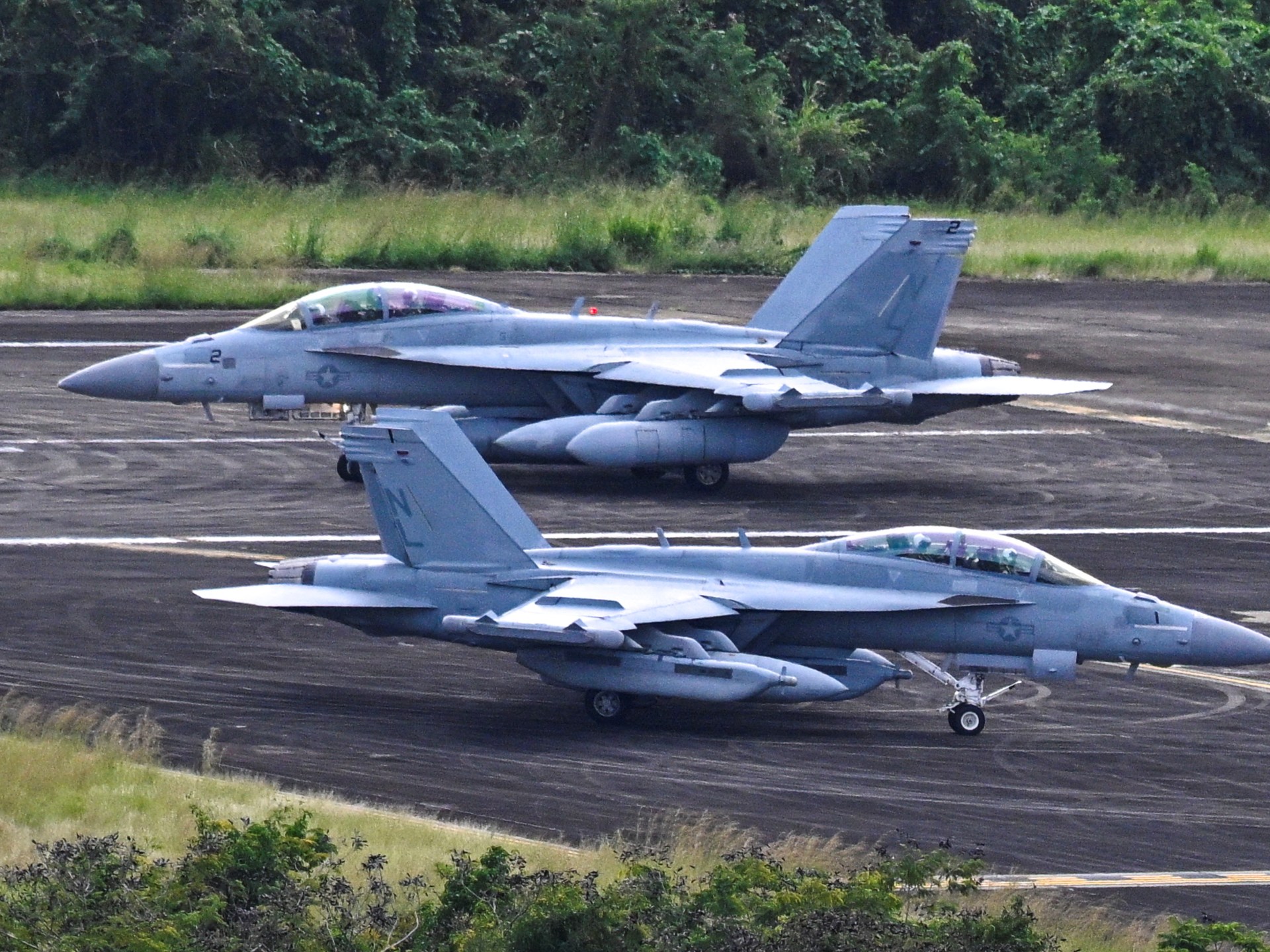

The United States military said it killed four people in its latest attack on a vessel in the eastern Pacific Ocean, announcing the “lethal” strike after resolutions seeking to rein in President Donald Trump’s aggression towards Venezuela were voted down by US lawmakers.
US Southern Command (SOUTHCOM), which is leading the burgeoning “Southern Spear” military operation in the Latin America region, said the attack on Wednesday targeted “four male narco-terrorists” without providing any evidence that the destroyed vessel was involved in drug trafficking.
- list 1 of 4Venezuela’s Machado leaves Oslo after trip to receive Nobel Peace Prize
- list 2 of 4‘I am concerned’: Regional leaders urge calm amid US-Venezuela tensions
- list 3 of 4US Senate passes $901bn defence bill
- list 4 of 4Trump aide Stephen Miller suggests Venezuelan oil belongs to US
end of list
“The vessel was transiting along a known narco-trafficking route in the Eastern Pacific and was engaged in narco-trafficking operations,” SOUTHCOM said in a post on social media alongside a video showing a speedboat being destroyed.
Ordered by US Defense Secretary Pete Hegseth, the attack brings to almost 100 the number of people killed in US strikes on 26 vessels – that Washington has acknowledged – in the eastern Pacific Ocean and Caribbean since September.
While legal experts have accused the US of carrying out a campaign of extrajudicial killings in international waters, Trump has justified the attacks as necessary to halt the flow of drugs into the US from drug cartels, particularly those based in Venezuela.
On Wednesday, the Republican-majority House of Representatives voted 213 to 211 against a resolution directing the president to remove US forces from hostilities with or against Venezuela without congressional authorisation.
Advertisement
The House also voted 216 to 210 against a resolution that would remove US forces from hostilities with “any presidentially designated terrorist organization in the Western Hemisphere” unless authorised by Congress.
The defeat of the resolutions comes as a huge US military deployment is under way in Latin America, involving thousands of troops, Washington’s largest aircraft carrier, and a nuclear-powered submarine, as Trump threatens military action to remove Venezuelan President Nicolas Maduro’s government.
On Tuesday, Trump ordered a naval blockade of all oil tankers, which are under US sanctions, entering and leaving Venezuelan ports, a move that Maduro’s government called a “grotesque threat” that was aimed at “stealing the riches that belong to our homeland”.
Last week, US soldiers boarded and seized the Skipper oil tanker off the coast of Venezuela and were reported to have brought the vessel to the US state of Texas to unload its oil cargo.
The New York Times reports that Venezuela’s navy has started to escort ships carrying petroleum products from ports following Trump’s announcement of the sea blockade. Several ships left the country’s east coast with a naval escort on Tuesday evening and Wednesday morning, the Times reported, citing three people familiar with the matter.
Latin American leaders and United Nations Secretary-General Antonio Guterres have also expressed concerns as the prospect of war looms larger as tensions mount between Washington and Caracas.
Mexican President Claudia Sheinbaum called on the UN to act to prevent violence in Venezuela.
“It has not been present. It must assume its role to prevent any bloodshed,” she said on Wednesday, reiterating Mexico’s position of being against intervention and foreign interference in Venezuela.
Brazil’s President Luiz Inacio Lula da Silva said he was “concerned about President Trump’s attitudes towards Latin America, about the threats”. Lula also said that he had urged dialogue between Caracas and Washington in a call with Trump earlier this month.
“The power of the word can outweigh the power of the gun … I said to Trump: ‘If you are interested in talking to Venezuela properly, we can contribute. Now, you have to be willing to talk, you have to be patient,'” Lula said.
In Venezuela, Maduro held a phone call with UN chief Guterres and denounced the US naval blockade, according to reports.
Maduro “denounced … the recent escalation of colonial threats against Venezuela”, the Agencia Venezuela news site reported.
Advertisement
The Venezuelan leader also described as “barbaric diplomacy” comments by US administration officials that “Venezuela’s natural resources belong to it”.
Related News
Hungarian protesters demand PM Viktor Orban quits over child abuse cases

RSF drone strike kills at least three in central Sudan, injures several
‘Collective punishment’: Family home of suspect demolished in West Bank