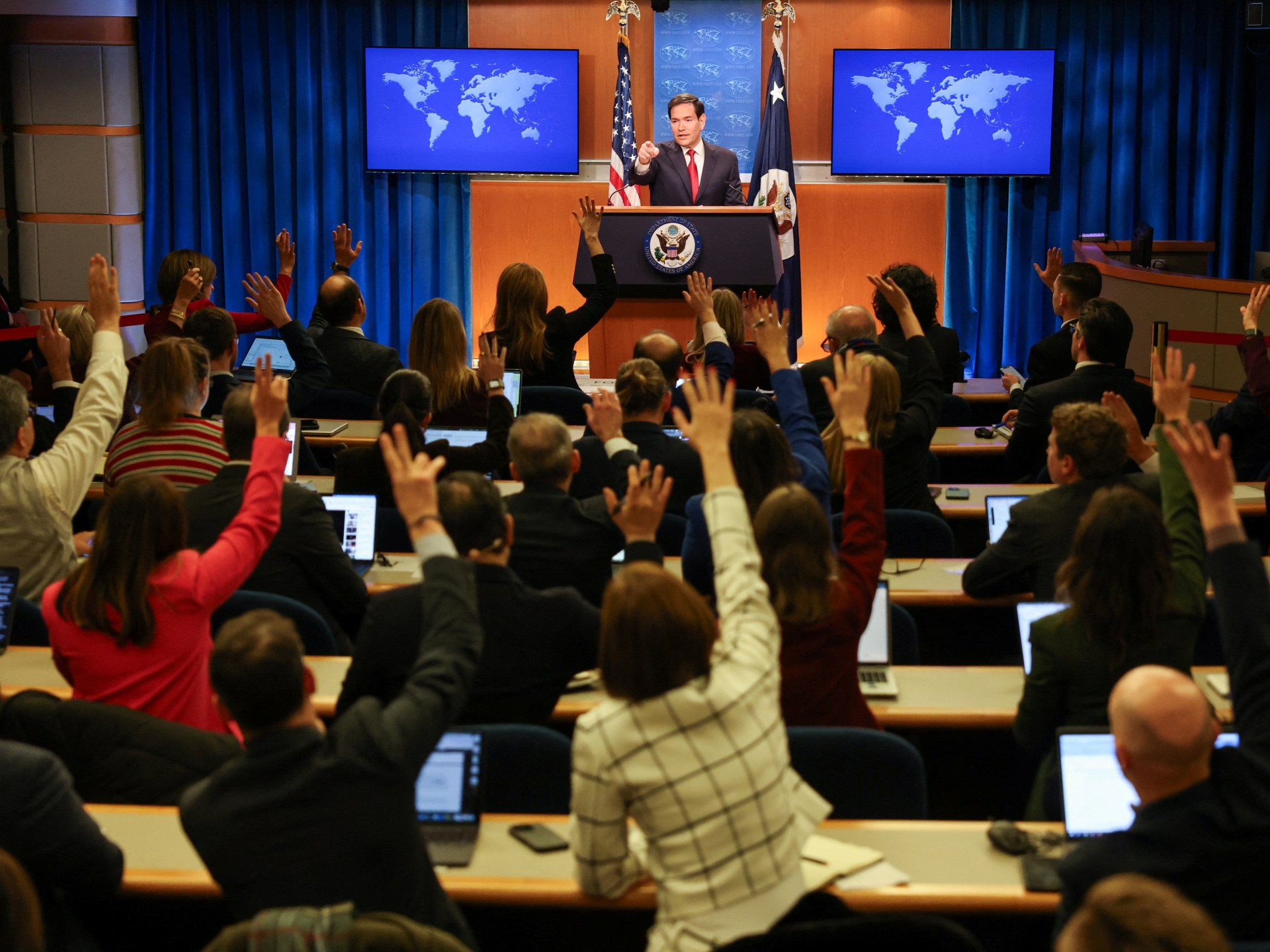

Top diplomat Marco Rubio has laid out foreign policy priorities under United States President Donald Trump, saying that the administration is focused on advancing Washington’s interests across the world.
In a two-hour briefing to reporters on Friday, the US secretary of state reiterated Trump’s hard line against Venezuela and defended cuts to foreign aid programmes.
- list 1 of 3Israel bombs Gaza wedding as mediators hold ceasefire talks in US
- list 2 of 3Rubio says ‘progress but ways to go’ in efforts to end Russia-Ukraine war
- list 3 of 3‘War on terror’ defence of Trump boat strikes doesn’t hold water: Experts
end of list
Rubio, the son of Cuban immigrants, also expressed outrage against “mass migration” into the US, echoing Trump’s own stance.
In addition to his diplomatic duties, Rubio also serves as White House national security adviser and the chief of the now-gutted US Agency for International Development (USAID).
Here are five key takeaways from the secretary of state’s wide-ranging media briefing:
Maduro cannot be trusted
Rubio suggested that further talks with Venezuela would be futile because President Nicolas Maduro cannot be trusted to live up to his commitments.
“He’s never kept any of the deals he’s made in the past, which makes it difficult to consider making one in the future,” Rubio said of Maduro.
The top US diplomat kept hammering accusations that Maduro has used the Venezuelan government to lead a campaign of narcotics trafficking and “terrorism”.
Trump has made similar allegations himself, accusing the Venezuelan president of masterminding a flood of drugs and criminals into the US.
He has also portrayed Maduro as a cartel leader, in charge of groups like the Venezuelan gang Tren de Aragua. Those assertions, however, have been contradicted by the US intelligence community, which found no evidence Maduro controls the gang.
On Friday, Rubio said the US is working with governments in the Western Hemisphere to ensure stability in the Caribbean region. But Venezuela, he underscored, is an outlier.
Advertisement
“There’s one place that doesn’t cooperate, and it’s the illegitimate regime in Venezuela. Not only do they not cooperate with us, they openly cooperate with terrorist and criminal elements,” he said.
“For example, they invite Hezbollah and Iran to operate from their territory.”
Trump’s allies have accused Maduro of forging ties with Hezbollah, but the US has not provided evidence that the Lebanese group, which was weakened by last year’s war with Israel, is operating in the South American country.
Rubio’s comments come as the US continues to amass troops and military assets around Venezuela, raising speculation about plans to topple Maduro by force.
Trump has also announced an oil blockade on Caracas as he and his top aides continue to falsely claim that Venezuela’s oil belongs to the US.
Rubio was asked on Friday how he would square Trump’s self-image as a peacemaker with the escalating military threats to Venezuela.
“We reserve the right — and have the right — to utilise every element of national power to defend the national interest of the United States,” Rubio said. “And no one can dispute that. Every country in the world reserves the same option. We just simply have more power than some of them.”
Ukraine ‘not our war’
The ongoing war in Ukraine — which has been raging since Russia’s full-scale invasion in February 2022 — was also a key topic in Friday’s news conference.
Rubio explained that the Trump administration is trying to gauge what Russia and Ukraine are able to accept in order to help reach a peace deal, but he emphasised that the conflict is not a top priority for Washington.
“It’s not our war. It’s a war on another continent,” he said.
But Rubio insisted that only the US can bring about a peace agreement in Ukraine.
“What we’re trying to figure out here is: What can Ukraine live with and what can Russia live with? Sort of identify what both sides’ positions are, and see if we can sort of drive them towards each other to some agreement,” Rubio said.
“If you were to ask [for] prioritisation, I would argue that something in our hemisphere for our national interest is more important than something in another continent,” he said. “But it doesn’t make Ukraine and Russia unimportant. We care about it. That’s why we’re involved in it.”
While campaigning for re-election in 2024, Trump had pledged to end the Ukraine conflict within 24 hours of reclaiming the presidency.
He has since had to walk back those remarks, but the Republican leader has maintained an active role in peace negotiations, even hosting Russian President Vladimir Putin for an Alaska meeting in August.
Advertisement
Trump has lobbied to win the Nobel Peace Prize for his work on ending world conflicts.
US pressing to finalise Gaza phase one
Rubio also stressed on Friday that Washington is pushing to complete phase one of the truce in Gaza, so the second stage can begin.
The three elements Rubio highlighted were setting up a Palestinian technocratic committee to help govern Gaza, establishing the foreign-led “Board of Peace”, and deploying an international policing force to the territory.
“This is something we’re aiming at very soon. It’s what we’re focused on right now like a laser,” he said.
“No one is arguing that the status quo is sustainable in the long term, nor desirable, and that’s why we have a sense of urgency about bringing phase one to its full completion.”
“Once we’ve established that, we have a lot of confidence that we are going to have the donors for the reconstruction effort and for all the humanitarian support in the long-term, building of phases two and phases three.”
The US is currently hosting talks with officials from Qatar, Egypt and Turkiye to discuss moving to the next stage.
Since the Trump-brokered ceasefire in October, Israel has killed 395 people in Gaza, including an average of two children a day. On Friday, Israeli forces targeted a wedding gathering, killing at least six people and wounding many others.
Israel has also refused to allow an adequate amount of aid into the territory and blocked the entry of temporary homes, despite the fact that displaced people’s tents have flooded amid harsh winter weather.
Al Jazeera asked Rubio about Israel’s violations, but the US secretary of state failed to address the premise of the question. Instead, he stressed that work to ensure peace in Gaza is ongoing.
“This is the hard work of diplomacy and peacemaking. Peacemaking isn’t just signing a piece of paper; it’s actually complying with it,” he said. “And compliance oftentimes, in most cases, requires daily, constant follow-up and nurturing.”
Cooperation with China
As a senator, Rubio was a China hawk. But on Friday, he struck a softer tone when he spoke about relations with Beijing, underscoring the need for cooperation despite bilateral tensions.
“I think I’ve been nice to China,” Rubio said jokingly. He added that the US has made “good progress” with China.
“If there’s a global challenge that China and the US can work together on, I mean, we can solve it,” he told reporters. “And there’ll be points of tension. We recognise that our job is to balance these two things. I think both sides understand that.”
After an escalating trade war early in Trump’s second term, the US and China reached a one-year deal in November to freeze tariffs and resolve other issues.
For nearly a decade, US officials have described the global competition with Beijing as their most pressing foreign policy issue.
But in recent months, Trump has turned his attention to the Americas, appearing to de-prioritise the rivalry with China.
Commitment to NATO
The Trump administration has been blasting Europe and its leaders over their migration policies and the regulations of the European Union, but Rubio reasserted the US commitment to NATO military alliance on Friday.
Advertisement
He suggested that NATO’s common defence, as spelled out in Article Five of the alliance treaty, would deter any Russian military campaign beyond Ukraine.
“It’s why we remain in NATO,” he said. “That’s why we’re in this alliance, and that’s why Article Five in the NATO alliance is important.”
The only request the US has of its fellow NATO allies, Rubio added, is that they increase their military spending.
Trump has sought to raise the minimum defence spending for members of the alliance to five percent of each country’s gross domestic product (GDP), but some countries, most notably Spain, have pushed for greater flexibility in their military budgets.
European allies in NATO have also expressed concern about Trump’s commitment to the military alliance, citing ambiguous statements he has made in the past about the Article Five commitment. But Rubio sought to put those worries to rest.
“We’re committed to the alliance. And our commitment isn’t just rhetorical,” Rubio said. “Our commitment is action, in the troops that have been deployed and the monies that have been spent and the capabilities that are located in the cooperation.”
Related News
Five killed as US military destroys two more vessels in Pacific Ocean
South Sudan army to secure critical Heglig oilfield in Sudan war spillover
Gaza ceasefire at a ‘critical moment’ mediators say, at risk of collapse