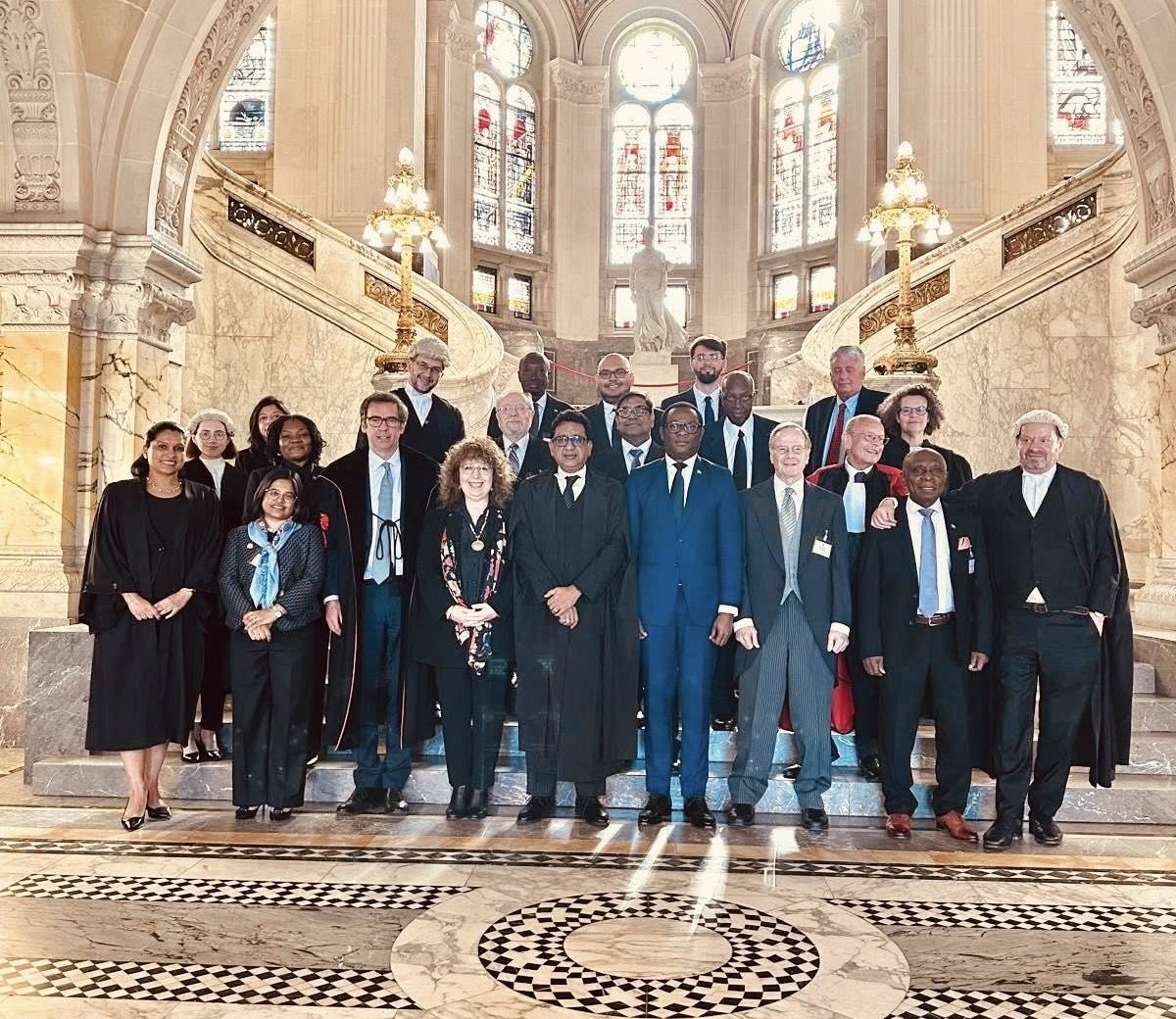


See full statement from the Attorney General’s Chambers:
The oral hearings in Guyana’s case against Venezuela before the International Court of Justice, the world’s highest international judicial tribunal, concluded this afternoon. Both Guyana and Venezuela presented their arguments in two rounds of oral pleadings between May 4 and May 11. The Court will now deliberate on the matters before it and, in the coming months, will issue its final Judgment on the merits of the case, which will be legally binding on both parties.
The very fact that this case reached the ICJ, and that the written and oral phases of the proceedings were carried out to their completions, represent a triumph for the rule of law and the rules-based international order. Disputes between States must be resolved peacefully, finally and in conformity with international law. They must not be allowed to fester indefinitely. They must never be resolved by threat or use of military force.
Guyana has pledged repeatedly, including at these oral hearings, that it will abide by the Court’s Judgment, whatever it may be. Guyana is confident – in fact, after these oral hearings ,Guyana is more confident than ever — that the Court will uphold the legal validity of the unanimous Arbitral Award of 3 October 1899, that established the international boundary between then British Guiana and Venezuela, and will confirm that it is the final, definitive and permanent lawful boundary between Guyana and Venezuela.
Guyana is very proud of the presentations it made in these hearings, on Monday, May 4 and Friday, May 8. It believes that its arguments were compelling and convincing, and that they showed the lack of merit in Venezuela’s arguments both on the facts and on the law. Guyana is grateful to its representatives in these proceedings, whom I have the privilege of leading, including the Honourable Hugh Todd, Minister of Foreign Affairs and International Cooperation, and Mr. Carl Greenidge, our Agent. Guyana commends and extends its deepest gratitude to its all-star international legal team headed by Mr. Paul Reichler (U.S.), Professor Philippe Sands (U.K) and Professor Alain Pellet (France), among other distinguished advocates.
The Court’s final Judgment will bring to an end, the controversy that arose in 1962, when Venezuela, for the first time, challenged the lawfulness of the 1899 Arbitral Award and the international boundary it established, after accepting, respecting and complying with the Award and the boundary, without protest for 63 years. The oral hearings established that Venezuela made this very belated protest precisely at the time Guyana was nearing its independence, British troops would be departing, and Venezuela would have a significant military advantage with which to press its antiquated claim to nearly three-quarters of Guyana’s territory, the very claim that the tribunal of five pre-eminent arbitrators rejected in 1899.
Before departing Guyana, in 1966, the British negotiated an agreement with Venezuela to assure that its challenge to the validity of the 1899 Arbitral Award would be resolved peacefully. The Geneva Agreement of 1966, to which Guyana became a party upon its independence that year, provided first for a four-year period of bilateral negotiations to resolve this dispute. These negotiations were unsuccessful. In the circumstances, the Geneva Agreement further provided, first that the Secretary General of the United Nations would choose the proper means of final settlement of the controversy, with the power to choose new means if the prior means that he selected failed to achieve such a settlement. After more than 50 years passed without a settlement, Secretary-General Antonio Guterres decided, in January 2018, that the controversy should be settled by the International Court of Justice. His decision was binding on the two parties.
Guyana then initiated the proceedings at the ICJ in March 2018. Venezuela responded by challenging the Court’s jurisdiction. After receiving the arguments of the two parties, the Court issued a Judgment in December 2020, in which it ruled that it had jurisdiction to determine the legal validity of the 1899 Arbitral Award, as well as the international boundary between Guyana and Venezuela. The case then proceeded to the merits phase, which included the presentation of written briefs, and ultimately the oral hearings which concluded today.
We will await the Court’s final Judgment on the Merits with patience, decorum, dignity and optimism. We will continue to address Venezuela in a spirit of peace, cooperation and friendship, and as sovereign equals. We will respect Venezuela’s sovereignty, as we have always done, and insist that Venezuela refrain from trespassing on, or threatening, Guyana’s sovereignty.
We have heard the statements of Venezuela’s representatives at these hearings, including today, that they do not accept the ICJ’s jurisdiction and will not abide by its rulings. This would be a breach of its most solemn obligations under the United Nations Charter, the Charter of the Organization of American States, and general international law. It will not be allowed by the international community of States to defy the most fundamental rules of international law, which demand a world order based on the rule of law. No doubt, that rules-based order is being tested now. Therefore, it is more important than ever, that it be preserved and strengthened.
It is our fervent hope that Venezuela’s expression of disrespect for the Court, and for international law, reflects the emotions that often accompany litigation of this kind. We hope, that after the passions recede, and responsible government officials reflect, they will conclude, as we have done, that both States are best served by an end to this longstanding conflict, and that the only way to secure a just and lasting peace, and an enduring friendship, is by respect for and compliance with, the Court’s final Judgment, whatever it may be.
Subscribe to get the latest posts sent to your email.
Related News
Pres. Ali calls on filmmakers to consider Guyana as production destination

Tucville man remanded for noise nuisance

‘Guyana using oil to build a balanced, low‑carbon future’ – Pres. Ali