VP Jagdeo urges Biodiversity Alliance to back UN targets, revive global urgency on nature finance
 31 October 2026
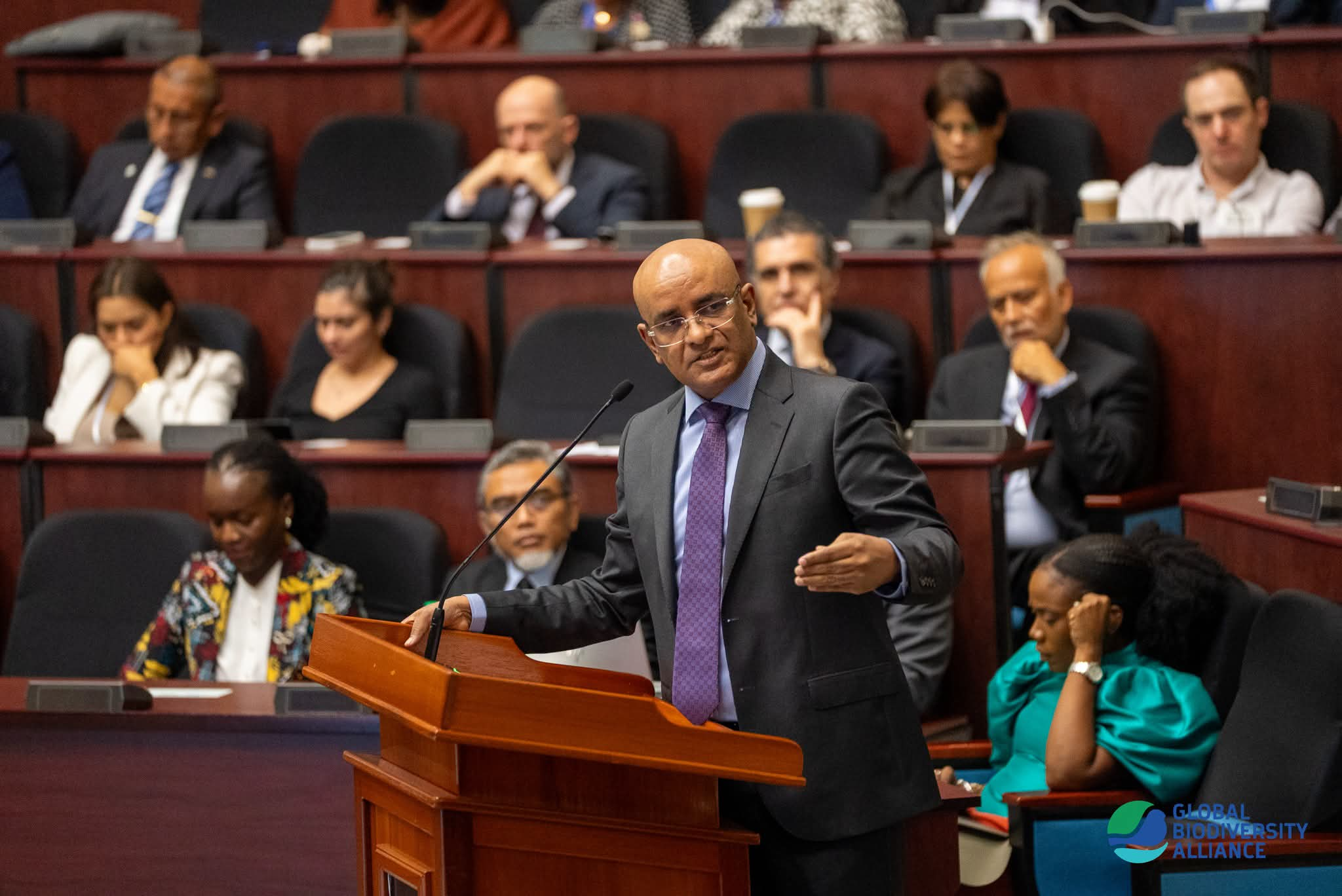


Vice President Dr Bharrat Jagdeo has called on members of the Global Biodiversity Alliance (GBA) to focus on supporting the targets of the UN Convention on Biological Diversity (CBD), rather than setting their own.
He made the remarks at the Second Global Biodiversity Alliance Conference at the Arthur Chung Conference Centre (ACCC) on Friday. The Alliance has grown from 17 to 142 members.
“The alliance cannot supplant the UN Convention on Biodiversity. That’s a point we need to make right up front,” the Vice President said
He said the Alliance must act in support of CBD decisions, especially after a disappointing outcome at the recent COP17 in Armenia.
Dr Jagdeo outlined three hard facts facing the sector. There is no compliance or major voluntary market for biodiversity credits. Public funding is below what is needed, with a gap of about US$700 billion. And there is still no agreement on what a biodiversity credit should look like
“We need to go back to establish a sense of urgency,” he stressed.
He set out four tasks for the Alliance: keep nature on policymakers’ agendas despite pressures from energy prices, food security, and regional conflict; give negotiators sound technical analysis; prevent backsliding on gains already made; and show practical examples that work
Drawing on his experience co-chairing the climate finance working group of Project Catalyst ahead of the 2009 Copenhagen climate talks, the Vice President said behind-the-scenes technical work helped prove forest carbon was among the cheapest ways to cut emissions.
“So I think that we need to get back to quiet work,” he said, proposing working groups to address the “hundreds of questions” being raised about biodiversity credits, as Guyana once did for forest carbon.
On backsliding, he warned that some in Europe now argue that high-forest, low-deforestation (HFLD) countries like Guyana should receive less compensation than countries that cleared their forests and are now replanting. He said this would reward poor practices and penalise conservation.
The vice president also pointed to Guyana’s record under the Low Carbon Development Strategy (LCDS), which he said was built from scratch without an existing model.
More than 3,000 projects have been completed in 252 Indigenous villages with about 20 per cent of LCDS funds, while the remaining 80 per cent supports adaptation, including 840 kilometres of canals and 125 kilometres of embankment.
Despite rapid growth in the oil and gas sector, a 25 per cent rise in electricity demand in two years, and about 40,000 vehicles imported annually, he said Guyana maintains a no-flaring policy, a carbon tax on scheduled flaring, and a commitment to protect 30 per cent of its territory by 2030.
“We can pledge to you that we will remain firmly in favour of strong environmental stewardship here and globally,” Dr Jagdeo said.
Subscribe to get the latest posts sent to your email.
Related News
Local Private Sector urged to tap into billions in carbon credit opportunities
Update: Welder arrested as police probe deadly Essequibo Coast fire

Ex-cop, court clerk charged over $17M fraud