Specialist finisher Bevon Jacobs adds batting firepower to the desert Vipers line-up for ExxonMobil GSL
 30 June 2026
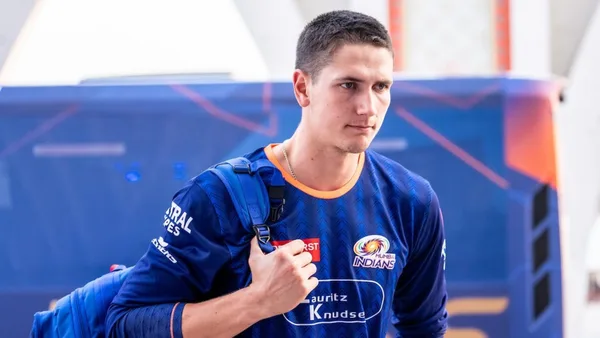


New Zealand middle-order batter Bevon Jacobs has joined the Desert Vipers for the ExxonMobil Guyana Global Super League 2026 (GSL), where he is expected to play a key role as a finisher.
The 24-year-old, who made his New Zealand debut in the shortest format last year following a stunning season in the domestic Super Smash for Auckland in 2024/25, has already enjoyed successful stints with the Antigua and Barbuda Falcons in the Caribbean Premier League (CPL), the Quetta Gladiators in the Pakistan Super League, and MI Emirates in the DP World ILT20. He was also included in the Mumbai Indians squad for the Indian Premier League.
Speaking on Vipers Voices, Jacobs discussed how he had shaped his game to become an effective finisher. “I think in T20 cricket, the game is always fast-paced no matter where you are batting,” he said.
“The most difficult part about being a middle order or lower middle order finisher is you never really know how many balls you are going to face. Sometimes you can get caught up in wanting to maybe take an extra ball to settle in, but often you do not get that luxury. You come in at seven, for example, and you have got six balls left in the innings.
“My role then is just to say, ‘What is the most impact I can create in this game?’ Then it no longer becomes about milestones, like fifties, half-centuries, centuries, all that sort of stuff. It is more about what impact can I bring to the game?
“And leaning on the experience of the other guys, I think helps me a lot. And just having that role clarity and being able to talk to someone like Daryl Mitchell out in the middle and just being like, ‘Okay, mate, what do you want from me here?’ Or ‘I am thinking this,’ and just bouncing those ideas off each other.
“I think (that approach) is really helpful for my game. And obviously that filters back down into Auckland cricket for when I play the Super Smash. But I think it is about making as much impact in as little time as possible because it is not often that I am going to get 40 balls to bat.”

Jacobs added that preparing to be a finisher went beyond match-day tactics. He said he also trained with that mindset in the nets, knowing he may be needed to attack from the first ball and find the boundary immediately.
“Sometimes it (training) does look like that because realistically, that (hitting boundaries from ball one) is the way it is going to be. Obviously, you try and warm up a little bit first but sometimes in the nets you do just go in there and say, ‘What is my field, I have got six balls here, this is a scenario, this is how many runs I need and can I make it happen?’
“Every now and again, the game is obviously going to ask you to improve in different ways, whether that is a change in technique in some area or maybe adding a new shot into your game. But yes, sometimes with power hitting, the training can be just as simple as going in there and seeing if I can hit the first ball for six.”
The Kiwi batter admitted that one of the toughest parts of being a finisher was accepting the possibility of failure, as the role often required a high-risk approach.
“I think initially it was not that easy (to reconcile to the possibility of failure and the risks of having to go in and swing hard from the start). And I think it is tough for anyone at the beginning to grapple with that, because obviously what you want to do for your country or for Auckland (or whichever team you are playing for) is to score runs.
“But sometimes, it is more about the impact that you make. A score of 17 off 10 or 11 balls at a strike rate of 170 – although that is considered low these days, depending on where you are batting – or an impact like hitting three sixes in nine balls, is going to do more good for your team than getting more runs at a lower strike rate.
“It is about what you can give to the team. And I think averages in the format are probably not looked at as much as they once were compared to strike rates. So, I think the game is adapting to now banking on a particular player having an impact in a short amount of time rather than averaging 40 every game but not striking high enough.”
Jacobs is among the Desert Vipers players with previous Caribbean experience, which is regarded as important for success in the GSL, and he said he hoped to share those lessons in the Vipers dressing room.
“What I have learnt from the experience of the CPL is how to bat in different conditions, which is something that is hard to come by, especially for someone based in New Zealand. And I think having these opportunities has been a privilege. It has been really awesome for me to try and expand my game in different continents and different conditions.
“I have learnt a lot, especially how to play spin which is obviously a massive factor in the Caribbean, and I am sure will be in the GSL as much as it is in the CPL. So it is about just taking those learnings into the game and trying to adapt quickly. I also know that I can lean on the other guys who have played there (Guyana) before, especially someone who is as experienced as Daryl Mitchell, who is going to be there as well.
“So, I am looking forward to that aspect and just trying to grow that part of my game continuously.”
Looking ahead to next month’s tournament, Jacobs said he was confident the Desert Vipers could secure a second trophy in 2026, adding to their DP World ILT20 triumph in the United Arab Emirates in January. “I think that is the only way you should think,” he said. “I do not think any other thoughts (should) enter our minds.
“We have got a strong group and we have got every chance to win as much as any other team. “So I think we just put all our effort and energy into prepping well and into each other and I have got no doubt that we will be able to put the performances together to get over the line and win that trophy.”
The members of the Desert Vipers team include Daryl Mitchell (NZ); Bevon Jacobs (NZ); Kyle Jamieson (NZ); Shadab Khan (PAK); Vriitya Aravind (UAE); Khuzaima Bin Tanveer (UAE); Matiullah Khan (UAE); Sanjay Pahal (UAE); Andries Gous (USA); Kyle Mayers (WI); Khary Pierre (WI); Ramon Simmonds (WI); Zachary Carter (WI) and Rilee Rossouw (SAF).
Subscribe to get the latest posts sent to your email.
Related News
Be prepared to operate in evolving defence environment – Army head tells new soldiers
Shepherd, Nabi pier GAW to thrilling win over Desert Vipers

Govt launches 3rd phase of $100k cash grant distribution for persons without bank accounts