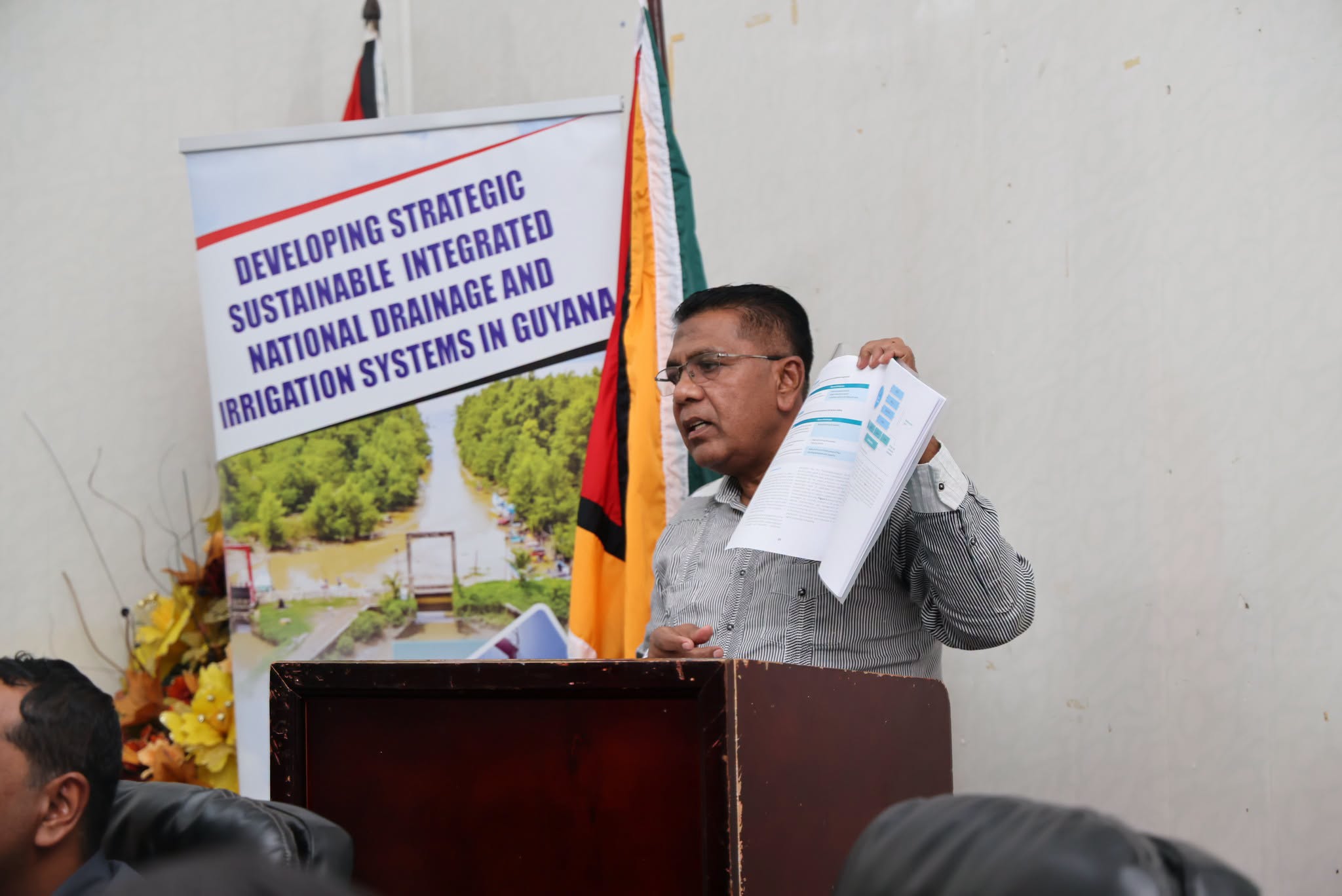


Guyana has launched its first-ever National Drainage and Irrigation Strategy, a landmark framework designed to modernise the country’s water management systems, strengthen climate resilience, and support national development.
Speaking at the strategy’s soft launch on Thursday, Minister of Agriculture Zulfikar Mustapha underscored the document’s significance, describing it as a historic milestone for the National Drainage and Irrigation Authority (NDIA).
“This is the first time that the National Drainage and Irrigation Authority has now published a strategy,” Minister Mustapha stated, adding, “the document represents an important step in Guyana’s journey toward becoming a more resilient, more productive and more prosperous nation.”
The minister noted that while Guyana continues to experience rapid economic growth and unprecedented levels of investment, the country must also confront the realities of climate change, including rising sea levels, changing weather patterns, and increasingly intense rainfall events.
“Climate change is real, and we are living in an area where we are more vulnerable than many parts around the world. We must plan strategically for what is happening now, and we must invest wisely,” he said.
According to Minister Mustapha, the strategy was developed through extensive consultations involving government agencies, local democratic organs, farmers’ organisations, water users’ associations, and other key stakeholders.
He explained that drainage and irrigation are no longer issues confined to agriculture alone but are critical to housing development, infrastructure expansion, food security, and national development.
Over the last five years, significant investments have been made to strengthen Guyana’s drainage and irrigation network, including the rehabilitation and construction of drainage channels, irrigation canals, sluices, pump stations, and other critical infrastructure.
The strategy also places strong emphasis on innovation, technology, data-driven planning, digital tools, and smarter water management practices to improve operational efficiency and long-term sustainability.
Meanwhile, NDIA Chairman Lionel Wordsworth welcomed the completion of the strategy, describing it as an important document that provides a phased roadmap for implementation and future development.
Wordsworth highlighted that the strategy addresses climate change challenges while promoting the digitisation of services, networks, and infrastructure.
He noted that many of the modernisation initiatives outlined in the document are already underway, including the use of advanced technology and GIS platforms to map and monitor drainage and irrigation infrastructure.
He added that the strategy will strengthen coordination with partner agencies and guide future investments to improve drainage and irrigation services across the country.
A broader public launch involving farmers, stakeholders, and beneficiaries is expected in the coming weeks. [DPI]
Subscribe to get the latest posts sent to your email.
Related News

Henry cousins murder trial: Case enters final phase as murder accused deny involvement in ...

National Cultural Centre set for major restoration as design phase advances
Cane harvester slapped with rape charge, granted $250,000 bail