

…as sexual and reproductive health symposium concludes
The Ministry of Education and the Ministry of Health, in partnership with UNICEF, UNFPA and other United Nations agencies, today concluded a two-day Sexual and Reproductive Health (SRH) Symposium at the Bartica Secondary School in Region 7. The initiative, now in its second year, wrapped up following intensive interactive sessions with dozens of secondary school students.
The exercise, which commenced on Friday, June 19th, brought together students and education stakeholders from Bartica Secondary and Three Miles Secondary schools. Centred within the national Health and Family Life Education framework, the initiative focused heavily on student empowerment, providing safe, structured spaces for young people to open up about puberty, menstrual health, teenage pregnancy, gender-based violence and healthy relationships.
Minister of Education Sonia Parag attended the symposium and challenged students to understand the biological realities of their development while building deep internal resilience against negative societal pressures.

Addressing the core theme of adolescent development, Minister Parag demystified the emotional and physical shifts young people experience, explaining how deep internal changes directly influence daily well-being.
“It is vital for both our young men and young women to understand that as you grow, your body undergoes profound chemical changes,” Minister Parag explained. “These internal shifts happen within the brain and across the body, directly contributing to your emotional, psychological and physical experiences. This is a natural biological process that you cannot stop, but understanding it is the true beginning of your self-confidence and personal identity.”
The Education Minister issued a strong warning against the dangers of peer pressure, specifically targeting harmful habits like vaping and alcohol consumption, which she warned can lead to life-altering addictions that erode fundamental human rights and educational access.
“You do not need to be cool by giving into peer pressure,” she stressed. “If you find vaping, it looks cool, you may want to vape. But how many of you understand that you have the power to say no to certain things? No one needs to be like someone else and destroy their own body. How many of you know that all of these things can turn into an addiction?”
As part of the government’s wider plan to address adolescent health and long-term well-being, Minister Parag briefed the students on the dangers of the Human Papillomavirus (HPV), how it spreads and the fact that the virus is the primary cause of cervical cancer, which is one of the leading causes of death for women across the world. She noted that this is entirely preventable through vaccination and highlighted that the Government of Guyana provides the protective vaccine completely free of cost to safeguard the nation’s young people before exposure.
“When we started going with the vaccines in different parts of the country and we started screening women, we understood that there were so many women who had pre-cancerous cells,” Minister Parag explained. “But with that vaccine, you can stop that from progressing. It’s important for our young people to know.”
Turning her attention to institutional support, the minister highlighted that a lack of resources should never stand in the way of a child’s fundamental right to education. She praised the ongoing national menstrual hygiene initiative, noting that the First Lady’s menstrual programme, which began by raising funds and donating sanitary napkins particularly to girls in the hinterland areas, has been so impactful that the government has formally integrated and budgeted for it this year. This commitment ensures that the programme not only prevents period-related school absenteeism, but also maintains good health and hygiene for adolescent girls.
The minister also directly connected menstrual health to the broader battle against gender-based discrimination and violence, arguing that young men must be active, supportive participants in the conversation rather than contributors to stigma.
“These are conversations that should be happening today, tomorrow, because it’s real and it’s important.”
Minister Parag concluded by encouraging the students to look within themselves for motivation and to always speak up and ask questions.
“Looking outside for motivation, you’ll never find it. Where does motivation come from? It comes from inside. If you rely on yourself and you want to be happy, you make sure that you’re happy and you’re not disappointed. Make sure you use your voice, ask questions. Doesn’t matter how silly questions are, ask the question.”
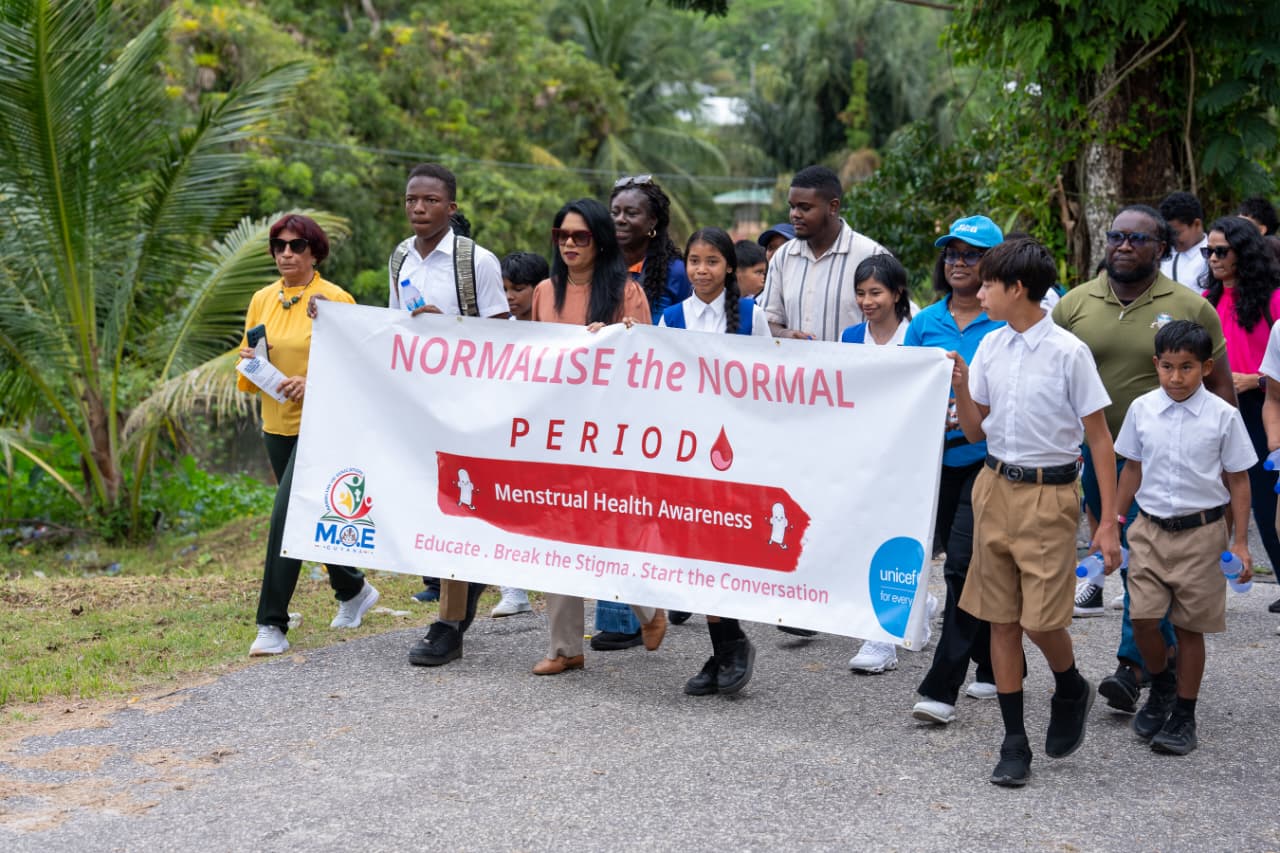
As a high-visibility component of the symposium, the students, policymakers and international partners took to the streets of Bartica for a public awareness “Period Walk,” marching through the town chanting, “Break the silence, stop the period shame!” to directly confront localized taboos.
The forum concluded with participating students from both secondary schools signing the adolescent health empowerment pledge. These enlarged poster documents will be permanently displayed in the respective schools, serving as a daily and visible reminder of students’ commitments to making informed positive health choices. The symposium received collaborative backing from UN Women and PAHO WHO, with vital funding and support provided by the Government of Canada.
Subscribe to get the latest posts sent to your email.
Related News
Guyana to have 24 public EV charging stations by year-end

Guyanese woman convicted in New York for welfare fraud, larceny
Alex Tenorio & Lisa Hamilton are winners of inaugural EU-Guyana Cup Pizza Making Compe...