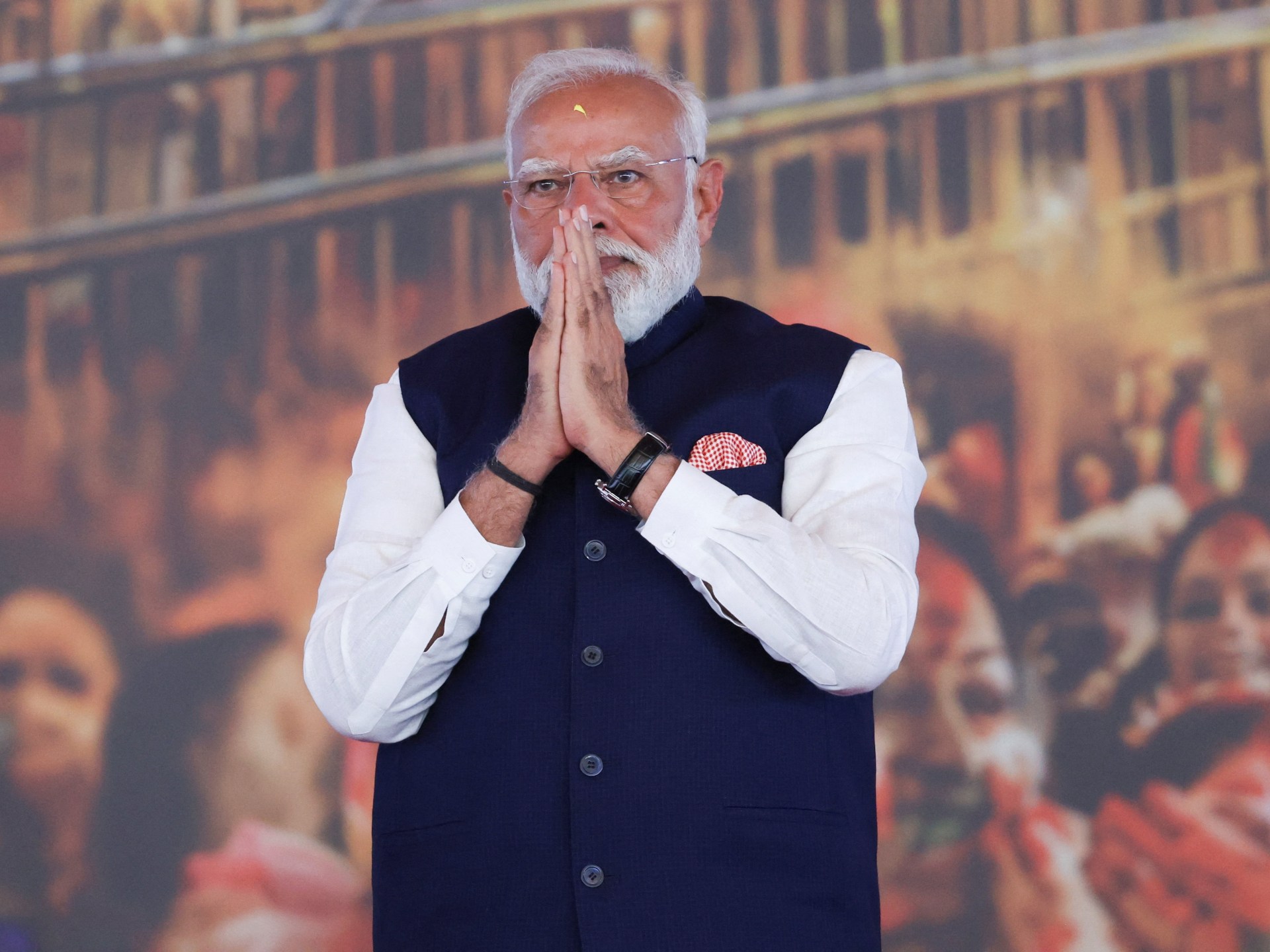

Prime Minister Narendra Modi has urged Indians to work from home, avoid international trips and not buy gold during the United States-Israeli war on Iran, which has caused global energy prices to surge, adding pressure on India’s foreign exchange reserves.
Modi made his plea during a public event in the southern city of Hyderabad on Sunday.
- list 1 of 4Russia kills three Ukrainians in 24 hours, accuses Kyiv of violating truce
- list 2 of 4Trump says US will not allow Iran to reach enriched uranium
- list 3 of 4US Jewish leader, Israel advocate Abe Foxman dies at 86
- list 4 of 4Trump to discuss Iran with Xi Jinping during China visit: Officials
end of list
Here is more about what Modi said, what’s behind the Indian government’s concerns and how they’re linked to the war on Iran.
What did Modi say?
Modi said people should move to online meetings instead of physical gatherings and use the work-from-home model that was adopted globally during the COVID-19 pandemic. He explained that such practices would cut down the use of fuel.
Additionally, Modi urged people to use public transport and carpooling to save fuel. He called on families to reduce their cooking oil consumption, describing that move as both healthy and patriotic.
Modi also asked Indians to avoid buying gold and to cut nonessential overseas travel for at least a year. The prime minister asked farmers to cut their fertiliser use by as much as half.
And he explained his justification for asking the people of India to make these changes in their lifestyles and plans: “In the current situation, we must place great emphasis on saving foreign exchange.”
Simply put, Modi was referring to the war on Iran and its far-reaching economic consequences, especially for India.
Early in the war too, Modi had compared the economic crisis spawned by the conflict to the situation during the COVID-19 pandemic. On Sunday, he extended that parallel to also ask Indians to adopt some of the restrictive measures forced upon the world by the coronavirus crisis.
Advertisement
Oil prices have climbed due to the war on Iran, which started on February 28. A barrel of Brent crude, the international benchmark, was worth $72.87 on February 27. As of Monday, a barrel of Brent crude was worth $105.45, an almost 50 percent increase.
Iranian attacks on oil and gas facilities in the Gulf in the early weeks of the war impacted energy supplies. Since early March, Iran has also restricted passage through the Strait of Hormuz, the narrow waterway through which 20 percent of the world’s oil and liquefied natural gas supplies passed before the war. Iran has allowed passage by vessels from select countries that need to negotiate their transit with the Islamic Revolutionary Guard Corps.
In April, the US announced a naval blockade on ships entering or leaving Iranian ports, further adding to the disruption of global oil and gas supplies.
With rising fuel costs, airlines have hiked ticket prices. According to the travel search site Kayak, the average international airfare from the US to all destinations was $1,101 in the last week of April, a 16 percent increase from the same period a year earlier.
Nearly half of the world’s traded urea, the most widely used fertiliser, and large volumes of other fertilisers are exported from Gulf countries through the Strait of Hormuz. Those supplies have now been dramatically disrupted.
“Patriotism is not only about the willingness to sacrifice one’s life on the border. In these times, it is about living responsibly and fulfilling our duties to the nation in our daily lives,” Modi said.
And those duties and responsibilities, per Modi’s comments, centre on India’s foreign exchange reserves.
What are India’s foreign exchange reserves?
India’s foreign exchange reserves as of May 1 were $690.69bn, down $7.79bn, or about 1.12 percent, from the end of March, according to the Reserve Bank of India, the central bank.
Compared with where India’s reserves stood before the war, the fall is more precipitous. As of February 27, India’s foreign exchange reserves stood at $728.5bn.
The International Monetary Fund projected that India’s current account deficit (CAD) will be $84bn in 2026. A negative CAD means that it is effectively overdrawn – it has spent more money than it has.
What do oil, gold, foreign travel and fertilisers have to do with all of this?
India is the world’s third largest oil importer after China and the US.
From April 2025 to March, the last Indian financial year, the country imported crude oil worth $123bn. That is the single largest contributor to India’s import budget.
Advertisement
At second spot? Gold. Indians imported gold worth $72bn in the 2025-2026 fiscal year, second in the world only to China.
According to the travel insurance firm ACKO, Indians travelling abroad spent $31.7bn in 2023-2024. In 2024, about 30.9 million Indian nationals departed India, according to data from the Bureau of Immigration. This was up from about 27.9 million Indian nationals in 2023.
India is also the world’s largest importer of urea – it imported about 10 million tonnes of the fertiliser last year, according to analysis from S&P Global.
Why is this worrying for India right now?
India’s foreign exchange reserves are depleted by large volumes of imports of oil, gold, fertilisers and by Indians spending abroad.
However, of these expenses, oil and fertilisers are hard for India to cut back on. Energy imports are essential to drive India’s economy, and fertilisers are critical both for the country’s agrarian economy – more than half of the country’s families depend on agriculture – and for food supplies.
That leaves gold and foreign travel. Whether Indians will take up Modi’s call, though, is unclear.
Related News
Two wins, two losses: What India, Pakistan have learned a year after war
Myanmar’s blanket prison term reduction trims Aung San Suu Kyi’s sentence
Hegseth testifies on Iran war before Senate committee: Key takeaways