C’bean, Latin America must build stronger transport links, improved logistics – WTCG Chair
 21 October 2026
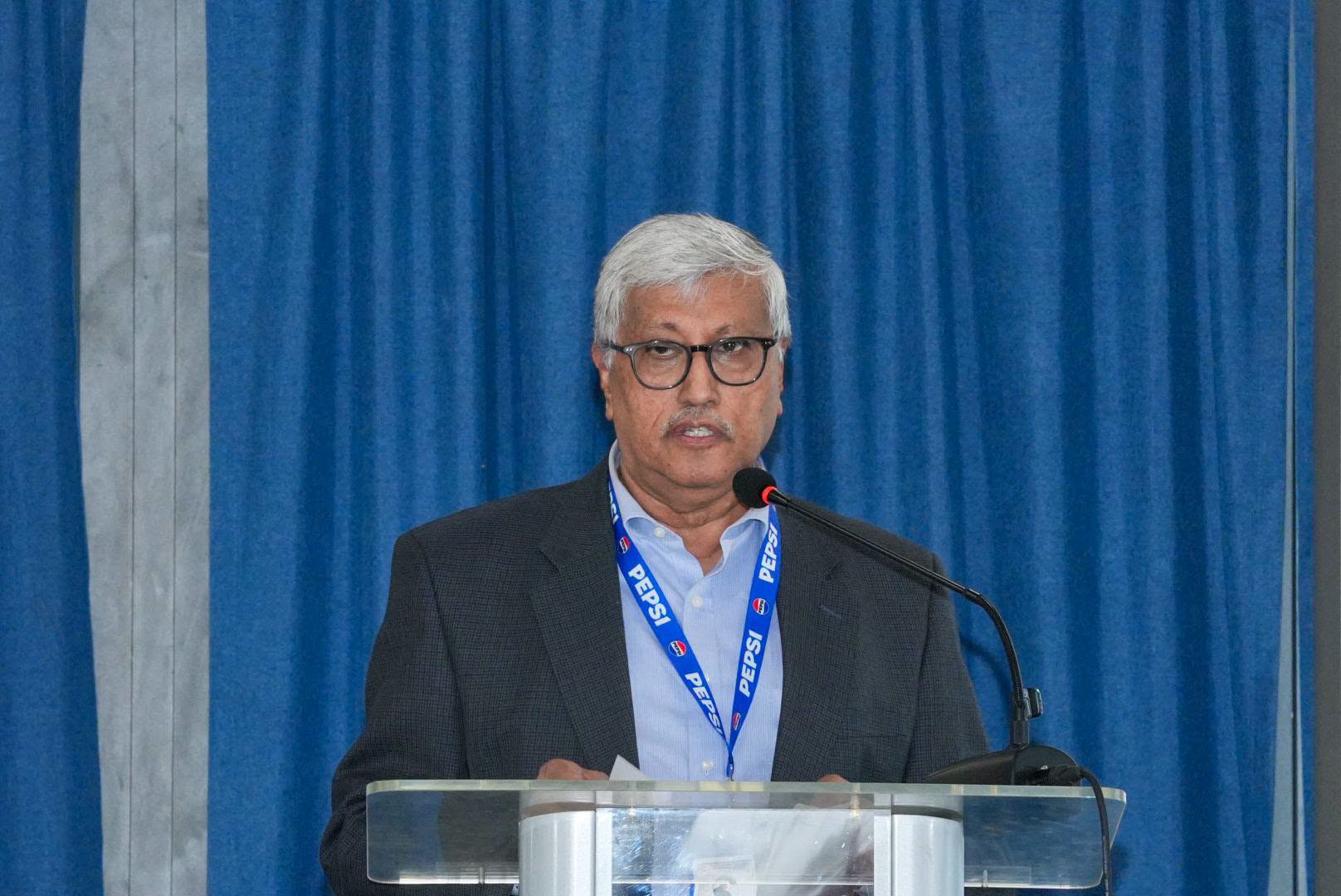


Chairman of the World Trade Centre Guyana (WTCG) and prominent Guyanese businessman, Komal Samaroo, has called for Caribbean and Latin American countries to strengthen efforts to build more meaningful economic relations, through stronger transport links and improved logistics.
Speaking during the opening of the WTCG International Trade and Investment Conference on Monday, Samaroo also emphasised the need to transition from informal border trade to more formal systems.
The four-day conference brings together regional representatives of both the private and public sectors, local and international business communities, and stakeholders, for discussions on examine potential trade investments in Guyana.
According to Samaroo, conference participants must ask “how do we protect our economics, create new opportunities, strengthen our resilience, and secure sustainable prosperity in an increasingly uncertain world”.
Specifically, he said questions should be asked such as “how can we minimise some of these risks by developing more onshoring and nearshoring strategies based on a more integrated regional supply chain in CARICOM?”
The businessman, who is also Chairman of the Demerara Distillers Limited (DDL), said as stakeholders seek to address these questions, they must take account of geographical realities with three CARICOM members – Guyana, Belize and Suriname – having potential supply chain linkages with the Latin American economy.
“These opportunities should be explored fully over the next four days. For example, should we not start exploring how we can link companies that support trade such as the banks and insurance companies to start exploring corresponding relationships to facilitate the movement of and payment for goods crossing borders through official channels controlled by the relevant customs authorities, how do we transition border trade from informality to formal trade routes is the question,” Samaroo posited.
In moving to build more meaningful economic relationships, he called for stronger transport links, improved logistics, and greater cooperation among the business community.
“The future should not be one in which Latin America and the Caribbean (LAC) remain neighbours separated by borders, but rather as partners in commercial trade, investment and shared prosperity,” Samaroo expressed.
In fact, he pointed to recent statistics from the Economic Commission for Latin America and the Caribbean (ECLAC) which show that goods exports from the region are expected to grow by 20 per cent in 2026. Regarding regional imports, ECLAC predicts they will grow by 16 per cent in value terms, driven by a 12 per cent expansion in volume and a 4 per cent increase in prices.
Commenting on these forecasts, Samaroo noted that “there is growth but I believe there’s greater opportunity to expand this growth”.
“As we seek to address the challenges that are before us, we must go after the low hanging fruits and complete the work that was started some time ago,” he further expressed, as he referred to previously established trade agreements that have not been fully optimised.
“We must identify what Government needs to do, what private sector can contribute and where regional and international partners can make a meaningful difference,” Samaroo said.
Meanwhile, also speaking during the opening of the conference was Secretary General of the Caribbean Community (CARICOM) Dr Carla Barnett who acknowledged the sweeping disruptions to global supply chains and market conditions, noting that while international trade is still growing, “it is doing so in a more fragment environment”.
For small economies like those in the Caribbean, she emphasised that these developments matter immensely and therefore urged greater production of goods and services and stronger economic ties among member states.
“The Caribbean community’s trade performance over the past five years has seen merchandise exports increasing from about US$19 billion to more than US$39 billion. Imports also rose to around US$42.9 billion in 2025, but export growth was stronger. As a result, the merchandise trade deficit narrowed substantially from levels exceeding US$10 billion in earlier years to approximately US$2.6 billion and US$3.3 billion in 2024 and 2025, respectively. That improvement is notable, but its composition also matters. Much of the export growth has been driven by energy and commodities. CARICOM continues to import a large share of its food, manufactured goods, and capital equipment. The challenge, therefore, is not only to increase exports, but to broaden the productive base from which those exports come,” Dr Barnett noted.
She added that services present a similar picture, noting that CARICOM is a net exporter of services with a trade surplus of more than US$7.2 billion in 2024.
“Services exports recovered well from the pandemic period, but travel accounted for about 82 per cent of total service exports in 2024. While that is a major strength, it also points to the importance of ensuring greater diversification,” she noted.
The CARICOM Secretary-General (SG) also disclosed that investment flows remain relatively modest.
“CARICOM and the wider Caribbean attracted approximately US$4 billion in inward foreign direct investment in both 2024 and 2025, accounting for only a small share of total inflows to Latin America and the Caribbean. These flows also remain concentrated in tourism, real estate, energy, and selected services, while greenfield investment remains comparatively weak. These trends reinforce the longstanding reality that our economies are small, very open, and highly concentrated,” she highlighted. In this regard, Dr Barnett emphasised that regional integration and collective action is becoming even more important.
“The effective functioning of a regional economy also depends on what we produce, how production is organised across borders, how investment is mobilised, how payments and capital move, how regulatory and tax systems interact, and whether the infrastructure supporting commerce allows firms to compete effectively from anywhere within and across in the region,” she outlined.
Pointing to key investment areas such as agriculture, culture, transportation, technology, and energy, Dr Barnett contended that the quality of investments matters as much as the volume.
She said, “we need investments that expand productive capacity, support innovation and diversification, strengthen regional value chains, and create employment. I encourage the businesses and investors participating in this conference this week to consider the CARICOM market through both a national and a regional lens. Each member state offers its own opportunities and comparative advantages.”
“At the same time, as we work to strengthen the economic connections among our markets, we create a platform, a wider platform for production, trade, and investment. Government and regional institutions can put frameworks in place, but it is the private sector which makes them work,” she added.
Subscribe to get the latest posts sent to your email.
Related News

Potential oil spill risk: Vessel stablised, cargo intact - CDC

28-Y-O killed during altercation at Amelia’s Ward

ERC commends measures to restrict importation of vaping products