

President Dr Irfaan Ali has called for a comprehensive approach to reparations for slavery, arguing that development financing, debt relief, and concessional loans should be used to address the inequalities created by the transatlantic slave trade.
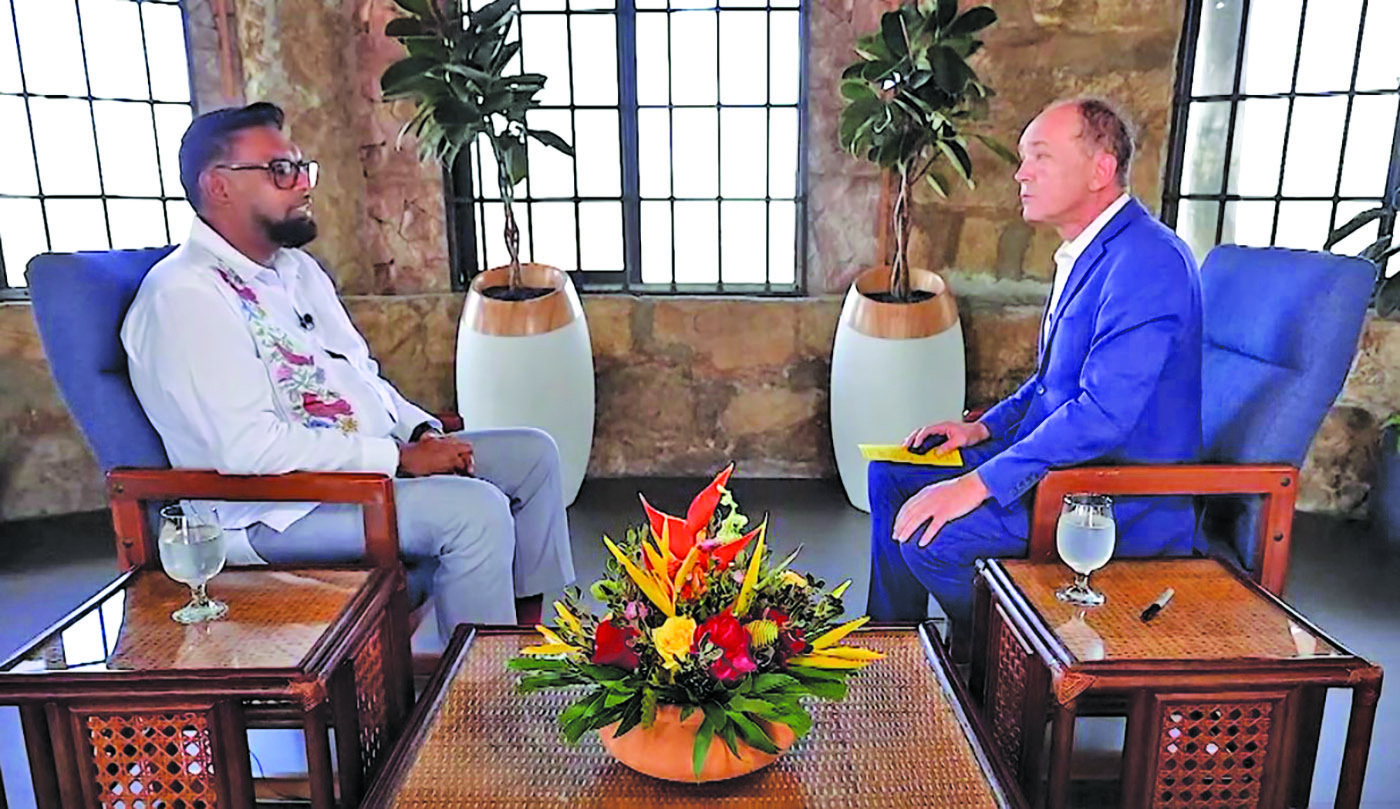
In an interview with Robert Moore of ITV News, the United Kingdom’s main commercial news network, Ali said reparations should not be treated as a monetary payout or an act of charity, but as a mechanism to recognise the lasting effects of slavery and support countries whose development was undermined by the atrocities.
The President also maintained that an apology from King Charles would help facilitate discussions on the issue, although he acknowledged the British monarch’s previous expressions of regret over slavery.
“The king has already expressed regret,” Ali said, adding that the next step would be an apology and a broader discussion on reparations.
He said the King’s upcoming visit to Guyana, followed by the Commonwealth Heads of Government Meeting, presents an opportunity for leaders to address the issue and agree on a way forward.
Ali stressed, however, that the royal visit should not be defined solely by the question of an apology, pointing to King Charles’ longstanding relationship with Guyana and his work in promoting tropical forests, climate action, and environmental protection.
“The trip is defined by the King’s long-standing relationship with Guyana, his global activism for Guyana, his global leadership for Guyana, his partnership with Guyana,” the President said.
He noted the King’s association with the Iwokrama Rainforest Conservation Area and his contribution to international efforts to recognise the importance of tropical forests in addressing climate change.
Ali described King Charles as a thinker on environmental issues whose contribution extends beyond activism to include discussions on carbon markets, climate financing, insurance, and loss and damage.
Nevertheless, the President said the question of slavery and its consequences could not be avoided during the King’s visit, given the Region’s history and the enduring impact of the slave trade.
“This is beyond personal. It’s the collective pain of the country,” Ali said, describing the suffering endured by enslaved Africans and the generations of trauma that followed.
He also highlighted the experiences of indentured labourers and Indigenous peoples, noting that the effects of slavery and other historical injustices must be considered in discussions about the Region’s development.
Ali said Guyana would continue to champion reparations through the Caribbean Community (Caricom), working alongside the African Union (AU) and other partners to advance the issue at the Commonwealth level.
He argued that the consequences of slavery must be distinguished from those of territorial conquest and war, maintaining that the forced enslavement of people represented a separate and profound injustice.
The President was also critical of British political figures who argue that there is nothing to regret or be ashamed of in the country’s history.
“They should re-examine their humanness and whether they’re exercising the attributes of humans who have a conscience, have feelings, have dignity and respect for others,” he said.
Ali rejected arguments that Britain’s role in the abolition of slavery should be viewed as grounds for praise, contending that the need for abolition arose from the system of enslavement itself.
He also expressed confidence that younger generations in Britain would play an important role in acknowledging the injustice and helping to shape a new approach to reparations.
Development financing, not a payout
On the form reparations should take, Ali said the focus should be on identifying and addressing development gaps that resulted from slavery rather than attempting to assign a monetary value to the suffering.
“You cannot ever value the type of injustice that took place. You can never create a monetary mechanism to address that,” he said.
Instead, he proposed that the historical impact of slavery be considered when determining the terms of development financing for affected countries.
This could include concessional loans, debt relief and financing for climate change adaptation and mitigation, education, health care and mental health services.
Ali said a special mechanism could be developed to account for the inequalities and underdevelopment that emerged from slavery, allowing affected countries to access more favourable financing arrangements.
He acknowledged that there would not be a single solution applicable to every country, but said discussions should seek to establish a workable framework that takes different needs into account.
The President pointed to the Region’s vulnerabilities to natural disasters and its continuing development needs, arguing that these challenges must be considered alongside the historical disadvantages created by slavery.
He also highlighted the long-term psychological consequences of slavery, noting that the effects on mental health across generations had not been adequately assessed.
Responding to concerns that Britain faces its own financial pressures, including demands on its National Health Service and defence spending, Ali argued that the resources accumulated through exploitation had helped Britain build a developed economy capable of withstanding economic shocks.
He said countries in the Caribbean continued to face constraints arising from underdevelopment and limited resources, making development support an important part of addressing the historical legacy.
However, Ali rejected the characterisation of reparations as “payback” or “vendetta”.
“This is not payback. It is not charity. It is none of those things,” he said.
He maintained that the objective was to establish a mature framework that acknowledges the suffering caused by slavery and provides practical support to address its continuing consequences.
The President said discussions at the Commonwealth level should seek to move beyond acknowledgement towards an agreed course of action, including a mechanism for development financing that reflects the historical impact of slavery.
While an apology would be significant, Ali said it should form part of a wider process aimed at addressing historical injustice and establishing a development path that allows affected countries to overcome inequalities that have persisted across generations.
Subscribe to get the latest posts sent to your email.
Related News
Guyana records rapid, sustained GDP growth since 2020 – World Bank

ExxonMobil Guyana to conduct offshore pipeline maintenance activities at Crane commencing ...
Miner arrested after gun, ammo found