‘Falklands are Argentinian’: Celebrations over England win revive old wounds
 16 July 2026
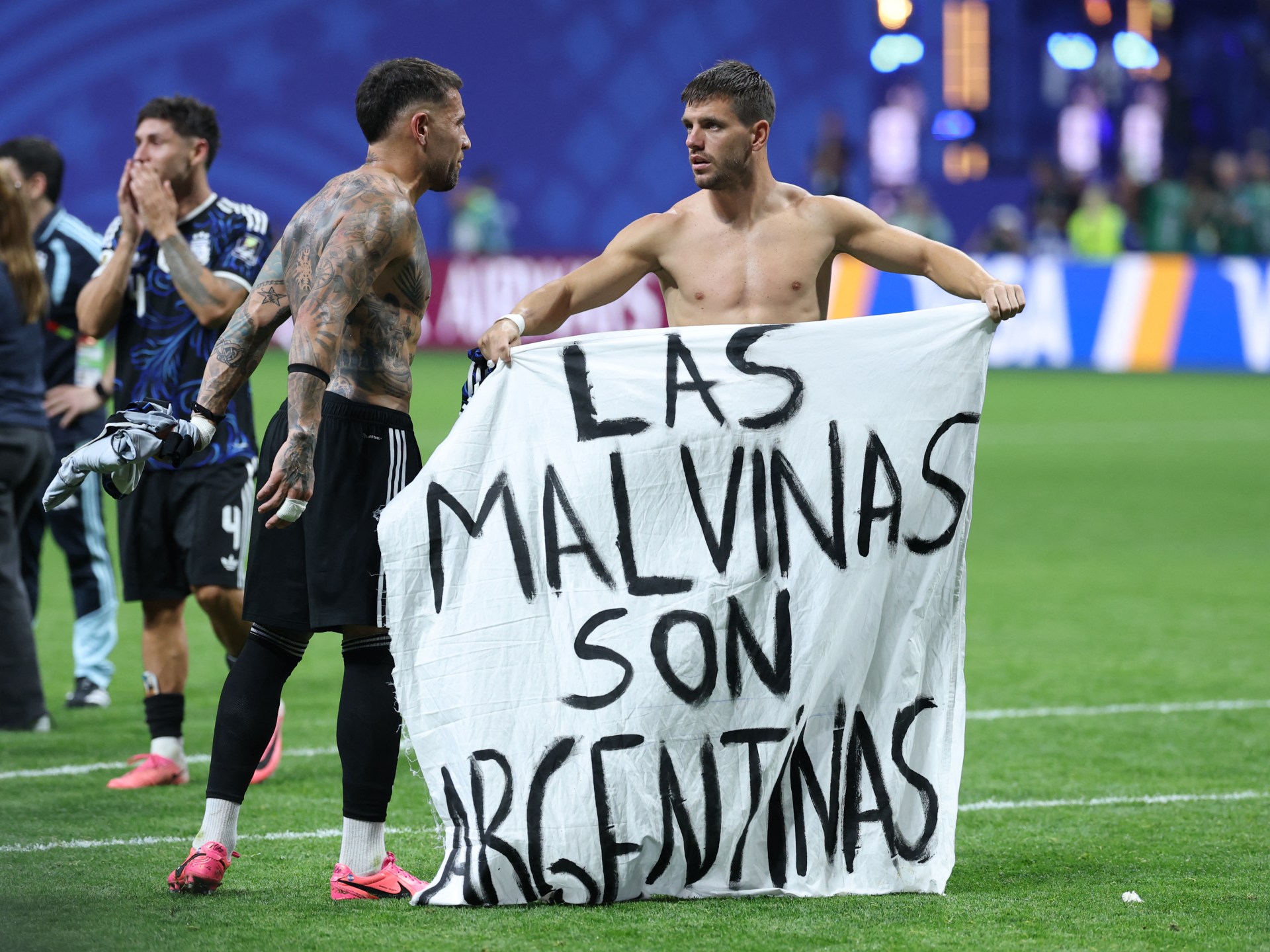

A spot in the final of the World Cup had just been secured, but Argentina’s football players wanted to declare another victory over England, whom they had just defeated 2-1 in the semifinal. Sweaty shirts off, they paraded on the field with a banner that read: “Las Malvinas son Argentinas,” translating to “The Falklands are Argentinian.”
The islands, British territory, have for decades been a source of simmering tensions between the United Kingdom and Argentina, which claims them. In recent years, the governments of the two countries have mostly tried to limit those differences to formal positions, without escalating the dispute.
- list 1 of 3Falklands claim: Can Argentina’s Milei use Trump ties to challenge UK?
- list 2 of 3World Cup England vs Argentina: Historic rivalry renewed before semifinal
- list 3 of 3Argentinian VP calls England ‘pirates’ ahead of World Cup semifinal clash
end of list
The Argentinian team now risks being sanctioned by the football governing body, FIFA, over the banner as it goes against the code of conduct, which bans “banners, flags, flyers, apparel and other paraphernalia that are of a political, offensive, and/or discriminatory nature” inside stadiums.
But the banner, say analysts, has also underscored how the Falklands are once again returning as a major political talking point in Argentina, stirred by the government of President Javier Milei and his close friendship with United States President Donald Trump.
Following their win, Argentinian Vice President Victoria Villarruel said in a post on X that “The Falklands are Argentine! They banned bringing them to the stadium and forgot that we carry them in our blood and our hearts.”
Villarruel is also the daughter of a Falklands War veteran and said on X before the game that they were playing against the “usurping pirates”.
Advertisement
“I’m not going to be politically correct or cold-hearted; against the English, it’s always something more. It’s the Malvinas, it’s Diego, it’s Leo’s last one, and it’s putting the brakes on the invaders,” she said.
“Go Argentina! Because until our last breath, we’re going to claim what’s ours!” Villarruel added.
A two-century-old dispute
The archipelago, with its two major islands of East Falkland and West Falkland, is situated 483km (300 miles) off the east coast of Argentina.
The dispute over the islands’ ownership dates back to the 19th century, with Argentina stating that it inherited them from Spain.
However, the UK has administered the islands since 1833, cementing its claim to the territory through its longstanding presence there, as Englishman John Strong named the islands after his patron, Viscount Falkland, in 1690.
In April 1982, the disputes over the territory reached boiling point, leading to the Falklands War after Argentina seized the islands in an attempt to control them.
Britain dispatched a military force to the archipelago, triggering 74 days of fighting that killed 655 Argentinian and 255 British service members and ended in the UK taking the territory.
That loss has since been a wound that many Argentinians have carried.
“That [World Cup semifinal] win reignites for Argentines the political issue of sovereignty over the islands,” Louise Clare, lecturer in modern British politics at the University of Manchester, told Al Jazeera. “It reignites the burning embers from a conflict nearly 45 years ago, and I think it never will cease to be significant for Argentina in terms of the relationship of the Malvinas and Argentine sovereignty.”
Argentina’s present position
In the days leading up to the match – the first time the two sides had faced each other since the World Cup in 2002 – Argentinian officials once again raised the dispute domestically.
In an opinion piece in the Argentinian newspaper La Nacion, Foreign Minister Pablo Quirno said Argentina’s claim to the Falkland Islands, or Las Malvinas as they are known in Argentina, was based on “historical and legal grounds”.
“The Falklands/Malvinas issue is neither another case of decolonisation nor a matter of self-determination. It is a special and particular colonial situation, originating in the violation of Argentina’s territorial integrity,” Quirno said.
“Time does not transform an illegitimate occupation into sovereignty. Nor will it divide the territorial unity of the Argentine Republic,” he wrote.
In response to Quirno’s op-ed, British Prime Minister Keir Starmer’s spokesperson told The Telegraph newspaper last week that the UK’s position was clear: “The Falkland Islanders are British with the right to determine their own future.”
Advertisement
The Trump angle
Yet recent months have injected a wild card into the mix, in the form of US President Donald Trump.
The Reuters news agency reported in April that a Pentagon memo had suggested options for Trump to target allies who had not been helpful enough during the Iran war, which included the US reviewing its position on the Falkland Islands. Trump has been critical of Starmer over the UK’s refusal to support the war on Iran.
Days later, Argentinian President Javier Milei, who had previously taken a more moderate stance on the issue, said Argentina was “making progress like never before” on the Falklands Islands.
Officially, until now, the US has both avoided talking about the archipelago’s sovereignty and acknowledged that it was under British administration.
Moreover, in 2013, a referendum held in the Falkland Islands on their status found that 99.8 percent of the islanders voted in favour of remaining a British overseas territory.
Symbolism – or more?
Clare explained that the archipelago’s status has always been at the core of Argentinian identity and will continue to be so until it is resolved.
“It’s something that’s been symbolic for successive Argentine governments because of just how significant the national cause is and what it means to Argentines,” she said.
“It’s sort of a win for Argentina, not just on the football match, but a win for Argentina in the sense of sort of that type of redemption from the prior losses in terms of the Falklands conflict in 1982,” she added.
Related News
Philippine Vice President Duterte’s impeachment trial begins: What we know
Is NATO at breaking point as it meets in Turkiye?
Venezuela earthquakes toll rises to 3,889 as risk of disease grows