

See the statement below on:
Partnering for the advancement of the agriculture sector: Collaborative Market Actor and Donor Project comes to a close

Over the last several years, a quiet but impactful project has been executed across Guyana—providing knowledge and invaluable networking opportunities for farmers, particularly women and youth in the agriculture sector in order to advance their operations and modernise their approach to business.
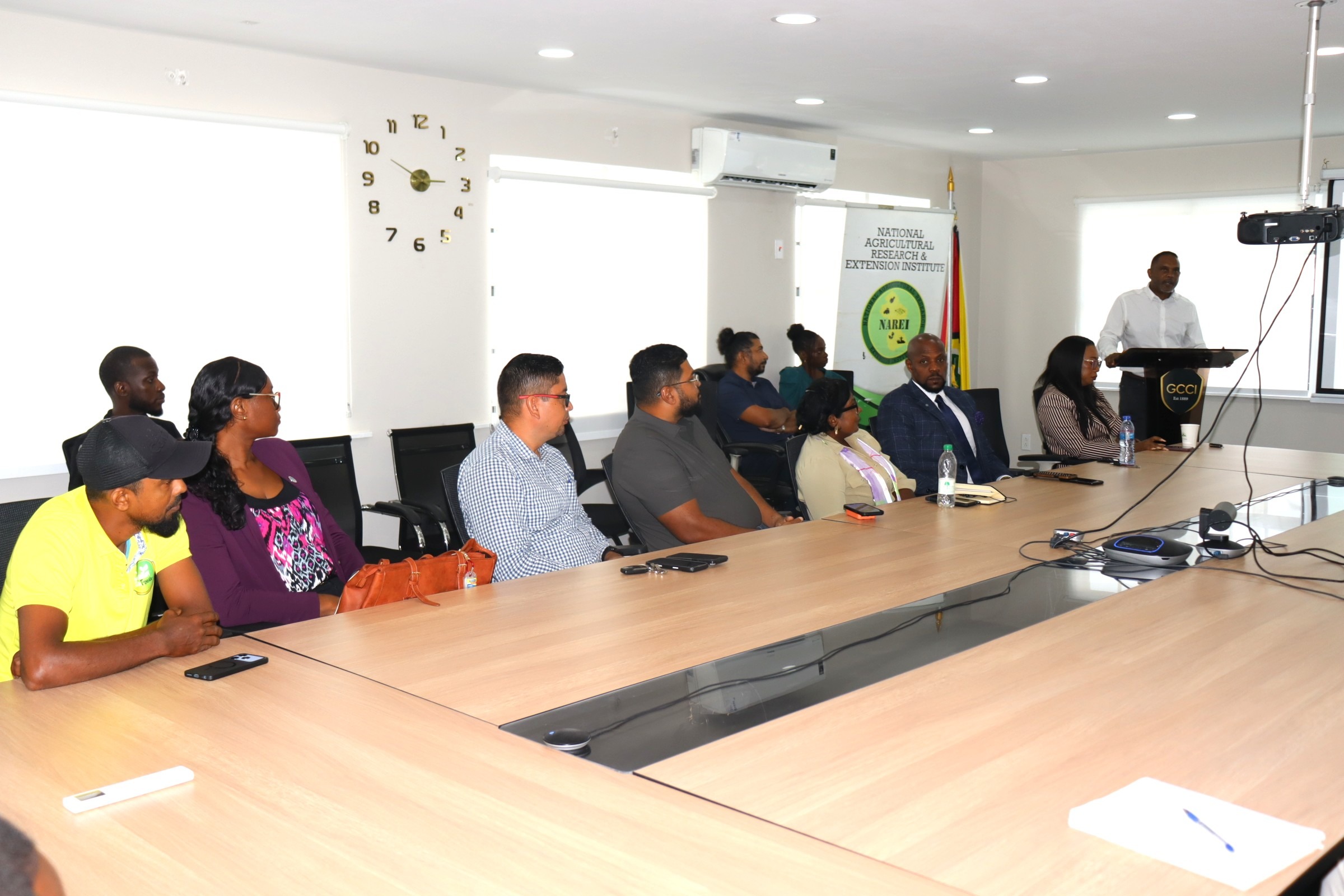
This ‘Market Actor and Donor Project’ was executed by the Georgetown Chamber of Commerce and Industry (GCCI) in partnership with the World University Service of Canada through funding from Global Affairs Canada, and saw collaboration with a number of organisations and agencies including the Ministry of Agriculture and its agencies— the National Agricultural Research and Extension Institute, the Guyana Marketing Corporation, Guyana Livestock Development Authority, Guyana Food Safety Authority, Government Analyst Food and Drug Department, and Pesticides And Toxic Chemicals Control Board—as well as the Guyana Bank for Trade and Industry, the Small Business Bureau, the Tourism and Hospitality Association, and Massy Stores. To celebrate the success of the programme—funded from Global Affairs Canada’s Sustainable Agriculture in the Caribbean project— the stakeholders held a close-out engagement on July 7 at the GCCI Secretariat.
Secretary of the GCCI and Chairperson of the Agriculture Committee, Mr. Brian Edwards who leads these efforts noted that the conclusion of this programme does not signal the end of efforts to propel agriculture, but it is proof of the viability of collaborative initiatives. “We’re not just marking the end of a project, we are celebrating the way forward of how we do business in Guyana in agriculture… Guyana Agriculture Connect was born out of a critical necessity—the need to bridge the gap between tradition and the modern market. We realised for our agriculture sector to truly thrive, we needed to move away from isolation, silos and short-term fixes, and instead build cohesive ecosystems,” he stated.
He described this collaboration as a dynamic bridge, geared towards strengthening relationships between producers, buyers, service providers, financial institutions, and supporting organisations. He highlighted, “It was designed to improve farming with access to high-quality input, technical knowledge, climate-smart agriculture practices, market information, and business development services. In short, we wanted to ensure SME farmers, women, youth, and historically unserved groups finally had a seat at the table and could participate effectively.”
The success and impact of the project, he underscored, is a testament to the fierce commitment to the development of local farmers. Recognising the role played by all of the programme’s partners, Mr. Edwards said, “We want to acknowledge and sincerely thank the Ministry of Agriculture and the Minister of Agriculture, our private sector partners, development partners, and producer organisations. Your collaboration has been the bedrock of these shared goals. While this specific WUSC project is officially coming to a close, let me be very clear: this is not the end. The relationships, the knowledge, and the robust market systems we have established together will continue to benefit the Guyanese
agriculture sector for years to come.”
President of the GCCI, Mrs. Kathy Smith impressed upon the attendees the extent at which this programme supports the GCCI’s goals for the development of the agriculture sector. “Brian has been doing tremendous work in the field of agriculture, agro-processing, in all 10 administrative teachers…We are empowering women across these regions, from Region One to Ten…and we have now started to see this project as phase one,” she said candidly. She disclosed that in furtherance to the work by the Chamber in this regard, the GCCI has partnered with the government of Guyana to provide 100 women in agriculture with shade houses.
Caribbean Director of WUSC, Mr. Doug Graham in extending his appreciation to the partners, said that the collaboration with the GCCI and partners has been rewarding. “It’s been a really important partnership that’s evolved and grown and to the point where we’re redundant, which is fantastic…Without these partnerships- both private sector, government, some are other development agencies or even groups of farmers, farmer groups, producer groups, without that collaborative effort, the project would not have achieved what it said that was going to be,” he said candidly.
Head of Cooperation at the High Commission of Canada to Guyana and Suriname, Mr. Adam Loyer noted that the SAC project was a $20 million Canadian project implemented in the Caribbean region. “The goal was the building of equitable prosperity, especially for women and youth producers…as mentioned by previous speakers, through the project’s inclusive market systems approach, the project was able to catalyse the bringing together of many, many organisations,” he stated.
He added that beyond simply facilitating producers to attend training to actively being able to shape their economic futures, the shift is one from simple participation to one of true agents. Further, he disclosed, “As Head of Cooperation, I’m pleased to have heard that Guyana emerged as one of the strongest performing SAC countries. Participants reported some of the largest increases in income and this is very important, with average annual net income nearly doubling from baseline levels when they remeasured partway through project. So perhaps those increases are even higher now. The project also reported one of the highest rates of climate smart agriculture adoption.”
The GCCI is proud of the success of this project, and intends to advance these initiatives to ensure that the agriculture sector is inclusive, and that all demographics are able to thrive.
Subscribe to get the latest posts sent to your email.