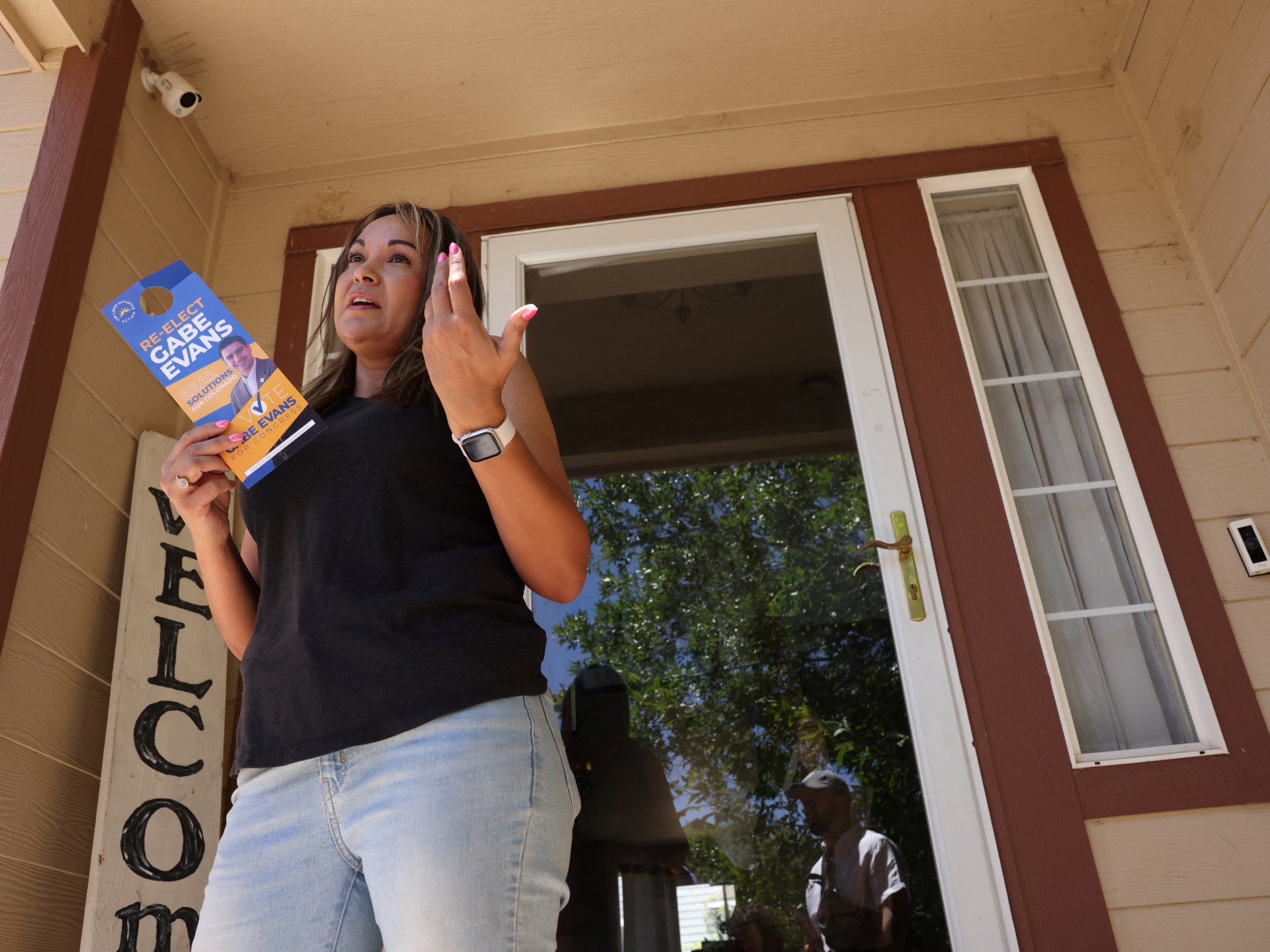

Voters in the western US state of Colorado will head to the polls this week in a round of primary elections that could influence the direction of the upcoming midterms in November.
Primary elections involve voters choosing which candidate will represent their respective political parties in general elections and can offer insights into the issues and ideas motivating voters.
- list 1 of 3Wins by Mamdani-backed candidates deal blow to pro-Israel camp in US
- list 2 of 3With water cuts looming in Arizona in US, locals fight data centres
- list 3 of 3Three firefighters killed in US wildfires along Colorado–Utah border
end of list
The Colorado primaries include several high-profile races being watched for their national significance, including the contest to replace outgoing Democratic Governor Jared Polis and elections for US Senate and House of Representatives seats.
Which races are being watched, when will the election take place, and what can we expect to see? We answer those questions and more in this brief explainer.
When is the election?
The election will take place on Tuesday, June 30, 2026.
When do polls open and close?
Polls open at 7am (13:00 GMT) and close at 7pm local time (01:00 GMT on July 1).
Which races are being watched?
Colorado’s Democratic gubernatorial primary has drawn several high-profile officials, including one of the state’s two current US senators.
The winner of the contest will replace outgoing Governor Polis, who is limited to one term. Republican voters will also select their gubernatorial candidate for the general election in November.
Contested primary races are also being held for the US Senate, House of Representatives, and state positions, such as secretary of state and attorney general.
Who are some of the main candidates?
At the centre of the Democratic gubernatorial primary are two familiar figures in the world of Colorado politics: US Senator Michael Bennet and state Attorney General Phil Weiser.
Advertisement
Bennet, who has represented Colorado in the US Senate since 2009 and briefly ran for president in 2019, would have to vacate his seat if he wins the Democratic primary and defeats the Republican candidate in November.
He has said that he would hold his seat until his term as governor begins and select an interim replacement himself, rather than allowing Polis to do so. Bennet’s current Senate seat will be on the ballot in 2028.

While Bennet has been a well-known figure in Colorado politics for more than a decade, he is facing a strong, progressive challenger in Weiser, who has criticised his alignment with the Democratic Party’s establishment wing and corporate interests.
If Bennet loses the primary, he will complete his current Senate term.
Several Republican candidates are also competing to represent their party in the race for governor, including state Representative Scott Bottoms, state Senator Barbara Kirkmeyer, and pastor and military veteran Victor Marx.
First-term Democratic US Senator John Hickenlooper is facing a primary challenge from community organiser and state Senator Julie Gonzales, a progressive who has criticised Hickenlooper’s positions from the left on issues such as corporate power and Israel and Palestine.
The winner of that race will face-off against Republican state Senator Mark Baisley, who is the sole candidate in his party’s primary.
What do the polls say?
Democrats have held the Colorado governor’s office since 2007, and the Democratic candidate in the race will be seen as a likely favourite heading into November.
A recent survey, conducted by Public Policy Polling and funded by a political action committee supporting Weiser, suggested the current attorney general would win 45 percent of the vote against 36 percent for Bennet. About 19 percent of respondents said they were undecided.
A survey by the same pollster earlier this month had Bennet leading Weiser by six points.
In the Republican primary, Marx has a fundraising advantage over his opponents, with more than double the contributions and available funds heading into election day.
Polls suggest Hickenlooper is ahead of Gonzalez, but the former’s margin of advantage has shrunk considerably over the last several months.
While a February survey by the progressive pollster Data for Progress suggested Hickenlooper leading by 32 points, a late May poll from Colorado Community Research had him ahead by just seven points.
Advertisement
The Data for Progress poll also suggested that Gonzalez had improved her position with voters as they became more familiar with her.
What role is Israel’s war on Gaza playing in the races?
Israel and Palestine have become a common flashpoint in contests within the Democratic Party, with members of the party’s progressive wing calling for an overhaul of US support for Israel over its genocidal war on Gaza and railing against the influence of pro-Israel groups in elections.
A large majority of Democratic voters have a negative view of Israel and support measures such as conditioning or cutting off arms sales to Israel, but many of the party’s leaders remain strong supporters of Israel.
A Quinnipiac poll in 2025 suggested that nearly 80 percent of Democratic voters believed that Israel was committing genocidal acts in Gaza, a position mirrored by many scholars and rights groups.
Calls for policy changes, such as an end to US arms sales to Israel, have often been accompanied by progressive attacks on the party’s pro-business wing, depicted together as part of an out-of-touch establishment that has not been responsive to the concerns of voters.
These dynamics are continuing to play out in Colorado, where Gonzalez has touted her support from the group Track AIPAC, which details spending by pro-Israel groups for politicians across the country.
Democratic US Representative Diana DeGette in Colorado’s first congressional district is also facing a strong primary challenge from the left from a 29-year-old democratic socialist and vocal critic of Israel, Melat Kiros.
The news outlet Politico reported that outside groups have poured about $3m into that race in recent weeks, largely in favour of DeGette, who enjoys a nearly three-to-one spending advantage as the contest comes to a close. Kiros, meanwhile, has been endorsed by figures such as leftist US Senator Bernie Sanders.
Related News

Why a new war in Yemen could be different for the Houthis

Iran, Qatar hold Hormuz talks amid int’l hopes dialogue with US will resume

Car bomb hits Colombia highway day after new president sworn in