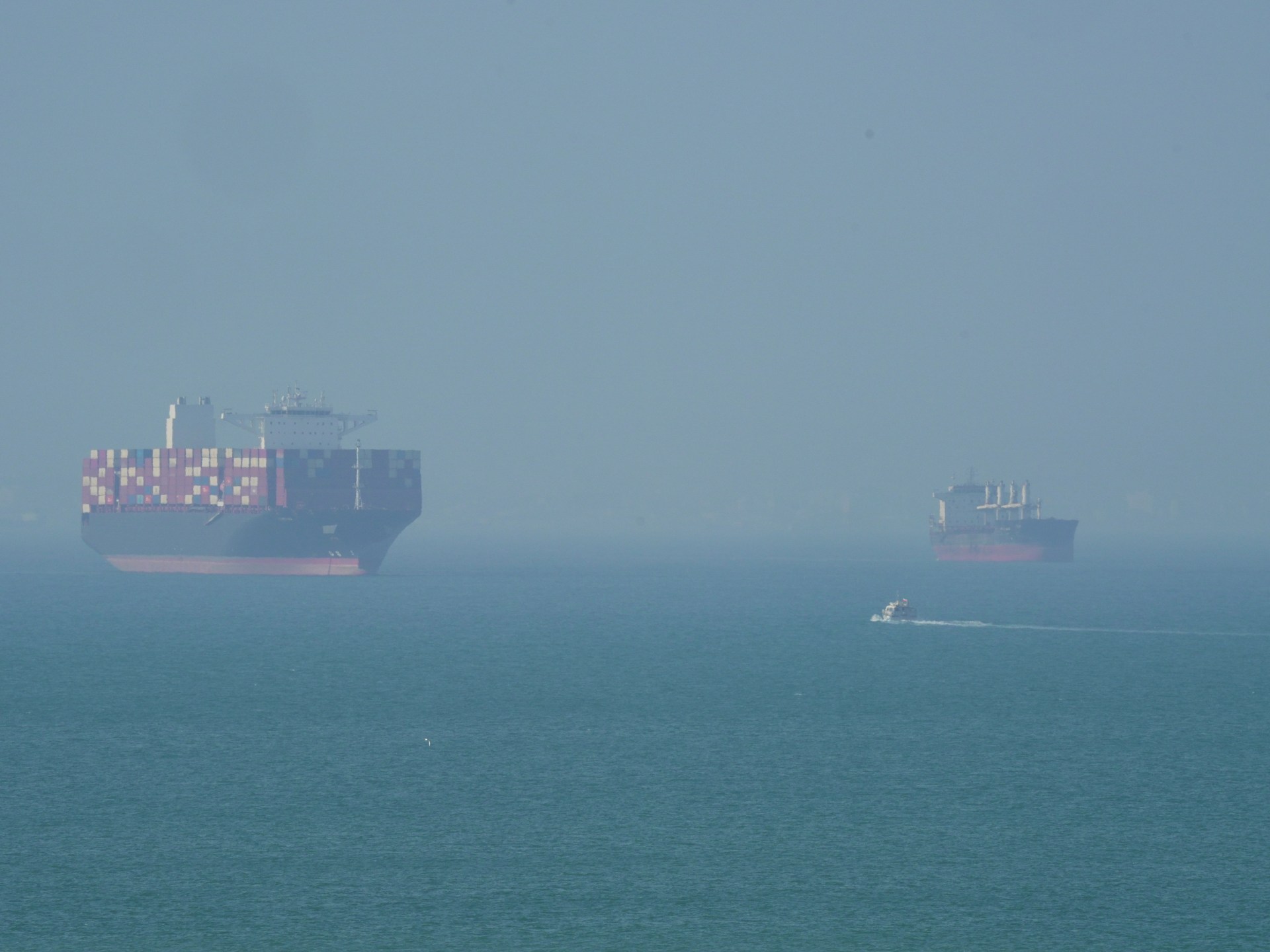

United States President Donald Trump has said Washington will guide ships stranded in the Strait of Hormuz to safety – in an initiative dubbed “Project Freedom” – signalling a potential challenge to Iran’s blockade of the strategic waterway.
“The Ship movement is merely meant to free up people, companies, and Countries that have done absolutely nothing wrong – They are victims of circumstance,” Trump posted on his Truth Social platform on Sunday, calling it a “humanitarian gesture”.
- list 1 of 4Japan PM says oil crisis having ‘enormous impact’ in Asia Pacific
- list 2 of 4Former NYC Mayor Giuliani hospitalised in ‘critical condition’
- list 3 of 4Japan PM: Hormuz closure ‘inflicting enormous impact’ on Asia Pacific
- list 4 of 4‘I can’t feel my leg’: Israeli gunfire disables teenagers in West Bank
end of list
The campaign, the US president said, came at the request of countries whose vessels remain stuck in the strait, which he described as “neutral and innocent bystanders”.
He added that US envoys were holding “positive” discussions with Iran, but warned that any interference with the operation would “have to be dealt with forcefully”. It remains unclear how the campaign will be implemented, as Iran has warned ships from entering the strait.
On Monday, the first day of Trump’s campaign to rescue ships struck in the Gulf, a US warship was hit with missiles by the Iranian navy near Jask, in the strait located between Iran and Oman. The US has denied the Iranian claims, but the incident has raised fears of escalation in hostilities.
Navigation through the strait has been disrupted after Tehran took control of the crucial waterway days after the US and Israel launched attacks on February 28. The war and disruption in the strait have triggered an oil price spike and dealt a blow to the global economy. A US naval blockade of Iranian ports has further escalated tensions.
Advertisement
Tehran and Washington have been exchanging proposals via mediator Pakistan to end the war since a ceasefire came into effect on April 8, but have failed to reach a broader agreement.
Iran has demanded a permanent end to hostilities, while Trump has insisted Tehran must first lift what he calls its blockade of the strait – a route that carries roughly a fifth of global oil and gas exports. The US president has also maintained that Iran’s nuclear programme remains a “red line”.
Both sides have continued to intercept and target vessels amid an ongoing maritime confrontation in the Gulf, raising questions about how Tehran and Washington can unblock the Strait of Hormuz and reach a long-term peace agreement.
What is the purpose of ‘Project Freedom’?
Trump said the operation would ensure safe passage for stranded vessels. “We will guide their Ships safely out of these restricted Waterways, so that they can freely and ably get on with their business,” he wrote.
US Central Command (CENTCOM) said it would support the effort, alongside a broader Department of State initiative – the Maritime Freedom Construct – aimed at improving coordination and information-sharing among international partners.
According to CENTCOM, the US deployment could include destroyers, more than 100 aircraft, unmanned platforms, and about 15,000 service members.
Jonathan Hackett, a retired US Marine Corps special operations specialist and former counterintelligence agent, added that the initiative reflects a narrowing of US objectives.
“At the beginning of this conflict, the stated objectives were regime change and dismantling Iran’s nuclear and missile capabilities,” Hackett told Al Jazeera. “Those goalposts have shifted towards a more economic outcome focused on the Strait of Hormuz.”
He warned, however, that any confrontation at sea could quickly escalate. “If we start having opposed encounters, the US will not just be escorting vessels – it will be defending them. That creates a new risk calculation, particularly for insurers.”
Hackett also questioned whether the US has sufficient resources. “There are only about a dozen Navy vessels capable of defending shipping,” he said. “Before the war, more than 100 ships transited the strait daily. The maths simply does not work.”
Analysts say the initiative may also be aimed at stabilising global markets. Despite the ceasefire, Iran’s blockade and US naval pressure have driven up oil prices, prompting economic strain and domestic political pressure in the US.
Advertisement
The announcement comes amid stalled diplomacy. Iran has proposed a 14-point plan to end the war, but Trump called it “unacceptable”. Iran’s Ministry of Foreign Affairs on Monday said it was assessing a response from Washington to its proposal.
How many ships are stranded?
The International Maritime Organization (IMO) estimates that up to 20,000 seafarers are stranded on board roughly 2,000 vessels in the Gulf near the Strait of Hormuz. These include oil and gas tankers, cargo ships, bulk carriers and cruise liners.
Since the conflict began, the IMO has recorded at least 19 attacks on vessels, killing 10 seafarers and injuring eight. It has warned that many ships are running critically low on food, fuel and water.
“There is no precedent for the stranding of so many seafarers in the modern age,” said Damien Chevallier, director of the IMO’s Maritime Safety Division.
The organisation has called on all sides to de-escalate to allow crews to be evacuated safely. However, incidents along the strait continue, with the United Kingdom Maritime Trade Operations (UKMTO) agency reporting that a tanker off the UAE port of Fujairah was struck by unknown projectiles, though all crew were safe.
Hours earlier, it said a bulk carrier had been attacked by multiple small aircraft near the Iranian coast.
How has Iran responded?
Iran has insisted that vessels transiting the strait must pay a toll and follow routes approved by the Islamic Revolutionary Guard Corps (IRGC).
Following Trump’s announcement, Ebrahim Azizi, head of the Iranian parliament’s National Security Commission, warned that any US intervention would violate the ceasefire.
“The Strait of Hormuz and the Persian Gulf would not be managed by Trump’s delusional posts,” he wrote on X.
Meanwhile, the US naval forces have begun anti-mine operations in the strait, though clearing the area could take weeks or months.
Hackett identified two immediate risks: Sea mines and Iran’s naval capabilities. “The US no longer has dedicated mine-sweeping vessels,” he said. “And Iran still has significant capacity, including fast-attack boats that could harass or block shipping.”
He also pointed to the role of insurers. “Even if passage is declared safe, the question is whether companies are willing to risk ships and crews without guarantees.”
Hackett added that the humanitarian framing of “Project Freedom” raises further questions. “If this is about helping stranded crews, how long have they been there? What resources are available? And what happens if those crews are from countries the US has strained relations with?”
Harlan Ullman, a former US naval officer and chairman of the Killowen Group, told Al Jazeera the operation could ease tensions – but only if Iran allows it.
“If this is a prelude to negotiations and Iran permits transit, it could be a positive step,” Ullman told Al Jazeera. “But if the strait is mined or Iran resists, this could become very dangerous.
“Iran has drones and fast boats that could make this difficult,” he added. “Any attack on a US warship would almost certainly trigger retaliation.”
Advertisement
Ullman stressed that diplomacy remains essential for a long-term peace agreement. “The only solution is reopening the strait, followed by sustained negotiations over Iran’s nuclear programme. If this is well thought out, it could help. If not, it risks escalation.”
Is there a precedent for this?
The situation echoes the so-called Tanker War of the 1980s, during the Iran-Iraq conflict, when both sides attacked oil shipments in the Gulf.
That war began in 1980 when Iraq invaded Iran. By 1984, it had extended to the Gulf, with attacks on oil tankers aimed at crippling economic lifelines. Iran responded by targeting vessels linked to Iraq and its allies.
In 1987, the US launched Operation Earnest Will, escorting reflagged Kuwaiti tankers under US protection.
The following year, the US frigate USS Samuel B Roberts was severely damaged by an Iranian mine, prompting Operation Praying Mantis, a major US assault on Iranian naval forces.
The conflict in the Gulf subsided later in 1988 after a United Nations-brokered ceasefire between Iran and Iraq.
Related News
Civilians or Hezbollah: Who did Israel hit on Lebanon’s ‘Black Wednesday’?
Mali’s Defence Minister Sadio Camara killed amid coordinated attacks
How long can Iran survive the US’s Hormuz blockade?