Trump ‘pretty sure’ of Iran deal, but can Pakistan-led efforts end the war?
 30 March 2026
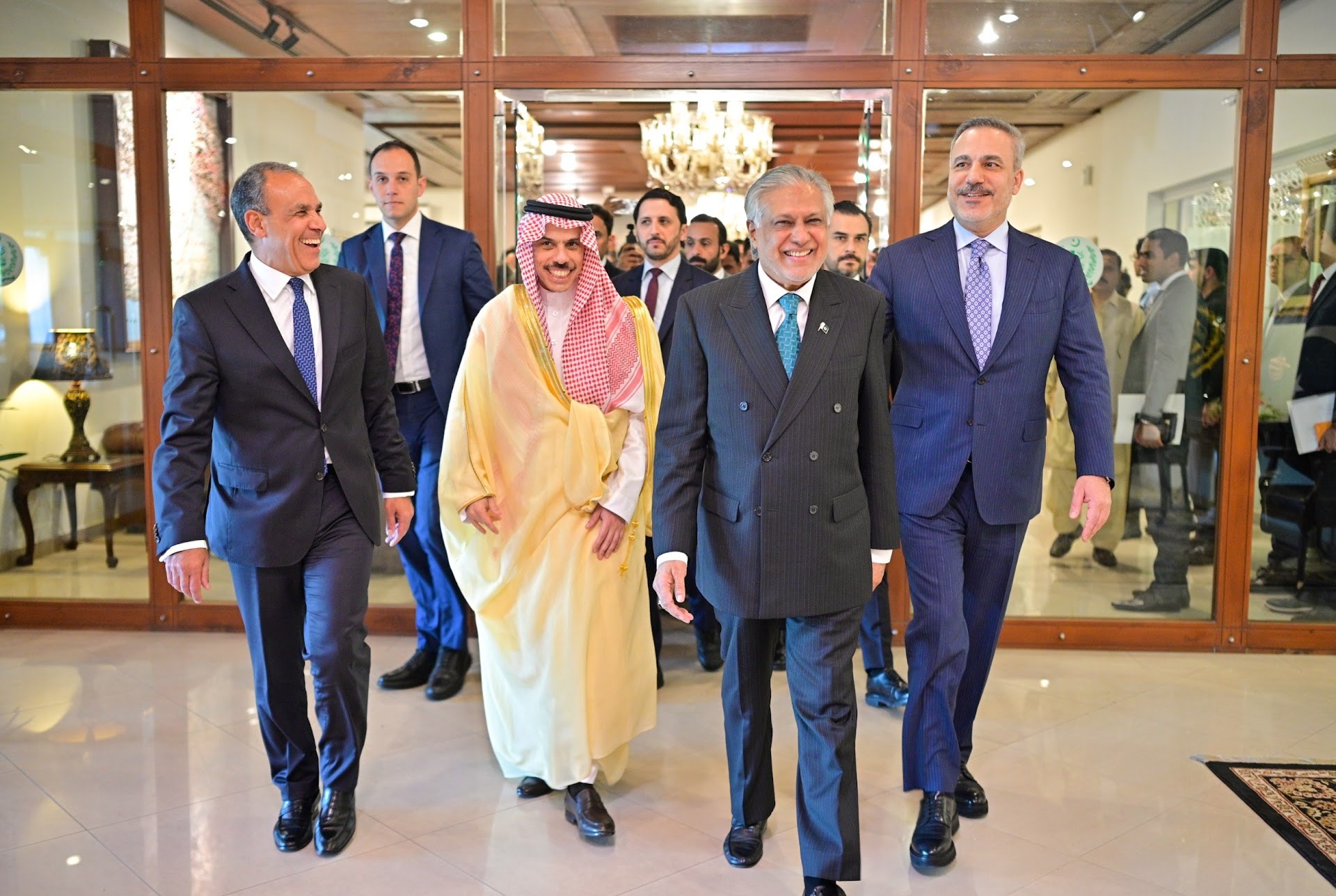

Islamabad, Pakistan – When the foreign ministers of Saudi Arabia, Turkiye and Egypt landed in Islamabad over the weekend, it marked the second meeting in less than two weeks of a diplomatic track working to contain the fallout of the US-Israel war on Iran and Tehran’s retaliatory strikes across the region.
Pakistan’s Deputy Prime Minister and Foreign Minister Ishaq Dar confirmed at the conclusion of Sunday’s consultations that the US and Iran had expressed confidence in Pakistan to facilitate direct talks. Islamabad, he said, was “honoured” to host them “in the coming days, for a comprehensive and lasting settlement of the ongoing conflict”.
- list 1 of 4Nixon to Trump: Pakistan’s long record as backchannel between rival powers
- list 2 of 4Pakistan hosts four-nation bid to encourage US, Iran towards diplomacy
- list 3 of 4‘A welcome gesture’: Pakistan seals Iran deal to send ships through Hormuz
- list 4 of 4Pakistan maintains ‘delicate balancing act’ as it hosts Iran talks
end of list
The four ministers, he added, held “a very detailed and in-depth discussion” on the war, reaffirmed “unity to contain the situation, reduce the risk of military escalations and create conditions for structured negotiations”, and agreed to constitute a Committee of Four senior officials, one from each foreign ministry, to work out the modalities of the process.
Besides Dar, the meeting was attended by foreign ministers Hakan Fidan of Turkiye, Badr Abdelatty of Egypt and Prince Faisal bin Farhan Al Saud of Saudi Arabia.
The quadrilateral format first came together on the sidelines of the broader Arab and Islamic consultative meeting in Riyadh, Saudi Arabia, on March 19. What began as a wider gathering has hardened into a focused four-country peace push, with Pakistan acting as the primary channel between Washington and Tehran.
Hours later, in an interview with the British newspaper Financial Times, United States President Donald Trump said his “favourite thing is to take the oil in Iran” and did not rule out seizing Kharg Island, the export hub that handles roughly 90 percent of Iran’s crude.
Advertisement
“Maybe we take Kharg Island, maybe we don’t. We have a lot of options,” Trump said. He also confirmed that indirect talks via Pakistani “emissaries” were progressing and reiterated the April 6 deadline he set on Truth Social on March 26 for Iran to accept a deal or face US strikes on its energy sector.
But on board Air Force One on Sunday, Trump said, “I do see a deal in Iran, yeah. Could be soon”, and described negotiations as going “extremely well”.
Those contrasting postures underscored the central tension confronting Pakistan’s diplomatic initiative.
At a moment when Islamabad and its partners are attempting to build a multilateral framework to prevent further escalation, the war appears headed in the opposite direction, with continued Israeli strikes and an expanding US military presence in the region.
‘Baby steps’ amid escalation
Mushahid Hussain Sayed, former Pakistani information minister, senator and foreign policy analyst, said the Islamabad meeting was significant for three reasons.
He described it as the first institutional initiative from the Muslim world aimed at opening a pathway to dialogue.
According to Sayed, Pakistan and Turkiye, both neighbours of Iran, are among the most credible interlocutors available, one a nuclear power and the other a NATO member.
“Both Iran and the US have reposed confidence in Pakistan as a bridge of communication between Tehran and Washington, and most likely the feasible venue for any future peace talks,” he told Al Jazeera.
But he was blunt about the limitations. “These are baby steps for diplomacy in a war scenario that is not only escalating but also becoming more complicated by the day,” Sayed said.
Masood Khan, Pakistan’s former ambassador to the US and the United Nations, said the meeting had “opened a diplomatic corridor, building on earlier shuttle diplomacy, sustained communications and behind-the-scenes efforts to persuade the United States and Iran to engage”.
The Committee of Four, he said, provides a structured backchannel, enabling “a step-by-step, layered, and calibrated process” supported by regional consensus.
Khan outlined four possible stages: trust-building measures, ceasefire negotiations, direct talks on complex issues including the nuclear programme and the Strait of Hormuz, and ultimately an agreement on reciprocal commitments.
However, he cautioned that major obstacles remain. “Tehran’s demands for war reparations and its sovereignty over the Strait of Hormuz are likely to prove the most difficult issues to resolve,” Khan told Al Jazeera.
Advertisement
Before the ministers’ meeting, Pakistan Prime Minister Shehbaz Sharif held a 90-minute call with Iranian President Masoud Pezeshkian, briefing him on Islamabad’s diplomatic outreach to the US, Gulf states and other Islamic countries to “create a conducive environment for peace talks”, according to a statement from the Prime Minister’s Office.
China’s Foreign Minister Wang Yi conveyed Beijing’s full backing for the initiative, while UN Secretary-General Antonio Guterres has also expressed support.
A senior Pakistani diplomat said China was “very supportive” of Pakistan’s efforts, while the Ministry of Foreign Affairs confirmed in a statement on Monday that at Wang’s invitation, Dar will visit China on March 31.
“In this context, the upcoming visit will provide an opportunity for both sides to hold in-depth discussions on regional developments, as well as bilateral and global issues of mutual interest,” the statement from the ministry said.
Dar suffered a hairline fracture in his shoulder after a fall on Sunday while meeting his Egyptian counterpart, according to his son, and the ministry said his upcoming visit, despite medical advice, underscores the importance of the Pakistan-China relationship.

Positions remain far apart
The positions formally put forward by both sides remain structurally incompatible, say analysts.
Washington’s 15-point plan, transmitted to Tehran via Pakistan, includes a one-month ceasefire, a handover by Iran of its highly enriched uranium stockpiles, a halt to further enrichment, curbs on Tehran’s ballistic missile programme and an end to support for regional proxies.
Iran’s counterproposal, outlined by state-funded broadcaster Press TV, citing a senior political security official, calls for a halt to aggression and killings, concrete guarantees against recurrence, reparations, an end to hostilities against Iran’s allies and formal recognition of Iranian sovereignty over the Strait of Hormuz.
Trump told reporters on board Air Force One on Sunday that Iran had agreed to “most of” the 15 points.
On Monday, Iran’s Foreign Ministry Spokesperson Esmaeil Baghaei confirmed that the country had received messages via intermediaries, but described the US proposals as “unrealistic, illogical and excessive”.
Baghaei appeared skeptical about the prospects of the Islamabad dialogue yielding a peace deal.
“The meetings that Pakistan has are a framework that they established themselves and we did not participate in,” he said. “It is good for the countries of the region to be concerned about ending the war, but they should be careful about which side started the war.”
Khan, the former diplomat, said Iran’s scepticism ran deep. “Iran suspects that the diplomatic process could serve as a smokescreen for a ground assault along its coastline, adjacent islands, or the Strait of Hormuz. No magic wand can erase such a deeply entrenched trust deficit overnight,” he said, adding that trust-building “must proceed at a brisk pace given the devastating humanitarian and military costs”.
Advertisement
Javad Heiran-Nia, director of the Persian Gulf Studies Group in Tehran, said any preliminary engagement must ensure neither side feels it has “surrendered”.
“The negotiation framework should be such that each party can participate without feeling it has given in, with a focus on low-cost and fruitful issues in the short term,” he told Al Jazeera.
A realistic first step, he said, would be a US commitment to postpone threats against Iran’s power plants for a sustained period, alongside guarantees from third countries on interim arrangements.
Reza Khanzadeh, an adjunct professor at George Mason University, said the burden of compromise ultimately lies with Washington.
Iran, he said, believes any deal short of its own terms could invite future attacks, making regime survival non-negotiable.
“They may be willing to compromise on the nuclear programme, the ballistic missile programme, and support for regional proxies,” he said. “Tehran will not compromise on its existence. And therefore, Iranians are willing to fight for as long as it takes.”
He also pointed to mounting domestic pressure in the US, noting Trump’s approval rating has fallen to 36 percent in recent polls, driven by rising fuel costs and public concern over the war.
Khan identified the most decisive confidence-building measure as one Washington has yet to deliver.
“A commitment from Washington to ensure that Israel halts its attacks on Iran and Lebanon and withdraws from recently occupied Lebanese territory. That, however, is easier said than done,” he said.
Strait of Hormuz and economic pressure
Iran’s agreement to allow 20 Pakistani-flagged vessels through the Strait of Hormuz, confirmed by Dar over the weekend and acknowledged by Trump, is the most immediate confidence-building measure on the table.
The strait remains effectively closed to normal shipping. The International Energy Agency has described the disruption as the worst oil shock in history, surpassing the crises of 1973 and 1979.
Brent crude rose above $116 per barrel in early Monday trading in Asia, up more than 50 percent since the war began on February 28. The World Trade Organization’s director-general, Ngozi Okonjo-Iweala, has said global trade is experiencing its “worst disruptions in the past 80 years”.
But Sayed, who is also the founding chairman of the Islamabad-based Pakistan China Institute, said Iran’s “closure of the Strait of Hormuz is not the cause but the consequence of the conflict”.
Just as Saudi King Faisal bin Abdulaziz Al Saud weaponised oil exports in October 1973 – cutting off supplies to the US and its allies in retaliation for their support of Israel during the Arab-Israeli war, triggering a global energy crisis – Iran had deployed the strait to counterbalance US-Israeli military firepower with an economic chokehold, he argued.
Khan cautioned against treating the strait as the centrepiece of any settlement.
“The Strait of Hormuz will remain a residual issue and will ultimately need to be addressed by the eight littoral states of the Persian Gulf, with reference to UNCLOS and established legal precedents,” he said, referring to the UN Convention on the Law of the Sea.
The immediate priority, he argued, was a broader halt to hostilities.
“The foremost confidence-building measure would be a pause in hostilities, a truce that provides respite to the warring sides and creates space for peacemakers,” he said.
Heiran-Nia proposed a phased approach.
“First agree on a limited ceasefire and halt to attacks on civilian targets; reduce forces in critical areas and establish confidential channels for information exchange in a second step; and then move to broader ceasefire negotiations,” the Tehran-based analyst said.
Advertisement
Any withdrawals, he added, should be measurable, with mediators acting as a “secret channel” to ensure reciprocity.

The spoiler problem
Even as diplomatic efforts continue, the military trajectory remains escalatory.
An amphibious task force of about 3,500 Marines and sailors led by the USS Tripoli arrived in the region on Friday, according to the US Central Command (CENTCOM).
Another 2,200 Marines are heading to the Gulf, alongside 2,000 soldiers from the Army’s 82nd Airborne Division.
Trump has made clear that military options remain under consideration. Other reports suggest the Pentagon is preparing for potential ground operations that could last weeks.
Israel, which waged its genocidal war on Gaza in October 2023 and has invaded southern Lebanon for the second time since, struck Tehran again on Sunday.
US and Israeli forces killed Iran’s Supreme Leader Ayatollah Ali Khamenei and other senior leaders in the opening salvo on February 28. They later killed top security official Ali Larijani on March 17.
Iran’s atomic energy organisation said a projectile landed within the compound of the Bushehr Nuclear Power Plant without causing damage, according to state media.
Israel’s Ambassador to the UN Danny Danon said operations would continue until Iran’s nuclear and missile capabilities are eliminated, adding that Israel was not part of any US-Iran talks.
Khan said, despite these pressures, Iran has, for now, “acquiesced to mediation and reposed their trust in Pakistan and Turkiye to move the process forward”.
But he warned of the risks if diplomacy fails.
“The biggest obstacle remains the continuous and unabated attacks on Iran and Lebanon by Israel, which appears to be operating in overdrive. Such escalatory steps risk derailing this seminal yet delicate diplomatic process and could plunge the world into a nuclear-triggered catastrophe, an outcome that must be averted at all costs,” he said.
Sayed agreed, arguing that Iran has “zero trust” in US and Israeli assurances.
“The key question that will determine the outcome is who can suffer more pain in the long run. The US and Israel can inflict pain, but they certainly cannot incur it. It is the classic lesson of asymmetrical warfare: the weaker side wins by not losing,” he said.
Heiran-Nia stressed that any agreement would require robust safeguards.
“Any confidence-building measures must include early warning mechanisms to detect and stop any attempts at sabotage,” he said. “These measures must be short-term, reversible and reciprocal so that any possible disruption does not cause permanent damage.”
Related News

Oscars 2026 live: Sinners, One Battle After Another race for Academy gold
Iran announces arrests, says US and Israel suffering ‘defeats’
European groups join aid convoy to Cuba amid crippling oil blockade