
News Americas, NEW YORK, NY, Weds. Mar. 11, 2026: As Washington rolled out its new hemispheric security doctrine on March 7th, a quiet but consequential question is emerging across the Caribbean: where is the economic offer?
At the March 7th “Shield of the Americas” summit in Doral, Florida, U.S. President Donald Trump gathered just three from the Caribbean – two from the 15 member CARICOM community – and a few other hand-picked leaders from Latin America – to launch what the White House described as the Americas Counter Cartel Coalition, part of a broader geo-political framework for the Americas that some officials have begun referring to as the Donroe Doctrine.
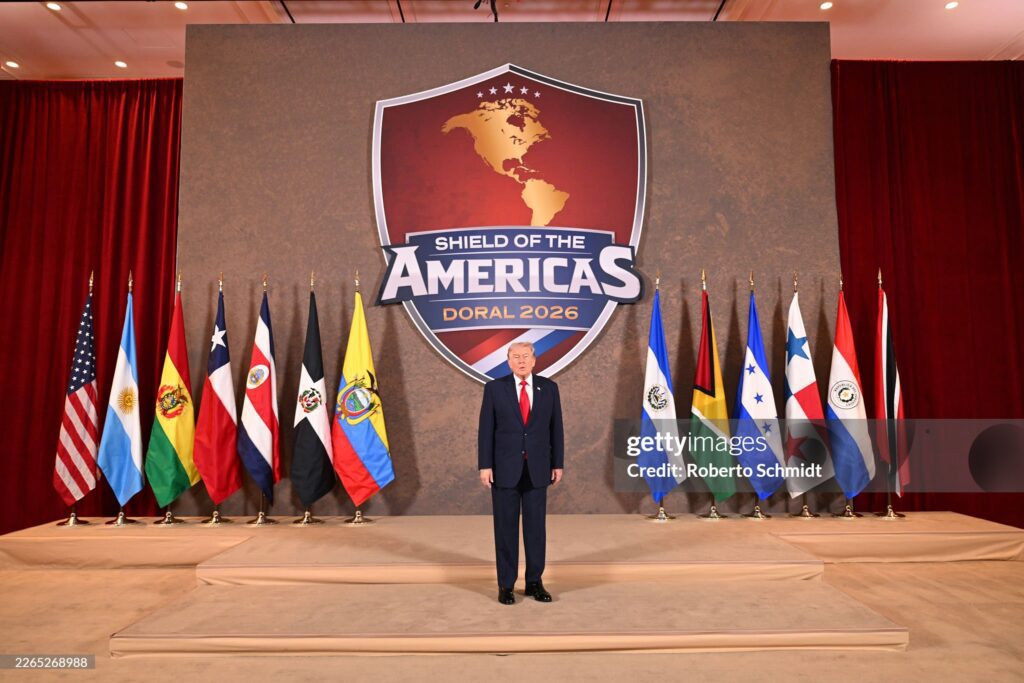
The initiative places heavy emphasis on security cooperation, intelligence sharing, and military coordination to combat drug cartels and transnational criminal networks operating across the hemisphere. The summit’s declaration focused on disrupting these networks and strengthening regional security partnerships.
Few Caribbean governments dispute the seriousness of organized crime or the need for coordinated responses to trafficking and violence. The region has long faced the spillover effects of narcotics routes, human trafficking networks, and arms flows that destabilize communities. But security alone rarely defines stability for small states.
For Caribbean economies, long-term stability depends not only on policing borders or confronting criminal organizations but also on functioning healthcare systems, reliable infrastructure, investment flows, and economic opportunity. And it is here that a gap in the emerging doctrine becomes visible.
For decades, the Caribbean has navigated relationships with multiple international partners that support different aspects of development. The United States remains the region’s largest tourism market and a vital source of remittances and foreign investment. China has emerged as a significant financier of infrastructure projects. Cuba has long provided medical cooperation that supports public health systems in several Caribbean states.
Recent geo-political pressure has encouraged some governments to distance themselves from both Beijing and Havana. Yet, replacing those relationships is not a simple exercise.
Chinese financing has played an increasingly visible role in Caribbean development. Between 2005 and 2024, Chinese investment supported major infrastructure projects across the region, including more than $6 billion in Jamaica, roughly $3 billion in Guyana, $2.28 billion in Trinidad and Tobago, and about $1 billion in Antigua and Barbuda. These investments, often tied to China’s Belt and Road Initiative, have funded highways, ports, energy infrastructure, stadiums, and telecommunications networks.
Such projects have helped address infrastructure gaps that Western lenders have often approached with extreme caution, with many viewing the Caribbean as a “wild west” and not a great place to invest.
Meanwhile, Cuban medical missions have for decades provided thousands of doctors and nurses across the Caribbean. In several smaller states, Cuban professionals staff hospitals, operate rural clinics, and deliver specialized services that local healthcare systems struggle to maintain on their own. Now the region is also being asked to terminate these missions or face Washington’s wrath as the administration tightens the economic noose on Cuba.
If regional governments are asked to reduce cooperation with these partners, the practical question becomes unavoidable: what replaces those contributions? Security partnerships can disrupt criminal networks. They cannot build and staff hospitals, finance highways, or train doctors.
If Washington seeks to counter China’s economic influence and reshape hemispheric alliances, where is the announcement of a large-scale development initiative for the Caribbean?
A dedicated U.S.-backed investment facility for infrastructure, energy transition, and climate resilience could provide a compelling economic alternative while strengthening long-term stability in the region. Small island states face mounting pressures from climate vulnerability, rising debt burdens, and limited domestic markets. Addressing these challenges requires sustained access to capital.
Without a credible development strategy, security initiatives alone may struggle to reshape the region’s economic partnerships. Ironically, the Chinese Embassy in the U.S. posted a video mocking the security alliance ‘Shield of the Americas’ on social media on the 10th.
The Caribbean’s diplomatic history has long been defined by pragmatic balance. Governments across the region have cultivated relationships with multiple global partners while seeking to preserve their sovereignty and development options.
That balancing act continues today.
Caribbean leaders understand the importance of working with Washington on security matters. The United States remains the hemisphere’s largest economic power and an indispensable partner in trade, tourism, and finance. But for the region’s small states, alliances cannot be built solely around military coordination or cartel suppression.
True stability in the Caribbean rests on broader foundations: resilient economies, functioning public institutions, and opportunities for the region’s young populations.
Great powers often compete through strategy. Small states respond through investment.
If the Donroe Doctrine is to shape a new era of hemispheric relations, Caribbean governments need to ask a simple question that extends beyond security partnerships: Where is the economic vision that accompanies the doctrine?
Because in the Caribbean, stability will ultimately be built not by missiles or patrol boats alone, but by hospitals that remain open, infrastructure that supports growth, and economies that offer people a future worth investing in and staying for.
EDITOR’S NOTE: Felicia J. Persaud is CEO of Invest Caribbean and AI Capital Exchange and founder of NewsAmericasNow.com.