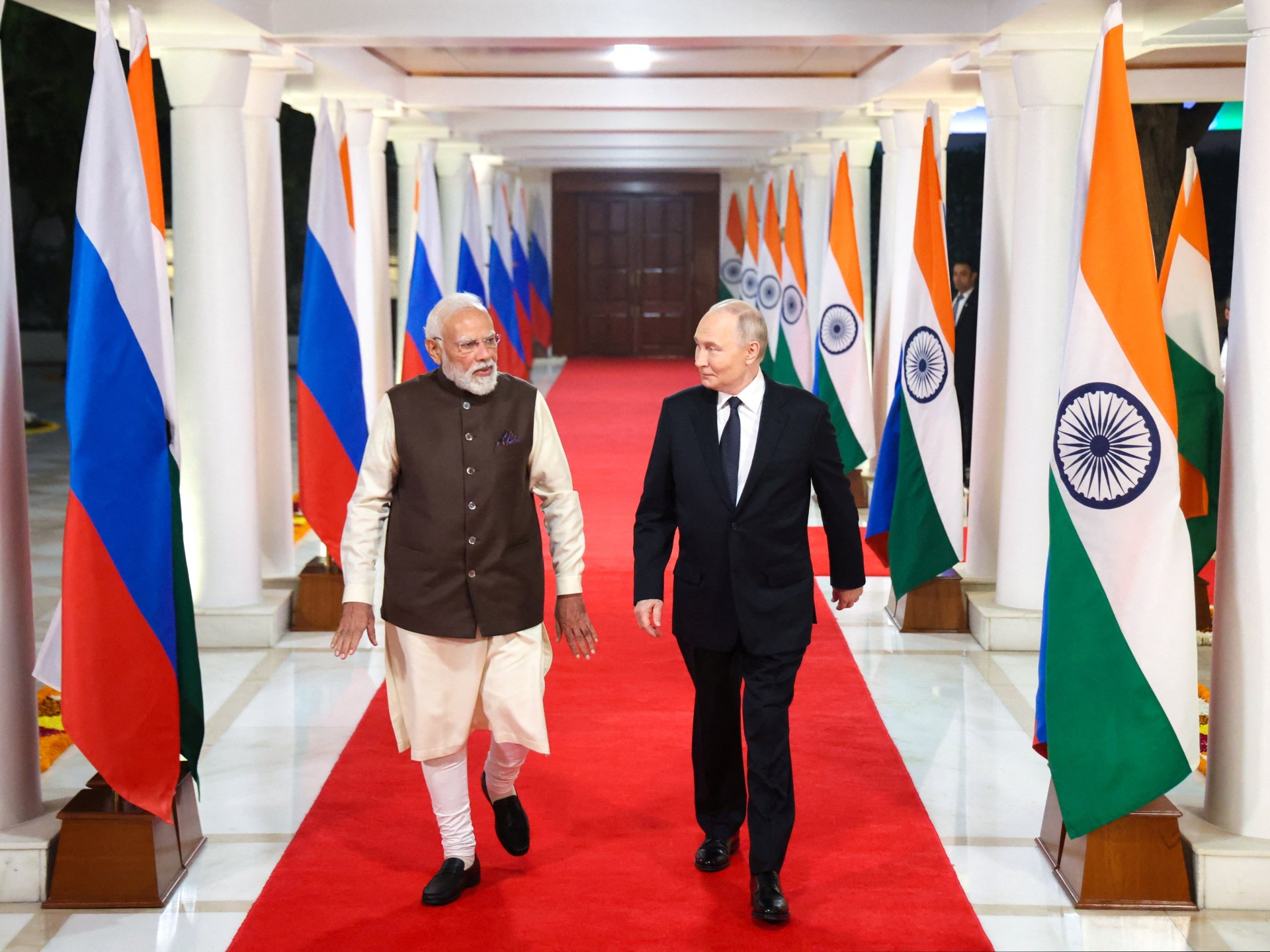

Russian President Vladimir Putin and Indian Prime Minister Narendra Modi have kicked off a daylong summit in the capital of India, where trade and Western sanctions over the war in Ukraine were set to loom large.
Friday’s summit is the first time Putin has visited India since the start of Russia’s full-fledged war on Ukraine in 2022, and comes as India is seeking a reprieve from United States sanctions related to its purchase of Russian oil.
- list 1 of 3Indian trade unions oppose new labour codes, call for demonstrations
- list 2 of 3India’s Olympic ambition in spotlight as Commonwealth Games build-up begins
- list 3 of 3Putin visits India amid Ukraine peace push: What’s on the agenda?
end of list
Moscow, in turn, is hoping to boost ties with India, already the top buyer of Russian arms. Officials have said they want to increase trade with India to $100bn by 2030 — up from an already all-time high of $68bn in 2024.
Modi gave Putin a warm welcome on Thursday, personally greeting him on the tarmac in New Delhi with a hug and a handshake. He later hosted the Russian leader for a private dinner at his residence.
Friday’s agenda included a morning visit to Rashtrapati Bhavan, the presidential palace, for a meeting with India’s ceremonial head of state, Droupadi Murmu. Putin will then travel to Raj Ghat, the memorial to Mahatma Gandhi.
Putin and Modi will then hold meetings at the Hyderabad House complex. They are scheduled to address the media before a gathering with business and trade leaders.
The Russian leader is set to depart India at 9pm local time (15:30 GMT).
Russia and India have had a strategic partnership for 25 years, stretching back to Putin’s first year in office as the country’s head of state.
However, the balancing act between maintaining ties with both the US and Russia has become more difficult in the wake of Russia’s 2022 invasion of Ukraine.
Advertisement
The Russian operation disrupted a longstanding tradition of the leaders trading annual visits. That partially resumed last year, when Modi visited Russia.
As Western countries curtailed their reliance on Russian crude oil amid the war, India ramped up its purchases.
But in August, the US doubled the 25 percent tariffs it had previously imposed on Indian goods to 50 percent, as a penalty for India’s Russian oil purchases, as Trump looked to pressure Putin into accepting a ceasefire.
India, however, continued buying Russian oil.
That is now changing: in November, Trump’s sanctions on Russian oil companies Rosneft and Lukoil went into effect, along with a threat of sanctions against companies from other countries that trade with these firms.
Purchases from the two companies account for about 60 percent of India’s oil imports.
New Delhi has said it was being unfairly targeted, noting that Western nations continue to do business with Moscow when it is in their interests. Speaking to Indian journalists in an interview before he arrived in New Delhi, Putin made a similar argument.
“The United States itself still buys nuclear fuel from us for its own nuclear power plants,” he said.
He added that if the US has the right to buy Russian fuel, India should enjoy “the same privilege”.
Putin is also expected to push India to buy more Russian weapons, another area where New Delhi has faced pressure from Washington.
Moscow has been hoping to sell India additional S-400 missile defence systems and Su-57 stealth fighter jets.
Friday’s meeting comes days after Putin met with a US delegation in Moscow, pushing for an end to the war in Ukraine. Both sides hailed progress after the meeting, but no breakthrough was reached.
On Thursday, US officials met with a Ukrainian delegation.
India has resisted condemning Russia over the war and has called for peace through dialogue and diplomacy.
Related News
At least 41 dead as heavy rain, flooding and landslides hit central Vietnam
South Africa seeks to prioritise developing world at historic G20 summit
Trump suspends immigration from ‘Third World’, orders review of green cards