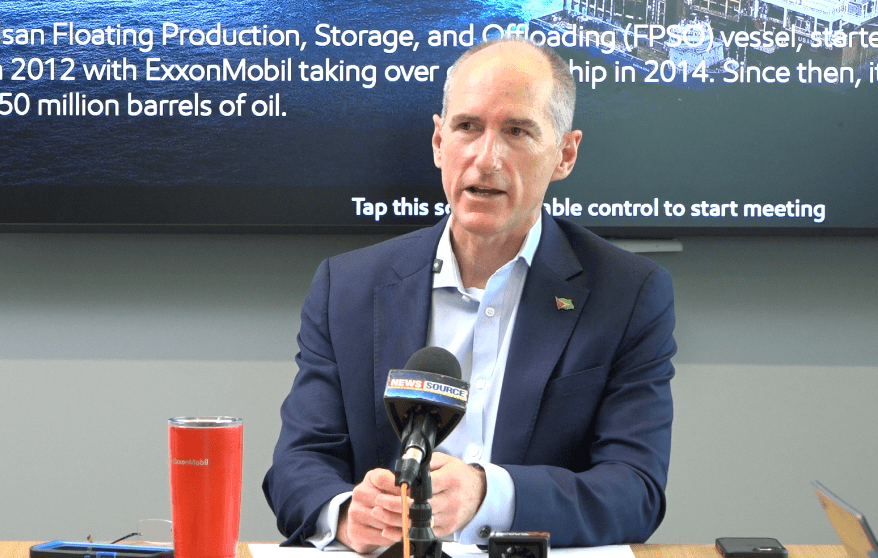


President of ExxonMobil Guyana Limited (EMGL), Alistair Routledge, says that the pipeline that will bring gas from offshore to Berbice, where a massive gas project will be built out, could cost an estimated US$2 billion – double the cost of current infrastructure already laid for the Gas-to-Energy (GtE) project since 2024.
The Guyana Government has been touting the development of a second gas project in Region Six (East Berbice–Corentyne) to support large-scale industrial growth with power plants; a data centre; and an alumina plant, among other heavy industries – an initiative that will be separate from the highly anticipated GtE project at Wales, West Bank Demerara, in Region Three (Essequibo Islands-West Demerara).
Already, some 250 kilometres of 12-inch pipelines, with the capacity of some 120 million standard cubic feet per day (mmscfd), have been installed by ExxonMobil to the tune of US$1 billion to bring the gas onshore for the 300-megawatt (MW) combined cycle power plant and natural gas liquids (NGL) facility at Wales. Routledge said that the installed pipeline is being maintained and kept ready for the start-up of the GtE Project later this year, utilising the rich gas from the Liza Fields in the Stabroek Block offshore Guyana.
According to the ExxonMobil Guyana President, the pipelines for the Berbice gas project would be much larger than the GtE infrastructure, bringing a higher quantity of gas onshore.
“As you know, it costs roughly a billion [US] dollars to lay a pipeline and put the risers in in order to supply gas from the Liza field to Wales in Region Three. To do similar for Berbice in larger volumes, a larger pipeline could easily be two billion [US] dollars or more. [It’s] not a small investment,” he told reporters during a press conference on Thursday at the company’s Ogle, East Coast Demerara, headquarters.
Routledge went on to add, “Don’t take that to the bank. That’s an order of magnitude. I’m just saying the pipeline that we would intend to build would be larger than the 12-inch for the Liza Field connection to Wales. And then you see inflation over years because that was installed in ‘24. I just want to set your expectation; it won’t be a US$1 billion pipeline. It’s going to be more than that.”
According to the ExxonMobil Guyana president, while they are yet to work out the specifications of the new pipelines, there are talks ongoing with the Surinamese Government on sharing the pipeline.
“It could be economies of scale to do that,” Routledge stated.
Guyana is keen on establishing a regional energy corridor, with President Dr Irfaan Ali declaring at the opening of the Guyana Energy Conference and Supply Chain Expo just last month that his Government is eager to partner with Suriname on developing the two neighbouring countries’ natural gas resources.
According to the head of state, Guyana is looking for “like-minded partners” as he directly appealed to Suriname to join Guyana in scaling up the second gas project planned for the Berbice region, which borders the Dutch-speaking nation.
In fact, Suriname’s Oil, Gas and Environment Minister Patrick Brunings, who had attended the Energy Conference in Georgetown, had acknowledged and highlighted the scope for potential collaboration in advancing the region’s energy transition.
Despite the projected increase in the pipeline costs for the Berbice gas project, ExxonMobil is confident in undertaking this significant investment in the infrastructure given the growing interests, especially from international companies, in Guyana’s energy potential.
“There is a significant amount of interest from other companies around the world in investing in Guyana. And to date, several letters of interest have been submitted to the Government and us indicating interest in projects such as data centres converting bauxite to alumina and more power generation. So, we can see real interest in building a domestic gas market…”
“In order to be comfortable that we move forward, we have to know that there’s a market for the gas that will pay for the gas at a price that can sustain that kind of investment. So, that’s why it’s so important that we work with these other companies that are interested in making these other investments in the country so that we can line out that commercial value chain. They’ll be looking to us to have surety of supply of gas, and we’ll be looking to them to make sure that they’re going to be ready to take the gas from us. So that’s what we’re working towards,” Routledge indicated.
Currently, ExxonMobil is operating four developments in the Stabroek Block offshore Guyana – Liza Phases One and Two, Payara, and Yellowtail, with its fifth project – Uaru – on schedule to come onstream in 2026; and the sixth – Whiptail – slated for start-up in 2027. All of these projects produce what has been described as “black crude”.
However, the seventh project – Hammerhead, slated for 2029 – and the eighth development – Longtail, expected in 2030 – are pegged as major gas development projects.
As part of its aggressive energy agenda and efforts to monetise the country’s natural gas resources, the Guyana Government has selected United States energy firm Fulcrum LNG Inc to work in a tripartite arrangement with ExxonMobil to develop the Berbice gas project.
Subscribe to get the latest posts sent to your email.