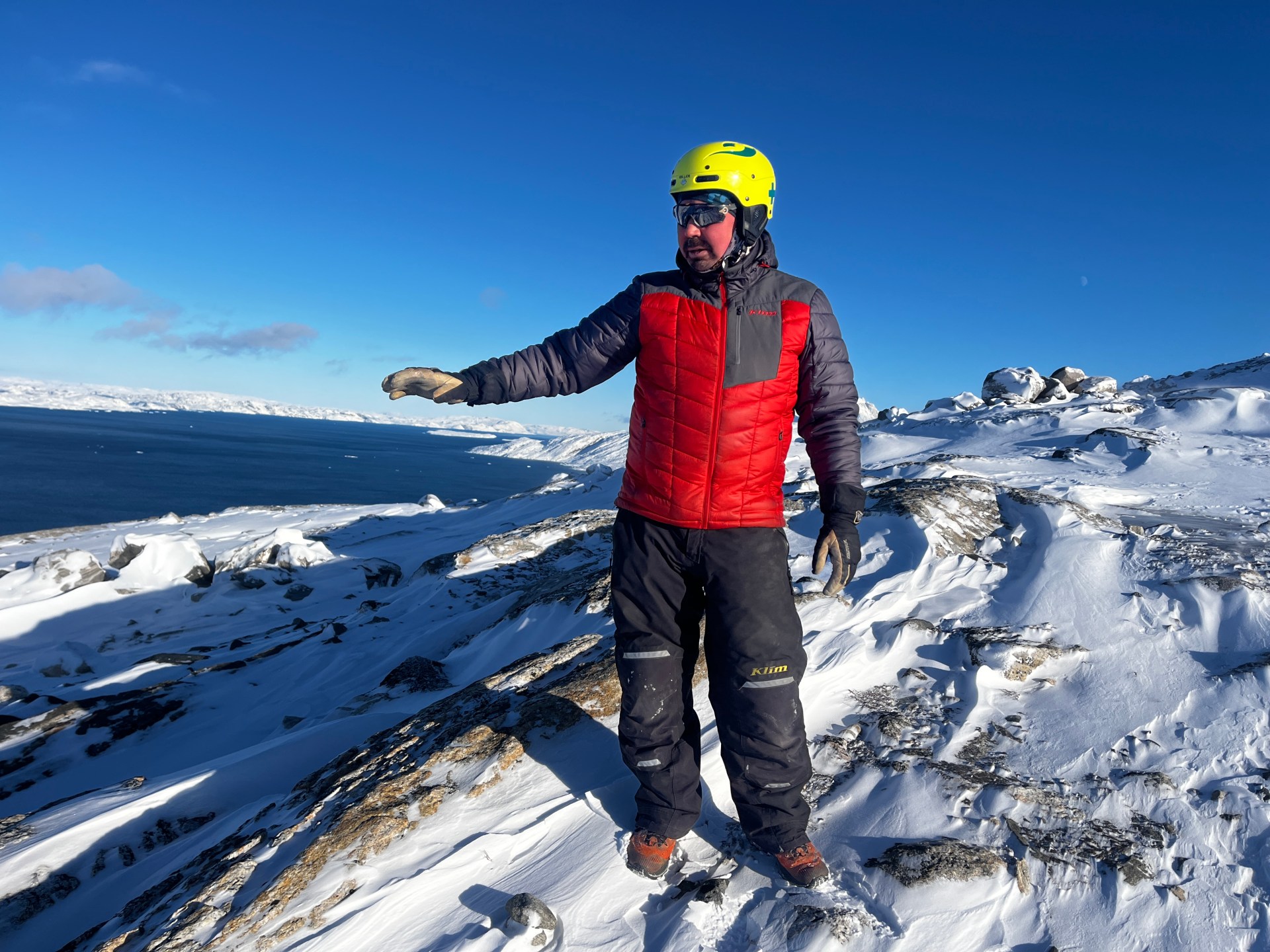

Nuuk, Greenland – The snowmobile climbs fast alongside the cables of the ski lift. But the lift itself is not running.
Suddenly, the driver and manager of the ski lift, Qulu Heilmann, stops and walks over to the bare rocks on the mountain outside Nuuk, the Greenlandic capital.
“You can see it – there should be snow here. People should be skiing here,” he said, pointing at the rocky slope close to the city’s airport.
He has worked here for 25 years.
But this year, he experienced something unusual. The lift and slopes never opened. There simply has not been enough snow.
“I have never seen anything like it. It has never happened before,” he said.
Greenland’s warmest January
The stalled ski season comes after Greenland’s west coast recorded its warmest January ever, according to the Danish Meteorological Institute (DMI).
The DMI said the average temperature in Nuuk in January was 0.1 degrees Celsius (32.2 degrees Fahrenheit), a new record. That is 7.8C (14F) warmer than the January normal for 1991-2020. The highest temperature in Nuuk this January was 11.3C (52.3F).
A normal January day in Nuuk is often around minus 11C – not plus 11C.
The same pattern ran along more than 2,000km (1,240 miles) of the west coast as multiple towns posted unusually high monthly averages.
Caroline Drost Jensen, a DMI climatologist, told Al Jazeera that while mild winter spells happen in Greenland, what stood out this year was the sheer number of records.
“I have to say, I was taken aback,” she said. “I have never seen so many records at once. It was really striking, … very, very eye-catching.”

Drost Jensen said a jet stream steering mild air north towards Greenland was the immediate driver behind the warm January.
Advertisement
But she added that a generally warmer baseline – from human-driven climate change – can push temperatures higher on top of those weather patterns.
Malene Jensen, who lives in central Nuuk, said she has noticed the change.
“It’s been a weird winter,” she said.
Arctic warming faster
Scientists have long warned that the Arctic does not warm at the same pace as the rest of the planet.
Research in recent years has described Arctic warming at roughly three to four times higher than the global average, driven by feedbacks such as the loss of reflective snow and sea ice, which exposes darker ocean and land that absorb more heat.
At the closed ski slope, Heilmann has noticed the warming in the Greenlandic capital over the past couple of decades. He decided to apply to the local government for artificial snowmaking equipment.
“We never actually thought it would be necessary. But now it is our biggest wish. It’s necessary if we want to keep the ski lift open in the shoulder season. And this year it might have given us many ski days,” Heilmann said.
Normally, the season opens in December and ends in April. For a small ski hill that depends on natural snowfall and has no artificial snowmaking system, a winter like this is devastating.
“We are missing a metre at least,” Heilmann says, standing on bare rocks halfway up the small mountain.
‘This year has been frightening’
The climate story also feeds into politics because less ice changes access over time.
A longer ice-free season can make Arctic sea routes more usable and widen the window for activity on land, including exploration linked to strategic minerals, such as rare earths.
That longer-term shift is part of why Greenland has been getting more attention from Washington.
United States President Donald Trump has been pressing for US control of Greenland, repeatedly saying he wants the island to become US territory.
Ulrik Pram Gad, a senior researcher at the Danish Institute for International Studies, said the melting ice does not create “immediate worries” in Washington but does change the long-term map.
He said that in “two, three, four decades”, there may be “basically no polar sea ice left”, opening “a new maritime domain” the US will want to monitor.
Back on Nuuk’s hill, Heilmann is not talking about maritime domains. He is talking about whether enough snow arrives at all.
Lately, the cold seems to have returned to Greenland. But there is still no snow in sight.
As he turned the snowmobile back towards the base station, Heilmann returned to a question many people in Greenland are asking.
Advertisement
“This year has been frightening. If we look to the future – how will it look in, let’s say, 20 or 30 years?”
Related News

Iran’s authorities showcase continuity as they back new leader during war
Are the US and Iran moving closer to war?

Kenya arrests suspect in duping men to fight for Russia in Ukraine war