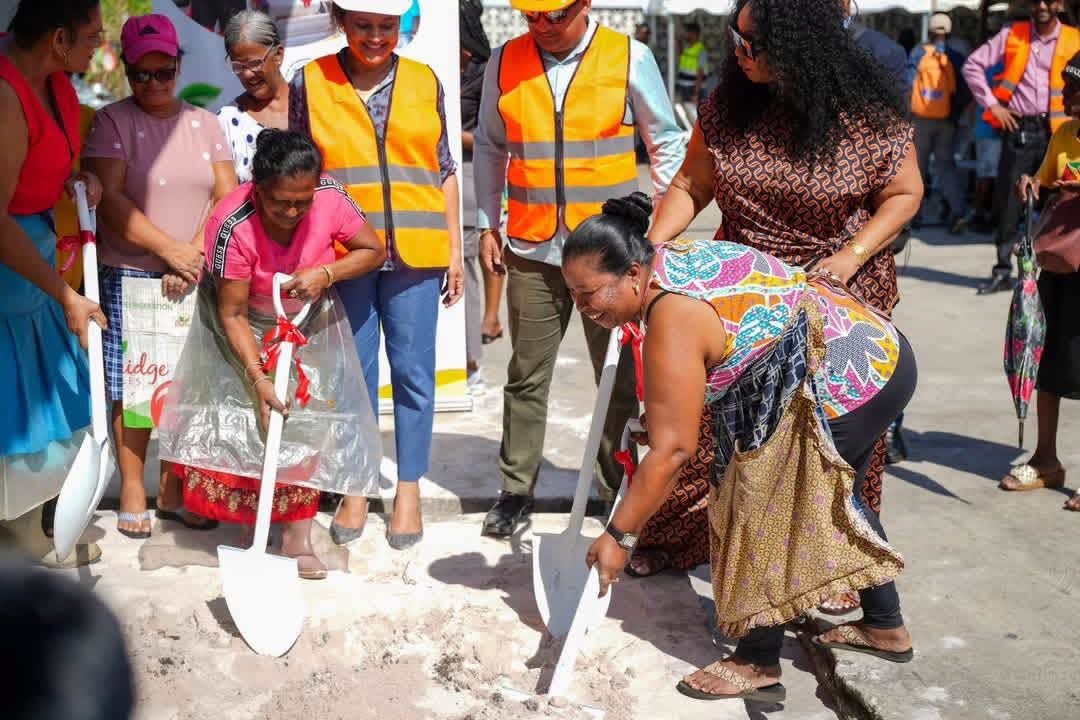


The sod was turned on Friday for the $1.029 billion reconstruction of the historic New Amsterdam Market, which dates back to approximately 1868, with the new facility expected to be completed in about 20 months.
Minister of Local Government and Regional Development Priya Manickchand performed the ceremonial sod-turning for the project in New Amsterdam, Region Six (East Berbice-Corentyne).
The project will be executed in phases and will include three market buildings, an open vending area, parking, improved drainage and other external works.

Approximately 323 vendors currently operate within and around the market, and officials say the phased construction was designed to minimise disruption and ensure that those who depend on vending for their livelihoods can continue earning while the facility is rebuilt.
The $1 billion project has been divided into four lots. Singh & Son Construction was awarded Lot One for $334.4 million; Emerald’s General Contracting & Distributors, Lot Two for $2584 million; A. A Construction, Lot Three for $278 million; and Engineered Construction Company, Lot Four for $159 million.
Origin Investments Inc. is the consultant for the project.
The reconstructed market will have more than 190 permanent stalls as well as a 6,230-square-foot open vending area. It will feature designated sections for dry goods and services, vegetables, meat and other commodities, along with a dedicated food court, male and female washrooms, administrative space, a service/goods lift and accessibility provisions.
The meat section is to have 33 stalls, separated according to the type of meat being sold, while another building will accommodate 106 vegetable stalls and six dry-goods stalls.
Parking, external walkways, improved drainage and facilities catering for persons with disabilities are also included in the design.
An engineer attached to the project explained that construction will proceed in stages to avoid shutting down the entire market.
Under the first phase, a building at the rear of the compound will be demolished, and affected vendors temporarily relocated. That section will subsequently accommodate the meat vendors and the open vending area, after which vendors occupying other sections can be shifted as construction progresses.

The individual buildings are expected to take approximately 13 to 15 months to complete, while the entire project, including the external works, is projected to be completed within about 20 months.
Manickchand told vendors that the intention was not simply to construct a facility for those presently trading inside the market, but to create sufficient space to bring those operating outside into an organised market environment.
“We didn’t come in here and build a market for the people in the market. We came in here, and we’re building a market that could accommodate everybody who is currently in the market and out of the market,” she said.
However, vendors used the ceremony to raise concerns about conditions they say are affecting their ability to compete, including persons vending immediately outside the municipal market and businesses operating in close proximity to the facility.
They complained that persons selling similar goods along the roadway were competing with established vendors who pay to operate within the market.
Vendors also raised concerns about what they said are town bylaws governing vending and certain commercial activities in close proximity to the municipal market.
Responding to concerns about businesses operating on privately owned properties, Manickchand sought to distinguish those operations from activities authorised by the Government.
“The government didn’t give the Chinese any land. It’s people renting their private properties or selling it from private individuals. And that’s not something you can stop,” she told the gathering.
However, Manickchand said the reconstruction would provide sufficient space for the authorities to address the separate issue of roadside vending. She said it would be unfair for vendors operating inside the market to pay fees and comply with market requirements while others were allowed to sell outside without being subjected to the same arrangements.
“Once the market is built, people have to come into the market,” Manickchand said.
She said the Government already has a register, obtained from the Mayor and Town Council, identifying the existing vendors, and warned that persons would not be able to suddenly establish roadside operations in an attempt to secure space in the reconstructed facility.
Once the new market is available, she said, those vending along the roadside would be required to move inside.
Subscribe to get the latest posts sent to your email.