‘Like Eid’: Bangladeshis hail landmark election, many vote after 17 years
 12 February 2026
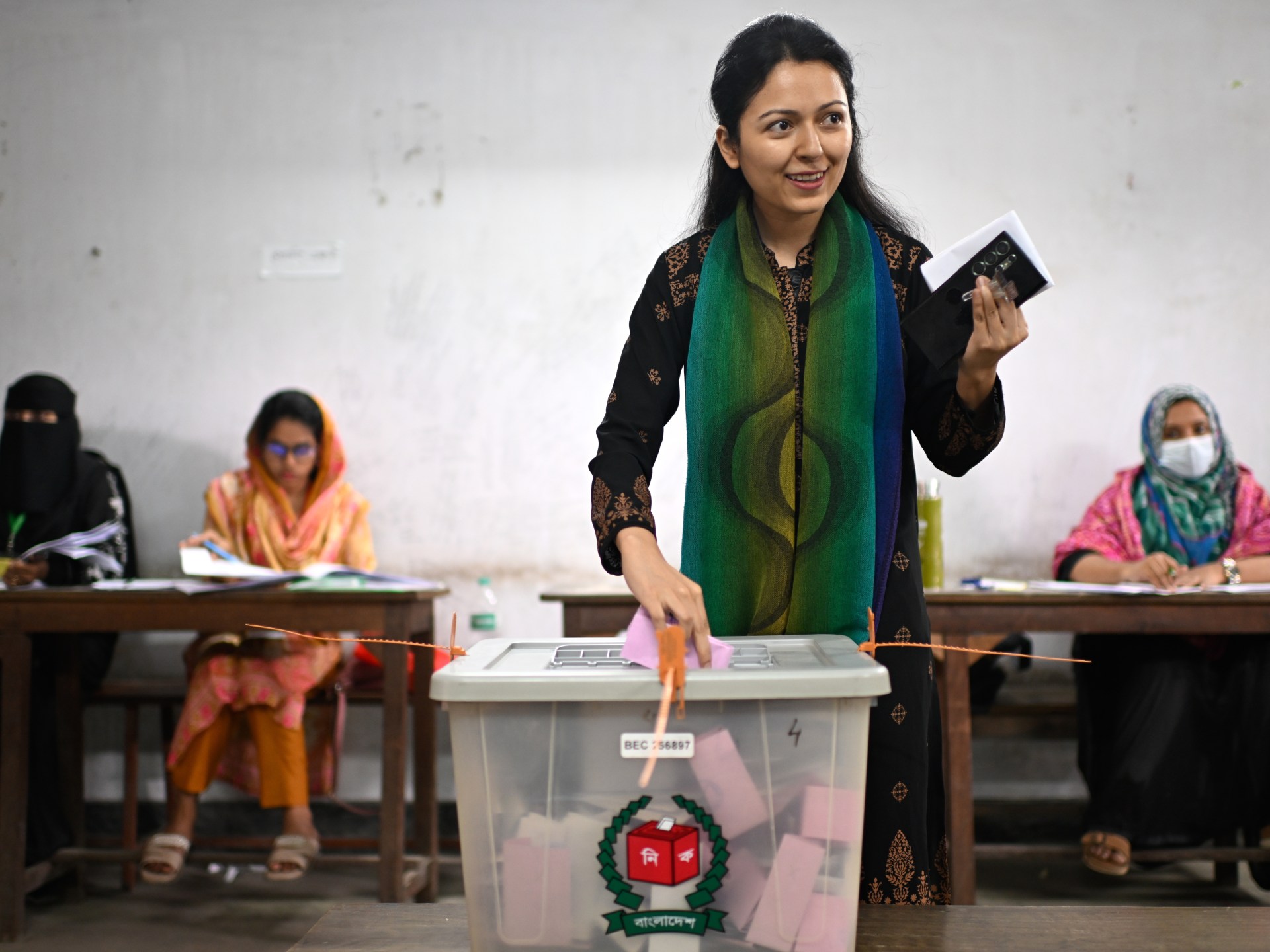

Dhaka, Bangladesh – Standing in a long queue at a government school in the capital Dhaka, Hasan Hoque, a former teacher, laughs and chats with a group of men who just arrived to cast their ballots.
“It’s been a while standing in this line, but nothing matches the feeling of casting my own vote. It feels like a festival,” Hoque told Al Jazeera, smiling.
- list 1 of 4Polls close in Bangladesh in crucial first election since deadly uprising
- list 2 of 4Follow the vote: Bangladesh election live results 2026
- list 3 of 4Photos: Bangladeshis turn out for historic election after Hasina’s downfall
- list 4 of 4Bangladesh’s vote for dignity
end of list
The last time he voted was in 2008 – the year former Prime Minister Sheikh Hasina returned to power and allegedly rigged subsequent elections until her autocratic 15-year regime was challenged by a student-led uprising in 2024, toppling her government and forcing her into exile in India.
“The elections we had after 2008 were farcical and one-sided under Awami League,” Hoque said, referring to Hasina’s political party, which was barred from elections after the uprising. “They would cast our votes themselves, so we were not even needed at the polling centres in those years.”
That changed on Thursday as Bangladesh held its first parliamentary election since the 2024 uprising, with the country of 173 million people seeking a return to democracy after years of turmoil.
Alongside choosing a new parliament, people also voted in a referendum to endorse the so-called “July Charter”, a document born out of the 2024 uprising that proposes sweeping constitutional reforms in order to save the country from future authoritarian rule.
‘Eid-like atmosphere’
Like Hoque, Jainab Lutfun Naher had also returned to the polling booth after 17 years.
Advertisement
“I was pregnant with my daughter in 2008. Today I voted again, and my daughter is now 17,” the voter from Dhaka’s Gulshan area told Al Jazeera. “It feels absolutely great to vote.”
Naher said the day felt emotional and empowering – and allowed her hope. “I want this country to prosper,” she said. “I want it to be democratic, where everyone has rights and freedoms.”
The people’s hopes are pinned on two alliances that were in the fray in Thursday’s vote – the Bangladesh Nationalist Party (BNP), led by Tarique Rahman, and the Jamaat-e-Islami-led coalition of 11 parties, which includes the National Citizen Party (NCP), founded by the youth activists who ousted Hasina.
Voting took place in 299 of 300 constituencies, with polling in one seat cancelled following the death of a candidate. The Election Commission declared a turnout of around 48 percent up until 2pm local time (08:00 GMT). A finally tally of the turnout is awaited.
Polls closed at 4.30pm (10:30 GMT) on Thursday and official results are expected early Friday morning.

Across polling stations in Dhaka, home to 20 parliamentary constituencies, a similar picture emerged: long queues snaking outside school gates and community centres that were turned into polling centres.
At one such school, first-time voter Nazmun Nahar said she “was so excited I could hardly sleep last night”.
“It felt like Eid,” she told Al Jazeera, referring to the Muslim religious festival and expressing a sentiment also shared by Chief Election Commissioner AMM Nasir Uddin, who told reporters that people were voting in an exuberant “Eid-like atmosphere”.
Reports from elsewhere in the country suggested a similarly festive mood, as the government declared a three-day holiday for the election and millions of voters travelled to their hometowns – many on train rooftops – to cast their vote.
Abdur Rahman, a voter in northern Bangladesh who travelled on one such crowded train, said almost everyone he knew — from neighbours to extended family — had returned home to cast their ballots.
“We were robbed of the joy of voting for so long,” Rahman said. “None of us wanted to miss this opportunity.”
‘Birthday of a new Bangladesh’
After casting his vote at Gulshan Model High School and College in Dhaka, BNP chairman Tarique Rahman, who is a frontrunner for the post of prime minister, said that if he comes to power, he will “prioritise improving law and order in the country so that people feel secure”.
“I am confident of winning the election,” Tarique Rahman told reporters.
Advertisement
Muhammad Yunus, the head of the interim government formed after the 2024 uprising, cast his ballot at the same centre.
“Today is the birthday of a new Bangladesh,” he said. “Through today’s process, people have rejected the past. From today, at every step, we have gained the opportunity to build a new Bangladesh.”
Shafiqur Rahman, leader of the Jamaat-e-Islami party, cast his vote at another polling centre in Dhaka.
“Through this vote, we hope a government will be formed that does not belong to any individual, family or party, but to the [millions] of people of this country,” he told reporters, calling the election a “turning point” for Bangladesh.
Analysts said that while there were scattered allegations of poll malpractices, the election process had largely been peaceful.
Asif Mohammad Shahan, professor of development studies at Dhaka University, told Al Jazeera the election did not see “reports of major irregularities”.
“Some isolated incidents have occurred, which are of course unwanted, but every election in Bangladesh has had some irregularities. Unless those are serious enough to change the overall result, they do not cross a critical threshold,” he said.
Political analyst Dilara Choudhury said a relatively peaceful election is a first step in Bangladesh’s long transition towards democratic normalcy. “Minimal violence in the election is good,” she told Al Jazeera.
“If both parties accept the results, it would be a first step for Bangladesh towards a new kind of politics or democratic transition,” she added.
But Choudhury cautioned that an election “does not mean a full transition to democracy”, arguing that the next phases would depend on whether governing and opposition forces jointly pursue reforms outlined in the July Charter and institutionalise them – including commitments to accountability, rule of law, and good governance.
Meanwhile, Mazeda Begum, a voter at Dhaka’s Civil Aviation School and College polling centre, said she hopes the new government — whoever forms it — will work for the country’s progress, particularly in education and economy.
“There are many problems in our education system and in the education of our children,” she said. “We also face economic difficulties in our daily lives. I hope the new government will work for us.”
At another polling centre in Dhaka’s Agargaon area, Nurul Amin had come to vote with deep expectations.
“I have come to vote after many years,” he told Al Jazeera. “This country needs to move forward, and the next government should fix our problems.”
Related News
Virginia’s Law: How Democrat proposal could spark flood of sex abuse claims
Myanmar election delivers walkover win for military-backed political party
Fela Kuti becomes first African to get Grammys Lifetime Achievement Award