
Some of the fastest meteors in the night sky return this week, as the Leonid meteor shower peaks on the night between November 17 and 18.
Racing at about 71km (44 miles) per second, they burn up as bright streaks, sometimes leaving glowing trails that hang in the sky for seconds.
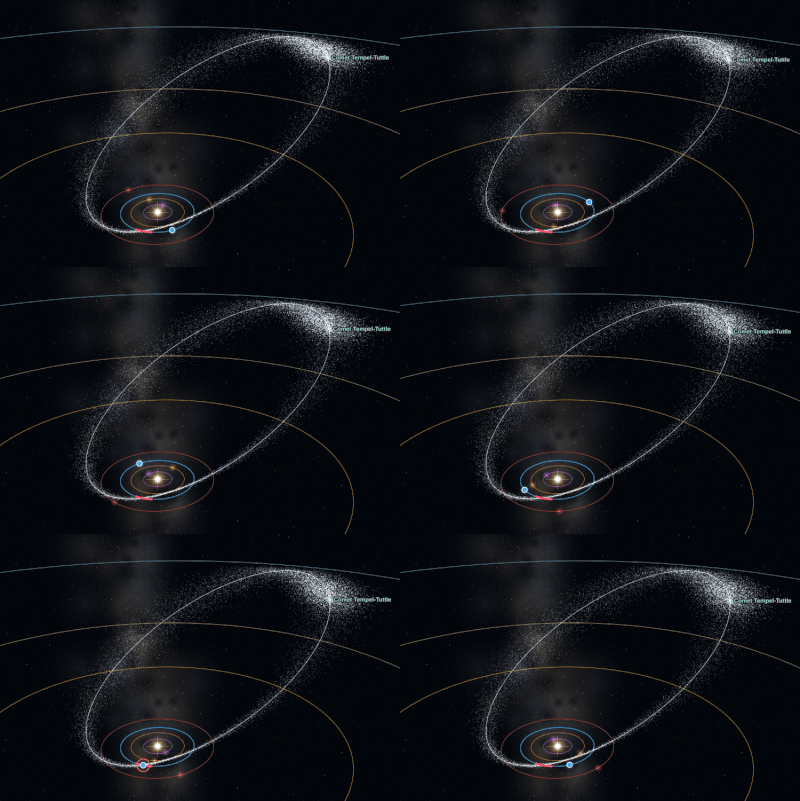
In this visual explainer, see how the shower forms as Earth crosses a comet’s dust trail, then search for your city to find the best viewing time.
What is a meteor shower?
A meteor shower happens when dozens, or sometimes hundreds, of “shooting stars” streak across the night sky. In reality, they are not stars, but tiny bits of space debris burning up in Earth’s atmosphere.
Most of this debris comes from comets, which are icy bodies that orbit the sun and shed dust as they get closer to it. When Earth’s orbit crosses one of these dust trails, the particles, called meteoroids, hit the atmosphere at high speed and heat up. They glow as meteors and usually burn up long before reaching the ground.
The Leonids come from Comet Tempel-Tuttle, whose dust trail Earth passes through every November. Drag the slider below to follow Earth through 2026 and see when it meets the stream.
What makes the Leonid meteor shower special?
The Leonids are named after the constellation Leo, the point in the sky from which they appear to come. They are known for fireballs, which are unusually bright meteors from larger bits of debris. They also produce Earth-grazers, meteors that skim the upper atmosphere at a shallow angle and leave long trails near the horizon.
Advertisement
What really sets them apart is their storms. Comet Tempel-Tuttle passes close to the sun about every 33 years and leaves debris behind. When that happens, the shower can produce a storm of at least 1,000 meteors an hour.
The 1833 storm over North America helped scientists work out where meteors come from. In 1966, thousands of meteors fell every minute for about 15 minutes. The most recent storms came in 1999, 2001 and 2002, and the comet next swings close to the sun in 2031.

Where in the sky should you look?
The Leonids can appear in any part of the sky, so the best approach is to find a dark spot with a wide view, lie back and take in as much sky as you can.
If you trace their paths backwards, the meteors all seem to streak out from a single point known as the radiant. This is an effect of perspective: the debris travels along roughly parallel paths, but the meteors appear to spread out from one point, much like railway tracks seem to meet in the distance.
For the Leonids, the radiant lies in the constellation Leo, which rises in the east around midnight.

When and how to watch from where you live
According to the International Meteor Organization (IMO), the Leonids are active from November 6 to 30 and are expected to peak on the night between November 17 and 18, around 23:45 GMT on Tuesday. Under clear, dark skies, the IMO expects up to about 15 meteors an hour at the peak.
The best time to watch is between midnight and dawn, as Leo climbs higher in the sky. The moon, which will be about half full on the peak night, sets around midnight in many places, leaving darker skies for the rest of the night.
Find a spot away from city lights and give your eyes about 20 minutes to adjust to the dark.
Use the widget below to find the best viewing times in your city.
Can you see the Leonid meteor shower from both hemispheres?
Yes. The Leonids are visible from the Northern Hemisphere and the Southern Hemisphere, but conditions are generally better in the north, where Leo climbs higher in the sky. South of the equator, the best chance is in the hour or two before dawn.
Will the moon affect the Leonid meteor shower in 2026?
Only slightly. The moon reaches its first quarter on November 17 and sets around midnight, so it should not interfere much during the best viewing hours.
How do the Leonids compare with other meteor showers?
The Leonids are far from the busiest shower. Under ideal conditions, the IMO puts their peak rate at about 15 meteors an hour, compared with about 100 for the Perseids in August and about 150 for the Geminids in December. What they lack in numbers, they make up for in speed and their history of storms.

Related News

Ukrainian strikes kill three in Russia’s Belgorod region

Thousands rally in New Delhi to demand India’s election chief resign

France tightens security in anticipation of weekend protests