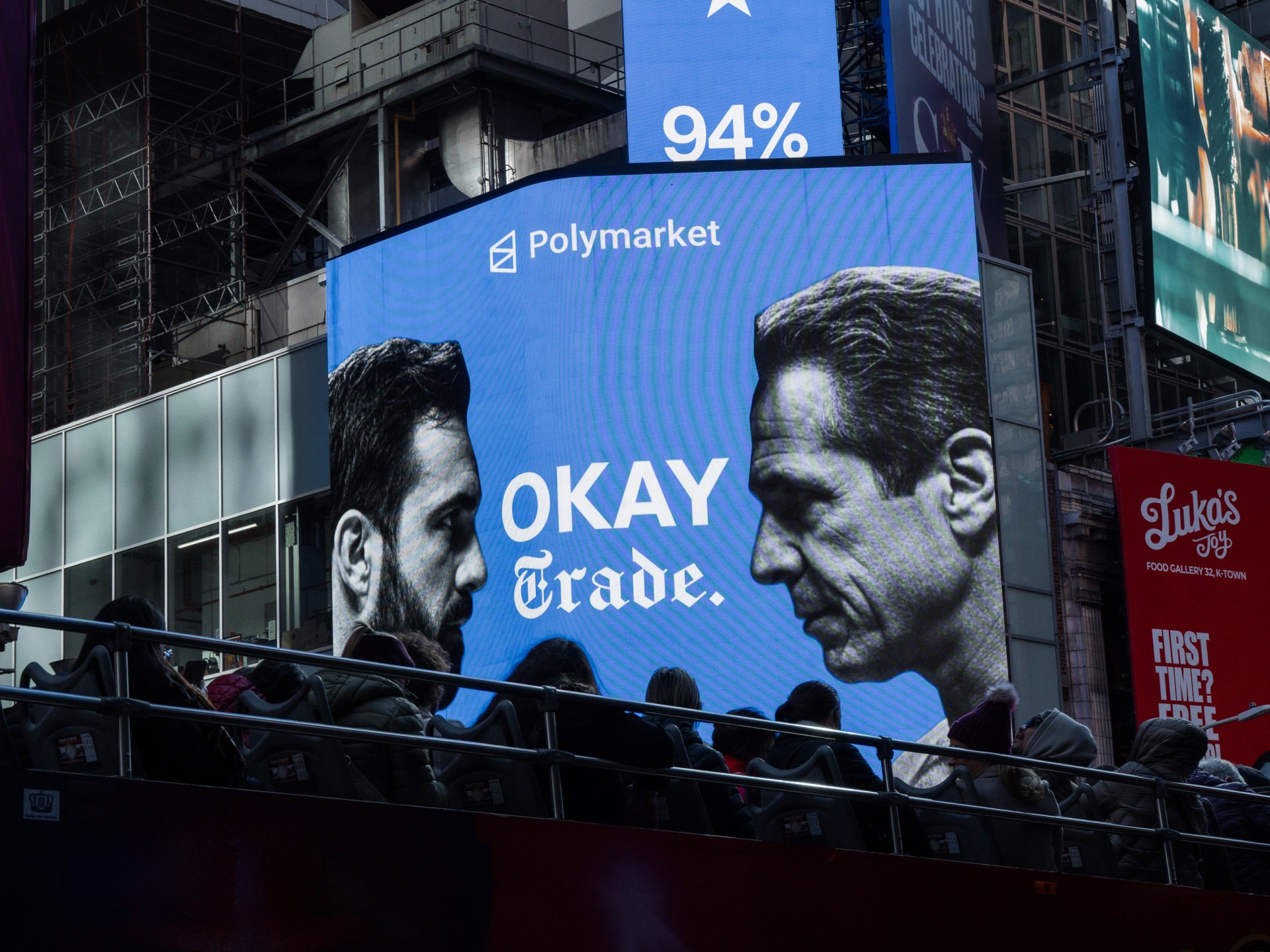

From cryptocurrency-based online platforms to oil futures and the United States S&P 500 stock benchmark, traders have made bets worth hundreds of millions of dollars since the start of the US-Israeli war on Iran with suspiciously well-timed trades that suggest knowledge of key White House decision-making.
One of the most well-documented examples has been Polymarket, a platform that lets users anonymously bet on event outcomes from sports tournaments to ceasefires without uploading an identity document.
- list 1 of 4From Pakistan to Egypt, Iran war drives up prices in Global South
- list 2 of 4Amid US-Israeli attacks, people in Iran struggle to survive ailing economy
- list 3 of 4US-Israel war on Iran: What’s happening on day 26 of attacks?
- list 4 of 4Iran’s new security boss Mohammad Zolghadr: Why his appointment matters
end of list
Polymarket gained mainstream popularity during the 2024 US presidential election, but it has become synonymous with suspected insider trading since January after well-timed bets on US plans to abduct Venezuelan President Nicolas Maduro, followed by the start of the war on Iran two months later.
Researchers have tracked dozens of examples of anonymous new accounts betting big but also correctly just before a critical event like the February 28 US-Israeli strikes that began the Iran war.
As of Wednesday, there were 355 live prediction markets on Polymarket linked to outcomes in the war, such as the identity of the next leader of Iran, the date of a US-Iran nuclear deal and when Iran will launch military action against Israel.
The independent on-chain analyst known as Andrew 10 GWEI told Al Jazeera one of the most “striking” recent examples of suspicious betting was his discovery of 38 accounts that he believes belong to one person and netted more than $2m betting correctly on the February 28 strikes.
Advertisement
Each of the accounts placed from four to 10 bets with a nearly 100 percent success rate, according to research Andrew shared on X. Also noteworthy was the fact that the user began preparing accounts with cryptocurrency transfers on February 22 before bets were placed on February 27 between 11:00 and 12:00 GMT on the chance of a February 28 strike.
Red flags
While successful Polymarket bets could be based on everything from open-source intelligence to simple beginners’ luck, researchers look for several red flags that suggest suspicious betting.
They include practices like “wallet splitting”, or dividing up bets among a series of accounts to avoid detection, or opening multiple wallets to place a new bet, said Ben Yorke, a former research analyst at Cointelegraph Consulting and founder of Starchild, a platform that lets users develop personal artificial intelligence agents.
“The most important aspect of a suspicious wallet would be a wallet with no history before,” Yorke told Al Jazeera. “An average user of Polymarket will have a long history, but if you’re doing insider trading, you wouldn’t want that link, so you would create a fresh wallet.”
A more recent case was identified this week on the X account Polymarket History, which found a group of newly created Polymarket accounts had bet $2m on the same three predictions: There is no Iran ceasefire by March 31, no entry of US forces into Iran by March 31 and US forces enter Iran by April 30.
Fintech platforms have not been the only source of suspicious betting over the past week as a series of well-timed Wall Street trades have also raised eyebrows and questions of possible insider trading.
The recent round of questionable trades all occurred early on Monday before the markets opened in the US and Trump announced on his Truth Social platform at 7:04am (11:04 GMT) that he was going to delay threatened attacks on Iranian energy infrastructure after “VERY GOOD AND PRODUCTIVE CONVERSATIONS” with Tehran.
In the 15 minutes before the announcement, trading spiked as 6,200 Brent crude and West Texas intermediate oil contracts with a notational value of $580m were exchanged, according to Bloomberg data.
The price of oil has fluctuated wildly since the start of the Iran war as it has responded to the conflict’s twists and turns. Iran’s closure of the Strait of Hormuz, a chokepoint for Middle Eastern oil and gas exports, has put additional pressure on prices.
After Trump’s news on Monday, the price of Brent crude oil fell sharply from $112 a barrel to about $99 while West Texas intermediate fell from about $99 to $86, netting a small fortune for anyone who bet big on a price drop.
Advertisement
At the same time, pretrading volume on the S&P 500 e-Mini, which trades on the future performance of the S&P 500, surged about 6:50 am (10:50 GMT) on the Chicago Mercantile Exchange.
As an index of the 500 largest publicly traded companies in the US, the S&P 500 is regarded as a bellwether for the US economy and often responds to major news events, including Trump’s announcement.
Unusual Whales, a platform that tracks unusual activity from large or influential investors known as “whales”, reported that one trade involved buying S&P 500 futures with a notational value of $1.5bn and selling oil futures with a value of $192m.
“These orders were 4-6x larger than anything else at the time. The trader seemingly made huge gains,” Unusual Whales wrote in a post on X.
Spikes were also seen on other futures markets like the DAX Index Futures and Euro Stoxx 50 Index and across the Nasdaq and Russell 2000 Indexes, according to Bloomberg.
Observers said this kind of activity was highly unusual because it happened before the market opened on Monday and on a day without an anticipated news hook, such as the release of critical US economic data or a company earnings call.
Independent commodities trader Peter Brandt told Al Jazeera that he found the timing of the trades suspicious among other large, recent “market-shaking announcements”.
“I’ve traded long enough [five decades] to know, where there is smoke, there is usually fire,” Brandt said, adding that the trades were nevertheless legal because there is no law in the US against “this type of insider trading” of futures contracts for oil and the S&P 500.
US economist and Nobel laureate Paul Krugman took a much harsher view, writing on Substack that there was an “obvious explanation” to Monday’s otherwise “baffling” trades.
“Somebody close to Trump knew what he was about to do, and exploited that inside information to make huge, instant profits,” he wrote, arguing that it amounted to more than simple insider trading.
“We have another word for situations in which people with access to confidential information regarding national security – such as plans to bomb or not to bomb another country – exploit that information for profit. That word is ‘treason’,” he wrote.
The White House did not immediately respond to Al Jazeera’s request for comment, but a White House spokesperson told the Financial Times this week that it does not “tolerate any administration official illegally profiteering off of insider knowledge” and accusations of insider trading were “baseless and irresponsible reporting”.
‘Insider trading’
Amid the growing scrutiny of recent trades on Iran-based news, members of the Democratic Party have called for more regulation of prediction sites like Polymarket.
Democratic Senator Chris Murphy, who has accused officials in Trump’s Republican administration of “insider trading” on Iran war news, last week introduced the Banning Event Trading on Sensitive Operations and Federal Functions (BETS OFF) Act in Congress.
Advertisement
The BETS OFF Act would prohibit platforms like Polymarket and its competitor Kalshi from allowing bets on “government actions, terrorism, war, assassination, and events where an individual knows or controls the outcome”.
In the short term, both Polymarket and Kalshi moved to address questions of insider trading this week.
Polymarket said on Monday that it had updated its rules to clarify that trading on stolen confidential information, illegal tips or by someone who could influence an outcome was prohibited as insider trading.
Kalshi, which unlike Polymarket requires users to submit identification, said it was launching “new technological guardrails that pre-emptively block politicians, athletes, and other relevant people from trading in certain politics and sports markets”.
Neither company immediately responded to Al Jazeera’s request for comment.
Critics like Democratic Representative Alexandria Ocasio-Cortez said on Tuesday that the changes are not enough.
“Just on the policy piece alone, there are SO many individuals – staff, advisers , consultants, cabinet secretaries, spouses, and more – that can trade on insider information. This is just a fig leaf to deflect from criticism. We need to do more,” she tweeted.
Related News
Force majeure: What is it and why have some Gulf countries invoked it?

Iran attacks cut 17% of Qatar’s LNG capacity for up to 5 years: QatarEnergy
ICE agents deployed to US airports: Which airports are affected?