Guyana highlights key cross-border infrastructure projects for South Korean investment
 02 December 2025
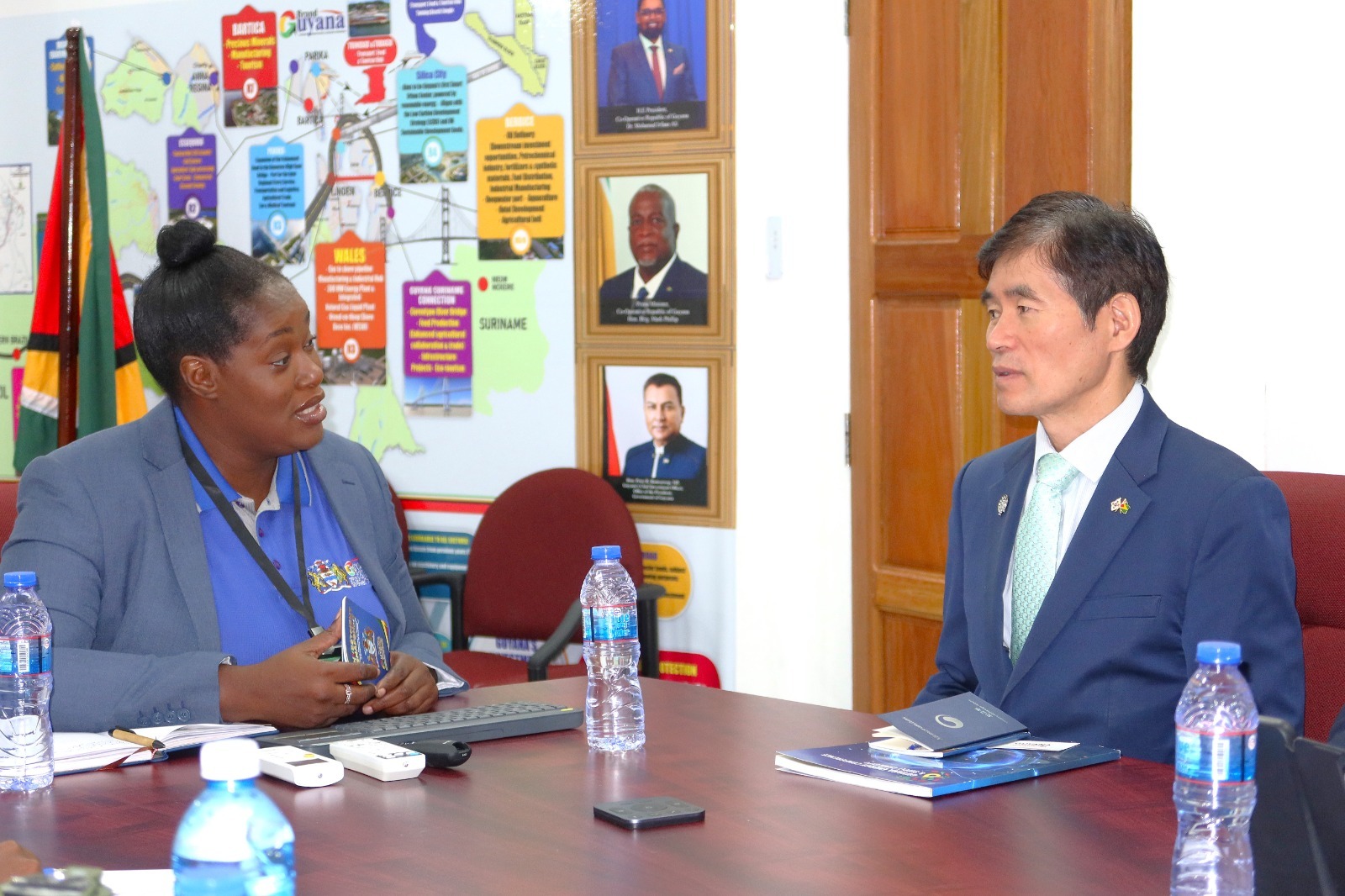


Director of Investment at the Guyana Officer for Investment (Go-Invest), Leanna Damond, recently met with Seijoong Kwon, Non-Resident Ambassador of the Republic of Korea to Guyana, and Secretary Young June Kim, to explore pathways for expanding bilateral investment cooperation.
According to a brief statement from Go-Invest, the discussion centered on outlining Guyana’s investment landscape, market entry requirements, available incentives, and emerging opportunities across infrastructure, energy, ICT, agriculture, manufacturing, and the blue economy.
“Ms. Damond highlighted major national and regional projects that are poised to attract new foreign investment, including the Guyana-Brazil road corridor, and the Guyana-Suriname bridge,” the statement noted.
Go-Invest noted that this engagement sets the stage for investment opportunities, with both sides expressing interest in expanding cooperation and promoting Guyana as a competitive investment destination within the Caribbean and the wider Atlantic market.
“Continued communication will be maintained to strengthen investor awareness in South Korea, reinforcing a foundation for long-term economic collaboration and future private-sector engagement,” the statement added.
In September, President Dr Irfaan Ali had met with Suriname’s President Jennifer Geerlings-Simons, where they reiterated their commitment to advance with the highly-anticipated Corentyne River Bridge, which will link the two South American neighbours.
The high-span Corentyne River bridge will run approximately 3.1 kilometres (km), connecting Moleson Creek in Guyana to South Drain in Suriname with a landing on Long Island in the Corentyne River, where a commercial hub and tourist destination will be established. That free zone will see major infrastructural development such as hotels, recreational parks, entertainment spots, tourist attractions, malls and farmers’ markets. This bridge project is one of the first agreements that was signed between President Ali and former Surinamese President Chandrikapersad Santokhi in their August 2020 cooperation pact. At the time, both leaders had underscored the critical role the bridge across the Corentyne River would play in advancing cooperation, creating more opportunities for development for the two nations. Meanwhile, both Guyana and Suriname have since settled on Chinese construction company, China Road and Bridge Corporation (CRBC), as the preferred contractor to build the new bridge.
However, it is unclear whether the contract has been signed. Back in October 2024, Public Works Minister Juan Edghill had told this publication that the contract between the contractor and the two countries would be signed as soon as the financing mechanism for the bridge is sorted out.
Both Guyana and Suriname had written the Government of China for financing of the bridge project. This publication was previously told by a senior Guyana Government official that the Chinese Government is willing to fund the project given its close bilateral relations with both Caribbean Community (CARICOM) Member States. However, the issue lies in Suriname’s economic situation. As part of its economic recovery programme, the Surinamese Government signed a structural adjustment programme with the International Monetary Fund (IMF), to restore its macroeconomic stability. But this programme makes it difficult for the Dutch-speaking country to take out loans, hence the snag in the process of securing financing for the bridge project. Both Guyana and Suriname are meant to share the cost of the bridge construction in a 50-50 arrangement.
Meanwhile, the Guyana Government is currently building out an all-weather road to Brazil. Works are currently progressing on Phase One, which runs from Linden to Mabura. The US$190 million Phase One of the project will see 121 kilometres of asphaltic road being built.
The project is being funded through the Caribbean Development Bank (CDB) via a US$112 million loan, a grant of £50 million (US$66 million) from the United Kingdom’s Caribbean Infrastructure Partnership Fund (UKCIF), and an input of US$12 million from the Guyana Government. That was the largest grant Guyana has ever received from the British Government.
In September, Edghill had stated that the government was preparing to tender for lots two, three, and four, propelling the project toward full completion.
Once realised, the project will slash travel time from Linden to Lethem from over 12 hours to approximately four hours.
It will lower transportation costs, improve access and services for remote communities, and enhance trade and tourism between Guyana and Brazil.
Importantly, residents of Linden and surrounding communities will be able to tap into a market of some 20 million people in northern Brazil, unlocking new opportunities for financial empowerment and regional growth.
Subscribe to get the latest posts sent to your email.