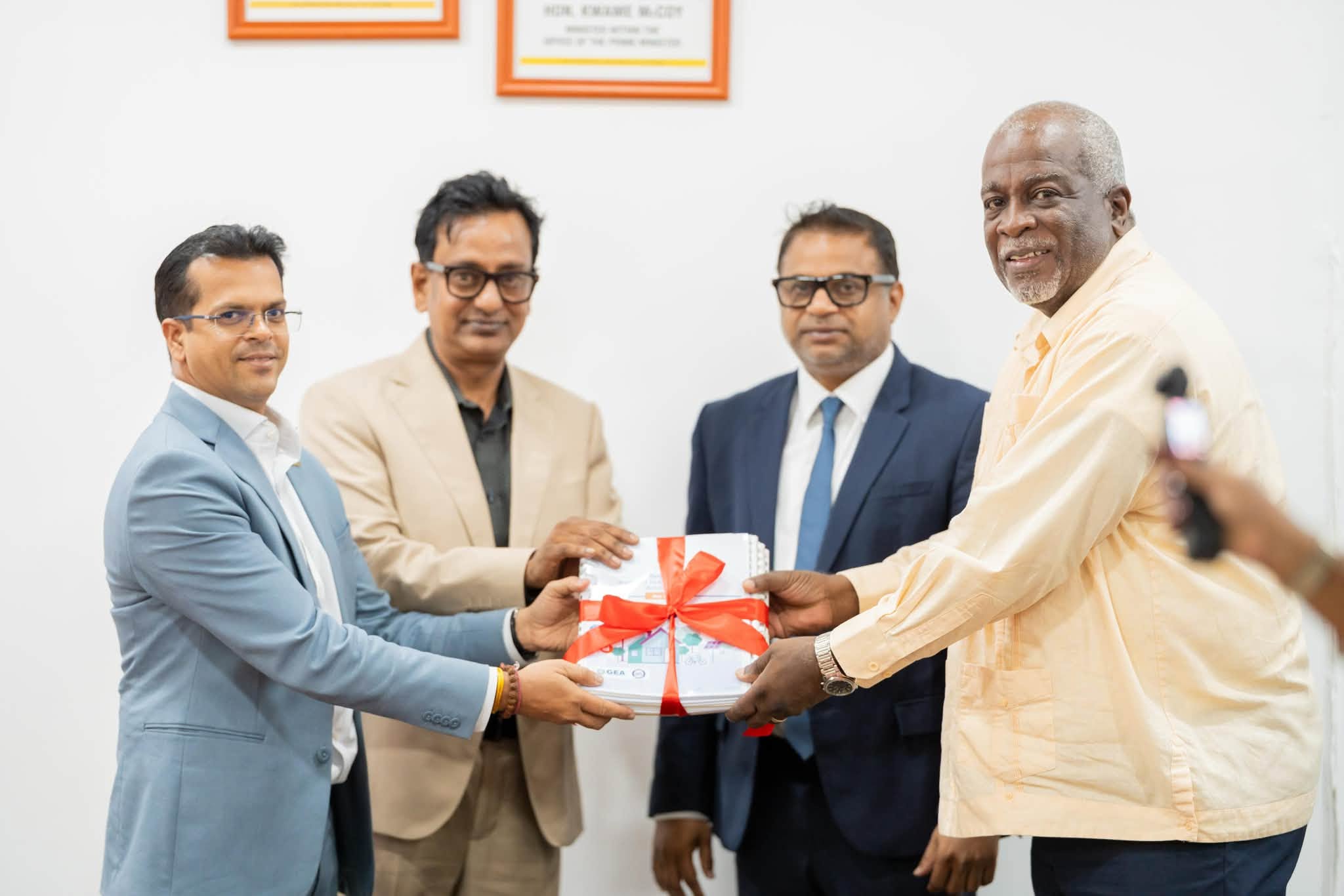


Prime Minister Brigadier (Ret’d), Mark Phillips, was on Wednesday, officially presented with the Demand Side Management (DSM) Action Plan for Guyana.
The Guyana DSM Action Plan was formally handed over to the Prime Minister, alongside Deodat Indar, Minister of Public Utilities and Aviation, by Mr. Kesh Nandlall, Team Leader of the Guyana Power and Light (GPL) Incorporated and Dr. Mahender Sharma, CEO of the Guyana Energy Agency (GEA).
The DSM Action Plan provides a strategic pathway for improving energy efficiency by prioritising measures that offer the most immediate and achievable benefits, making them both practical for implementation in the country and beneficial to energy consumers.
The Plan’s implementation is expected to deliver energy savings of 516 GWh (gigawatt-hours), representing a 20 percent reduction target by 2030, based on a projected electricity generation of 2,508 GWh.
Two key stakeholder groups are critical to its rollout, namely consumers who adopt DSM measures, and utilities that promote and facilitate their adoption.
As Guyana’s economy continues to expand and diversify, demand for energy is expected to increase across all sectors. Under the Low Carbon Development Strategy (LCDS) 2030, meeting this growing demand while advancing sustainable development remains a national priority. The LCDS 2030 targets increasing renewable energy penetration, underscoring the country’s commitment to expanding renewable energy technologies, improving energy efficiency, and reducing dependence on imported fossil fuels.
This DSM Action Plan complements ongoing national efforts to expand electricity generation, recognising that while increasing electricity supply remains important to meeting growing energy demand, energy efficiency and demand-side management play an integral role in optimising energy use, enhancing system performance, and supporting Guyana’s transition to a sustainable, resilient, and low-carbon energy future.
Prime Minister Phillips said the Action Plan comes at a critical time, as Guyana’s rapid economic growth and expanding development agenda continue to drive increased electricity demand.
“If you have such high economic growth, you become a site for investment. The more investors you have, and the more social sector spending by Government, improving housing, improving educational facilities, including hospitals, improving infrastructure, everything demands some increase in electricity, both on the supply side and the demand side.”
He noted that while Government continues to expand electricity generation through transitional energy and greater use of renewable energy, responsible electricity use remains important to ensuring that consumers benefit fully from lower energy costs, he said “Smart consumption will help us to meet that growth in demand”.
PM Phillips added that the Action Plan is therefore rooted in conservation across all areas of electricity use.
The Prime Minister also highlighted the role of households in the country’s changing energy landscape, noting that citizens are being encouraged to participate more actively in energy generation and conservation.
“One of the big points here is that the average household is now being encouraged to become what you call a prosumer, a provider and a consumer of energy at the same time.” Adding, “If you have solar panels on your home, it means that you could help to satisfy your need, and the excess becomes an incentive for you, because the excess goes to the grid and you can get credits.”
The Prime Minister further noted that the success of the Action Plan will depend not only on infrastructure and policy measures, but also on sustained public education that encourages responsible electricity use from an early age.
Minister of Public Utilities and Aviation, Deodat Indar, also welcomed the Demand Side Management Action Plan, noting that it provides a practical approach to balancing electricity generation with responsible consumption. He noted, managing electricity demand can help reduce unnecessary pressure on generation infrastructure and support a more balanced approach to generation, conservation, and long-term cost management.
The Plan promotes the efficient and responsible use of electricity through measures that encourage energy conservation and greater demand-side flexibility. In doing so, it supports more efficient energy consumption patterns that will help to improve overall system efficiency, lower energy costs, enhance grid reliability, manage peak demand, maximise the benefits of existing and future energy infrastructure investments, and stimulate job creation and economic growth.
The DSM Action Plan outlines ten priority initiatives across five sectors: residential, office buildings, commercial establishments, industrial, and community services, to be implemented over a five-year period.
These initiatives include Electrical Utility-End Initiatives, DSM Awareness Programmes, Government Procurement, Promotion of Energy-Efficient (EE) Appliances, Energy Audits of Large Consumers, Promotion of the CARICOM Regional Energy Efficiency Building Code, Efficient and Resilient Water Utility Operations, Energy-Efficient Street Lighting, Integration of Distributed Energy Resources (DERs) and Electric Vehicle (EV) Charging Infrastructure.
Moreover, the electrical utility-end initiatives will include upgrades to distribution lines, the rollout of smart meters and/or pre-paid meters to customers by 2030, and improvements to the customer billing systems. DSM awareness programmes will encompass residential and commercial outreach through social media platforms, as well as training programmes, workshops, exhibitions, and school-based education initiatives.
At the same time, Government procurement for public buildings will focus on energy efficiency retrofits, including air conditioning and refrigeration upgrades across Ministries and agencies, as well as energy-efficient considerations in new public building designs and renovations. In addition, the promotion of energy-efficient (EE) appliances will include labelling initiatives for air conditioners and refrigerators, along with awareness and dissemination programmes targeting sales outlets, importers, the private sector, and regional events. Surveys of hotels and resorts will also support this effort.
Within the commercial sector, energy audits of large consumers will include energy assessments, power factor improvement, and the promotion of energy efficiency and renewable energy solutions. Alongside these measures, the promotion of the CARICOM Regional Energy Efficiency Building Code will focus on capacity-building workshops for civil and architectural engineers and encouraging the adoption of the code in the design of new public buildings.
In the water sector, efficient and resilient water utility operations will span energy-efficient retrofits such as pump upgrades and variable frequency drives (VFDs), and the integration of renewable energy at water treatment plants (WTPs), well stations, and associated buildings.
Meanwhile, energy-efficient street lighting will be installed across local communities, with implementation supported by Neighbourhood Democratic Councils (NDCs) and Regional Democratic Councils (RDCs) under local government and public works road upgrade programmes.
Similarly, distributed energy resources will be promoted across public and private buildings, including rooftop solar photovoltaic (PV) systems for residential and commercial customers and installations at Ministries, banks, and other prominent public and private facilities.
Additionally, electric vehicle (EV) charging infrastructure will support the establishment of charging stations across ministries and the private sector alongside efforts to encourage the adoption of electric vehicles on local roadways.
These collective measures aim to further strengthen the utility sector and support more efficient and sustainable management of electricity supply and demand countrywide.
The Guyana Power and Light (GPL) Incorporated and Guyana Energy Agency (GEA), as the primary implementing institutions, continue to collaborate on the rollout of the Demand Side Management (DSM) Action Plan. Through its targeted initiatives, the Plan provides a national framework to guide informed energy decision-making, harness Guyana’s energy efficiency potential, and support the adoption of more sustainable, affordable and reliable energy practices, while advancing the country’s broader transition toward a cleaner, low-carbon energy future.
Subscribe to get the latest posts sent to your email.
Related News
300 acres of onions to cut import bill
Supplementary Financial Paper slated for consideration at Monday’s parliamentary sitting
HOATTA engages hospitals on requirements governing organ & tissue transplants