
Germany has approved almost 800 million euros ($913m) in arms export licences to Israel in the first five months of 2026, more than in the previous 20 months combined, the government in Berlin has confirmed.
According to a Federal Foreign Office reply to a parliamentary question by the far-right Alternative for Germany (AfD) party, nearly all the approvals were cleared in April and May.
The approvals portend a dramatic surge in weapons exports to Israel from one of the country’s most steadfast allies in Europe despite the German government’s insistence that it is concerned about the devastation wrought by Israel’s military in Gaza.
The big spend
The government said more than 60 percent of the value of the arms licences is earmarked for a single, unnamed “major maritime project”.
The most likely candidate, analysts said, is a submarine built by the German manufacturer TKMS.
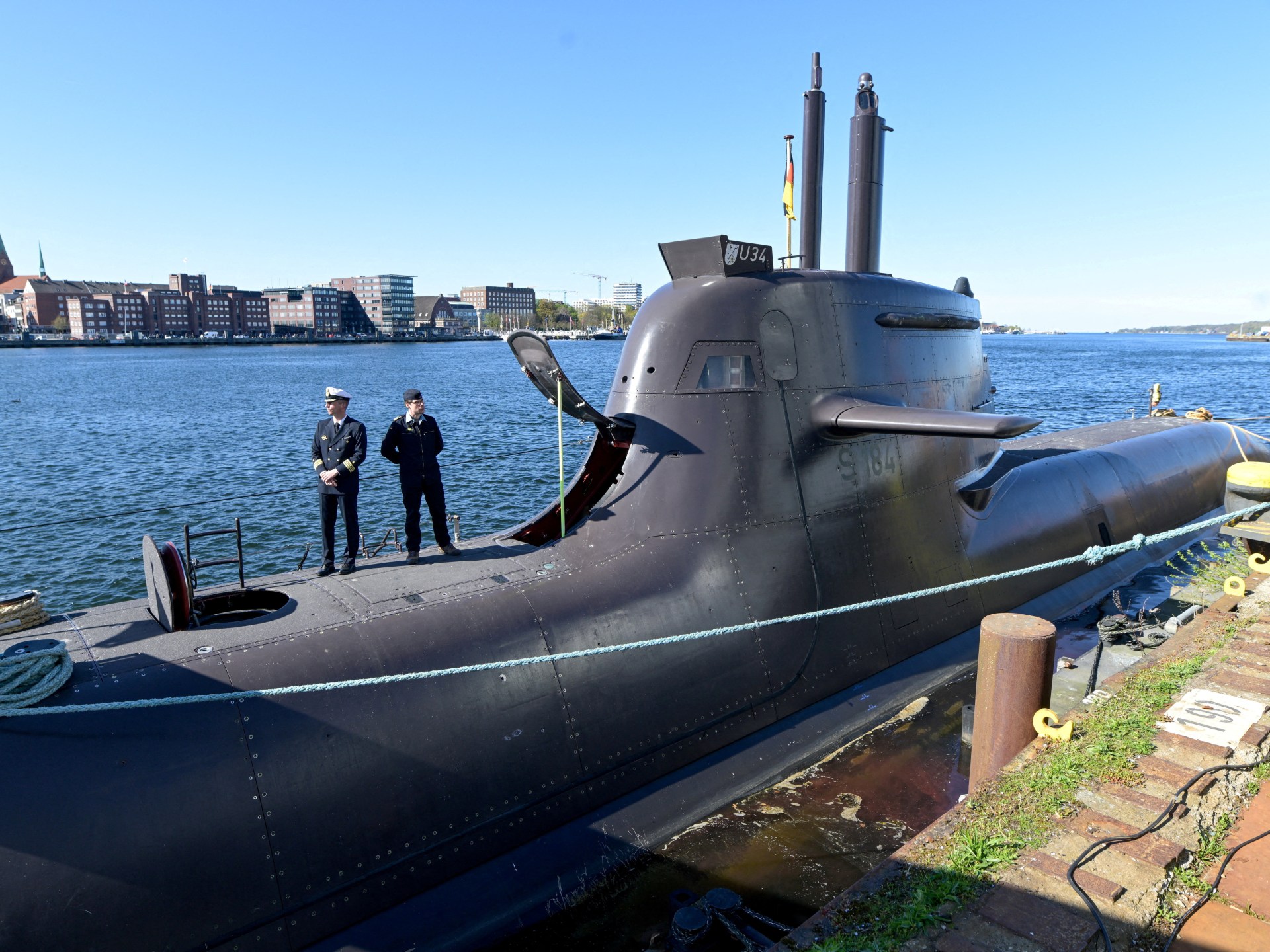
The INS Drakon, a nuclear-capable Dolphin II-class submarine, underwent its maiden voyage last year at a shipyard in Kiel on the Baltic Sea. Its estimated value is 480 million euros ($548m). It was officially handed over to the Israeli Navy last week, according to German media reports.
According to several reports, it could feature a vertical launching system (VLS), enabling it to launch nuclear-tipped cruise missiles or ballistic missiles. Israel would become only the second navy after South Korea known to field a VLS on a modern, air-independent propulsion (AIP), conventionally powered submarine.
During its sea trials, the submarine’s tower was covered with tarpaulins and fibreglass plates to prevent observers from determining its weapons configuration. Strategically, submarines of this class could provide a sea-based second-strike capability – the ability of a country to fire back nuclear weapons after it has itself faced a nuclear attack.
Advertisement
In May, TKMS signed a memorandum of understanding on future collaboration with Elbit Systems, Israel’s largest private defence contractor.
The German Foreign Office and Ministry of Economic Affairs and Energy, under whose purview arms export licences fall, both declined to comment on the matter.
Max Mutschler, a senior researcher with the Bonn International Centre for Conflict Studies, told Al Jazeera: “Unfortunately, the fact that the federal government does not explicitly mention this is also typical of the lack of transparency surrounding arms exports.”
Last year, reports conflicted over whether the export licence for the submarine had been granted. The order dates back to 2012. While TKMS indicated approval, the German government denied it at the time.
Germany’s shifting positions
The hesitation might have stemmed from legal concerns surrounding proceedings against Germany at the International Court of Justice in The Hague as well as shifting public opinion in Germany, which has largely turned against arms exports to Israel. According to media reports, Germany is helping finance about 30 percent of the costs for the Drakon and roughly one-third of those for the future Dakar class.
This month, TKMS was also selected by Canada as the preferred bidder to build up to 12 submarines in what would be the largest order in TKMS’s history. The value of the vessels alone is estimated at 12 billion euros ($13.7bn) to 18 billion euros ($21bn).
For years, submarine deals with Germany have been under investigation by the Israeli judiciary over bribery allegations involving close associates of Prime Minister Benjamin Netanyahu.
Ruth Rohde from the British research organisation Shadow World Investigations told Al Jazeera: “Israel has used German ships to fire at Gaza, to blockade and starve Gaza, and is using submarines to station nuclear weapons. At a time when Israel is waging brutal wars on its neighbours and is committing a genocide in Gaza, this submarine export would give Israel another tool in its arsenal of mass destruction.”
Berlin’s arms export policy towards Israel has been marked by reversals. In early August, Chancellor Friedrich Merz announced that Germany would issue no further licences for military equipment that could be used by Israel in the Gaza Strip. By that time, an Al Jazeera investigation had shown that Germany had already exported almost $12m worth of weapons consignments to Israel since October 2023 when Israel launched its genocidal war on Gaza.
And the partial suspension proved short-lived: In November, the government lifted the restrictions and returned to reviewing export applications on a case-by-case basis. Even during the suspension, previously approved deliveries continued. In September, for instance, a $794,000 weapons consignment from Germany landed at Ben-Gurion Airport near Tel Aviv.
Advertisement
Mutschler told Al Jazeera that some people in government “found the export of certain weapons to Israel problematic in light of numerous and credible reports of Israeli war crimes during the military operation in Gaza”. However, it was not enough to “bring about a generally restrictive arms export policy toward Israel”.
The economic calculation
Germany is one of the world’s largest arms exporters. In the first six months of 2026, licences were granted for arms worth 13.87 billion euros ($15.8bn), according to the Arms Export Report of the Ministry of Economics, published in mid-July. That is more than four times as much as during the same period in 2025. Ukraine remains the primary recipient of German arms exports.
Mutschler explained: “Arms exports have been and continue to be viewed by most federal governments primarily from an economic perspective and welcomed as a means of strengthening the defence industry.” He added: “The fact that these arms shipments can also be used to commit war crimes seems to play a significantly smaller role in the decision-making process.”
As a crisis in Germany’s economy – whose strength has relied primarily on exports, particularly in the car industry – has intensified, its defence industry has boomed in recent years. This development was publicly attributed to Russia’s invasion of Ukraine although plans for increased defence spending had already been prepared beforehand, according to reports.
Pieter D Wezeman, a senior researcher at the Stockholm International Peace Research Institute, sees this as a general trend. He told Al Jazeera: “The demand for arms in Europe has increased dramatically over the past few years whereas the demand for arms in many other parts of the world does not seem to be decreasing or is likely to increase.”
The German market remains very important to the country’s arms industry as Germany is set to double its military spending from well below 2 percent of it gross domestic product to a stated goal of 3.5 percent of its GDP within a few years, Wezeman explained. “Germany is now the largest military spender in Europe [not counting Russia], and its arms industry is a core component of the European military-industrial base.”
Related News
Thousands protest in Germany as far-right AfD party meets

Maradona to Messi: Why Bangladesh loves Argentina’s footballers
Israel raids West Bank live: Dozens of Palestinians detained during assault