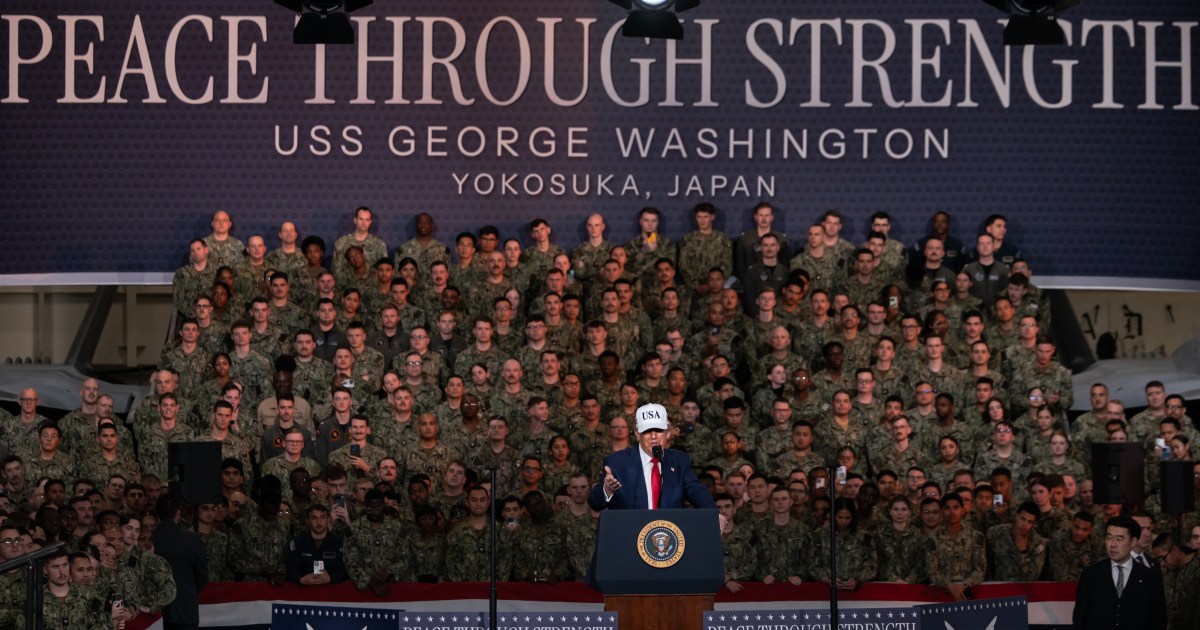

Washington, DC – A periodic document spelling out the United States’s foreign policy and security has emphasised the need for US “preeminence” in the Western Hemisphere, reflecting President Donald Trump’s push for regional dominance.
The National Security Strategy (NNS), released on Friday, also called for balancing trade with China and deterring it from seizing Taiwan.
- list 1 of 3Putin pledges ‘uninterrupted’ fuel shipment to India amid US sanctions
- list 2 of 3Opening ‘Pandora’s box’: What happens if the US attacks Venezuela?
- list 3 of 3Fighting flares in DR Congo within hours of Trump’s peace deal ceremony
end of list
But unlike the previous assessment, which was published during the Joe Biden presidency in 2022, the new NNS did not focus primarily on China or mark competition with Beijing as the top challenge for the US.
Instead, the US administration stressed non-interventionist policies. It reflected Trump’s disdain for multilateralism and international organisations, saying that the “world’s fundamental political unit is and will remain the nation-state”.
Here are five key takeaways from the document.
Hemispheric dominance
The US is seeking to “restore American preeminence in the Western Hemisphere” by reinforcing the Monroe Doctrine – a 19th-century US policy in opposition to European colonisation and interference in the Americas.
Other than deterring foreign influence in the hemisphere, it will push to combat the drug trade and irregular migration while encouraging “private economies”.
“We will reward and encourage the region’s governments, political parties, and movements broadly aligned with our principles and strategy,” the document reads.
Trump has already put this approach into action by publicly backing conservative politicians in Latin America and bailing out the Argentinian economy under right-wing President Javier Melei with $40bn.
Advertisement
“We will deny non-Hemispheric competitors the ability to position forces or other threatening capabilities, or to own or control strategically vital assets, in our Hemisphere,” the document says.
“This ‘Trump Corollary’ to the Monroe Doctrine is a common-sense and potent restoration of American power and priorities, consistent with American security interests.”
The NSS also calls for shifting US military assets to the Western Hemisphere, “away from theatres whose relative import to American national security has declined in recent decades”.
The strategy comes as the US ramps up its deadly attacks on boats in the Caribbean Sea and Atlantic Ocean that it says are carrying drugs.
The Trump administration has also ordered a military buildup around Venezuela, raising speculations that Washington may be looking to topple left-wing President Nicolas Maduro by force.
Deterring conflict over Taiwan
The last two National Security Strategies, including the one released during Trump’s first term in the White House, described the competition with China as the top priority for the US.
But the rivalry with Beijing was not put front and centre in this NNS.
Still, the document highlighted the need to win the economic competition in Asia and to rebalance trade with China. To that end, it stressed the need to work with Asian allies to provide a counterweight to Beijing, singling out India.
“We must continue to improve commercial (and other) relations with India to encourage New Delhi to contribute to Indo-Pacific security,” it said.
The document spelt out the risks of China seizing Taiwan by force, noting that the self-governing island, which Beijing claims as its own, is a major producer of computer chips.
It also underscored that capturing Taiwan would give China access to the Second Island Chain in the Asia Pacific and bolster its position in the South China Sea, a vital artery for global trade.
“Hence deterring a conflict over Taiwan, ideally by preserving military overmatch, is a priority,” the NNS says.
The strategy called on US partners in the area to increase their military spending to deter conflict.
“We will build a military capable of denying aggression anywhere in the First Island Chain,” it said.
“But the American military cannot, and should not have to, do this alone. Our allies must step up and spend—and more importantly do—much more for collective defence.”
Berating Europe
Although Trump has cracked down on speech critical of Israel in the US and ordered the Department of Justice to target his political rivals, the NNS scorned Europe over what it called “censorship of free speech and suppression of political opposition”.
Advertisement
The strategy proclaimed that Europe is facing the “prospect of civilizational erasure” due to migration policies and “failed focus on regulatory suffocation”.
It also hit out at European officials’ “unrealistic expectations” for the war between Russia and Ukraine, saying that the US has a “core interest” in ending the conflict.
A US proposal to end the war, which would allow Russia to hold on to large territories in eastern Ukraine, garnered rare criticism from some European leaders last month.
The NNS blamed, without providing examples, the “subversion of democratic processes” for what it described as some European governments’ unresponsiveness to their people’s desire for peace.
The document also suggested that the US may withdraw the security umbrella it has long held over the old continent.
Instead, Washington would prioritise “enabling Europe to stand on its own feet and operate as a group of aligned sovereign nations, including by taking primary responsibility for its own defence, without being dominated by any adversarial power”, the NNS reads.
Switching focus from the Middle East
The NSS stresses that the Middle East is no longer the top strategic priority for the US.
It says that past considerations that made the region so important – namely, energy production and widespread conflict – “no longer hold”.
With the US ramping up its own energy production, “America’s historic reason for focusing on the Middle East will recede,” the strategy says.
It goes on to argue that the conflict and violence in the region are also subsiding, citing the ceasefire in Gaza and the US attack on Iran in June, which it said “significantly degraded” Tehran’s nuclear programme.
“Conflict remains the Middle East’s most troublesome dynamic, but there is today less to this problem than headlines might lead one to believe,” it reads.
The US administration envisioned a rosy future for the region, saying that instead of dominating Washington’s interests, the Middle East “will increasingly become a source and destination of international investment”, including in artificial intelligence.
It describes the region as an “emerging as a place of partnership, friendship, and investment”.
But in reality, the Middle East continues to be beset by crises and violence. Despite the truce in Gaza, near-daily Israeli attacks have continued as deadly raids by settlers and soldiers against Palestinians escalate in the occupied West Bank.
Israel has also been stepping up its air strikes in Lebanon, augmenting fears of another all-out assault against the country to disarm a weakened Hezbollah by force.
In Syria, a year into the fall of the government of former President Bashar al-Assad, Israel has pushed on with incursions and strikes in an effort to militarily dominate the south of the country beyond the occupied Golan Heights.
And with its uncompromising commitment to Israel’s security, the US remains deeply entrenched in the region with continuing military presence in Syria, Iraq and the Gulf area.
Advertisement
The NSS acknowledges that the US continues to have key interests in the Middle East, including ensuring “that Israel remains secure” and protecting energy supplies and shipping lanes.
“But the days in which the Middle East dominated American foreign policy in both long-term planning and day-to-day execution are thankfully over – not because the Middle East no longer matters, but because it is no longer the constant irritant, and potential source of imminent catastrophe, that it once was,” it says.
‘Flexible realism’
The US will pursue its own interests in dealing with other countries, the document says, suggesting that Washington will not push for the spread of democracy and human rights.
“We seek good relations and peaceful commercial relations with the nations of the world without imposing on them democratic or other social change that differs widely from their traditions and histories,” it said.
“We recognise and affirm that there is nothing inconsistent or hypocritical in acting according to such a realistic assessment or in maintaining good relations with countries whose governing systems and societies differ from ours even as we push like-minded friends to uphold our shared norms, furthering our interests as we do so.”
However, the strategy suggests the US will still press some countries – namely Western partners – over what it sees as important values.
“We will oppose elite-driven, anti-democratic restrictions on core liberties in Europe, the Anglosphere, and the rest of the democratic world, especially among our allies,” it said.
Related News

Two US National Guard members shot and killed near White House

Israel bombs Syria, Gaza after extrajudicial killings in occupied West Bank
One killed in ‘riot’ in Iraq’s Erbil after attack on Khor Mor gas field