David Granger now opposes fixed benefits for fmr Presidents despite assenting to 2015 law
 25 November 2026
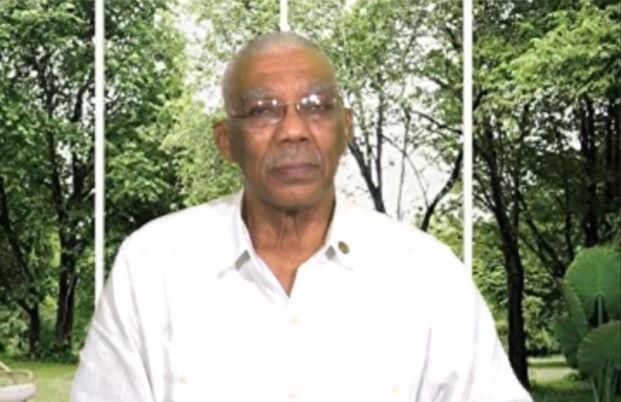


Former President David Granger, who led the A Partnership for National Unity/Alliance for Change (APNU/AFC) Administration between 2015-2020, now believes that benefits to former Heads of State should not be fixed, arguing that the cost of living and value of money are changing rapidly, a position that contrasts with the 2015 legislation he assented to as President, which introduced caps on several benefits.
Granger’s position was made known in correspondence to an APNU Opposition Member of Parliament (MP) Ganesh Mahipaul, who read the letter to the National Assembly on Monday during debate on the Former Presidents (Benefits and Other Facilities) Bill 2026. The Bill seeks to repeal the 2015 Act and reinstate the framework of the 2009 legislation. Government Parliamentarians have argued that the 2015 law, assented to by Granger was vindictive and stripped away benefits that should be afforded to former Presidents.
For instance, under the 2015 Act, monthly allowances for electricity, water and telephone services were capped at $25,000 each, while annual medical expenses were limited to $200,000 and restricted to services obtained at public health facilities in Guyana. In his letter, Granger reportedly stated that “it would be unwise to fix inflexible monetary benefits in these times”, and suggested that Government and Opposition work towards developing a “flexible formula that reflects the changing economic realities”.
He also urged Parliament to adopt a policy that allows former Presidents and their dependents to live in dignity, comfort, good health and safety, rather than treating the issue as a political victory.
However, Mahipaul said that APNU supports increasing the existing benefit limits but does not support uncapped entitlements, arguing that this could create opportunities for abuse.
Mahipaul argued that former Presidents already receive substantial pensions and questioned the need for unlimited additional benefits. He disclosed that when Granger left office in August 2020, his monthly pension was $1,498,438, equivalent to seven-eighths of the President’s salary.
He further projected that by 2030, a former President’s pension could exceed $3 million monthly, assuming annual salary increases of nine per cent over the next five years. Mahipaul said APNU was prepared to increase the electricity allowance from $25,000 to $150,000 and the telephone allowance to $100,000, among other adjustments, but maintained that leaving the benefits uncapped could result in abuse.
No history of abuse
Attorney General (AG) Anil Nandlall, however, rejected the Opposition’s concerns, arguing that there was no established history of former Presidents abusing the benefits provided under the 2009 framework. He pointed to former President Desmond Hoyte, along with Samuel Hinds, Bharrat Jagdeo and Donald Ramotar, as former Heads of State who benefited under that legislation.
Nandlall explained that the 2009 Act provides for payment of electricity, water and telephone expenses at the former President’s residence in Guyana. It also provides for household staff, including an attendant and gardener, as well as full-time security personnel and Presidential guard services at the residence. He maintained that these provisions are tied to the former President’s residence and do not permit unrestricted spending at other properties or locations.
The AG rejected claims from the opposition that the 2009 framework allows for abuse by former Presidents. For instance, he explained that the 2009 Act, which the Government is now seeking to restore, caters for payment in respect of expenses incurred for the provision and use of water, electricity, telephone at the place of residence in Guyana for the former President.
Responding to the opposition’s claims, Nandlall said “you hear the madness about farm, about all manner of things, when the Bill since 2009 says ‘residence’ and what does it say, it says ‘water, electricity and telephone services’…so Mr Speaker, right there is a cap…If we can’t provide light, water and electricity for our former Presidents at their house, then we should be ashamed of ourselves as a nation.”
The 2026 Bill also seeks to restore tax exemptions enjoyed by serving Presidents and remove the restrictions on medical expenses. It would also eliminate provisions in the 2015 legislation that disqualify former Presidents from benefits if they take up employment after leaving office or are convicted.
Unthinkable
Parliamentary Affairs and Governance Minister Gail Teixeira described the 2015 legislation as vindictive and argued that former Presidents should not be prevented from working after leaving office. She also questioned the decision to impose limits on medical expenses, noting that the demands of the presidency take a physical toll on those who occupy the office, arguing that it is “unthinkable” to cap medical expenses to former Presidents.
“How can you say to a person who served their country, ‘you’re not going to be able to work, you’re not going to be able to have a consultancy’, so how is the man to live? On pension? … you have no idea what it’s like to be a President you know, I worked with all the Presidents from ‘92 to now and every medical person says that when you become a President, your five years is aged ten years, it’s been written about by scientists. When you look at Obama, Obama went in looking gorgeous, he’s old now, and it wasn’t years, he aged in the five years, it takes a toll because you’re 24/7 on board,” Teixeira asserted, maintaining her view that the 2015 law passed by the former APNU/AFC Administration was intended to be “vindictive”.
Ordinary Guyanese
Teixeira also took aim at those opposition parliamentarians who objected to these benefits to former Presidents on the basis of what ordinary Guyanese gain. She reminded that it was the APNU/AFC that brought a number of hardships on ordinary Guyanese through their policies which included some 200 new taxes and the shutting down of the sugar estates which sent 5000 workers on the breadline. She also reminded of the dismissal of almost 2000 Community Support Officers (CSOs), asking “where was the love” for ordinary Guyanese then.
Nonetheless, she maintained that the Peoples Progressive Party Civic (PPP/C) administration has always and will continue to invest in Guyanese, contending that currently, Guyana has the “broadest and most transparent social protection system in the entire Caribbean in terms of pension, healthcare, education”.
The Former Presidents (Benefits and Other Facilities) Bill 2026 was subsequently passed by the National Assembly following hours of debate, repealing the 2015 Act enacted by the APNU/AFC Coalition shortly after taking office in July of that year.
Discover more from INews Guyana
Subscribe to get the latest posts sent to your email.
Related News

More than 350 athletes expected for ARC Youth Relay Festival

Never stray from oath to protect, preserve Guyana – Pres Ali tells MPs
MV Barima tragedy: Crew were drinking during journey – survivor who lost 4 grandchildren...