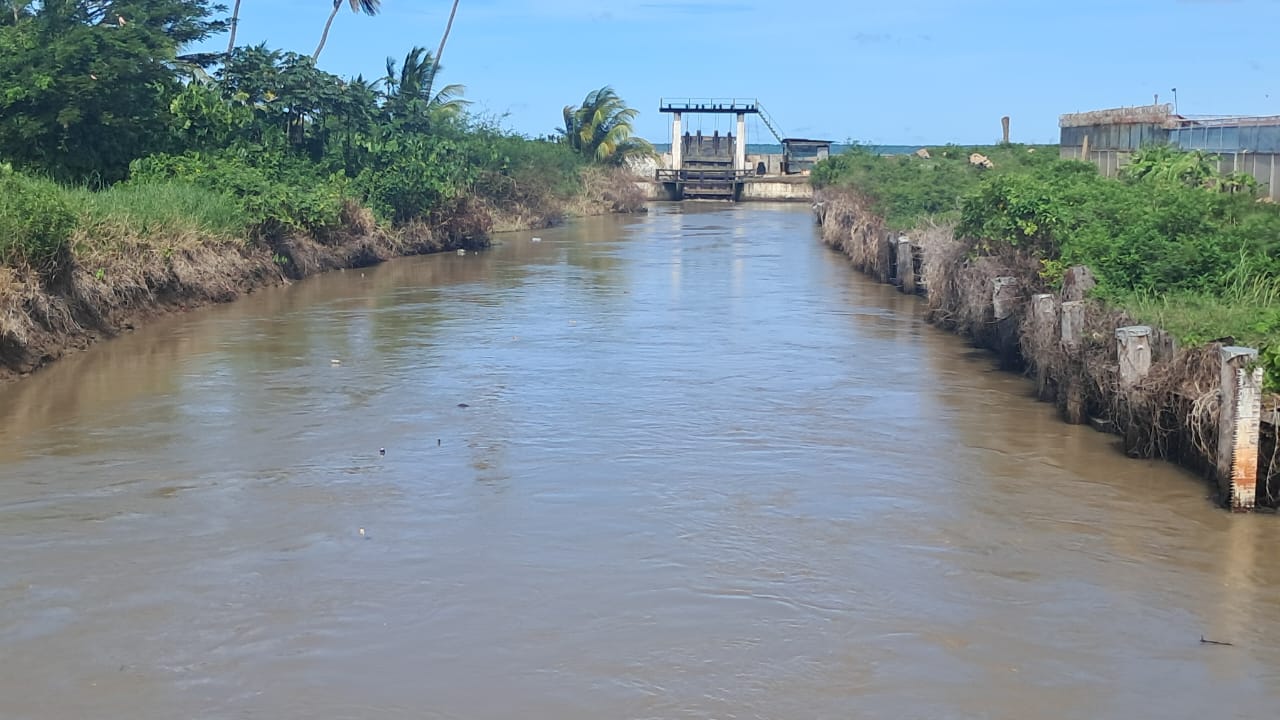


Several communities along the upper Corentyne were left dealing with floodwaters on Tuesday after days of intense rainfall, combined with lock sluices, resulted in water overtopping yards and entering homes.
Among the hardest hit were Crabwood Creek and the Number 76 and 77 Housing Schemes within the municipality of Corriverton, where residents reported water reaching ankle height in parts of their homes.
Recent forecasts from the Guyana Hydrometeorological Service had already indicated a period of unsettled weather, with several consecutive days of cloudy conditions, intermittent rainfall, and accumulations of up to 50 millimeters within a 6-day period, particularly along coastal areas.
For residents like Cleveland Greeves of Number 77 Housing Scheme, the flooding came overnight. Greeves explained that persistent rainfall continued throughout the night, and by Tuesday morning, the situation had worsened.

“When I wake up and step out of bed, the water was already ankle high,” he said, noting that several personal items were damaged. He said clothes stored in suitcases under his bed were soaked, resulting in losses.
At Number 76 Housing Scheme, Theodora Roberts also experienced similar conditions, with water entering his home and rising to ankle level in his kitchen. Roberts said he was forced to quickly move appliances, including his refrigerator, to higher ground in an effort to prevent further damage.
In addition to household losses, he noted that plants in his kitchen garden were also affected by the floodwaters.
In an invited comment, Mayor of Corriverton, Imran Amin, attributed the flooding primarily to a combination of heavy rainfall and tidal conditions that prevented the effective discharge of water from the drainage system.
He explained that during the peak of the downpour, the kokers within the township were closed due to high tide, which significantly restricted the outflow of water.

“We had some extreme rainfall over the past two days, and at the time of the downpour, the kokers were closed because of the high tide, so the water could not flow out, causing a buildup in the drains and canals,” Amin told Inews.
According to Amin, this resulted in a temporary accumulation of water across sections of the town, particularly in low-lying areas that rely heavily on these drainage outlets.
He identified Number 77 Housing Scheme, parts of Ray’s Course in Springlands, and areas along the eastern side of the public road near Number 78 Village as among the worst affected.
The mayor further pointed to issues with pumping capacity, noting that a non-operational pump at Number 74 Village may have contributed to the severity of the flooding.
“The pump was not working prior to that, and if it had been working continuously, it could have helped to remove the water faster, and we would not have seen that level of flooding,” he said.
Despite the challenges, Amin noted that once the tide receded and the kokers were reopened, the accumulated water was able to drain within a relatively short period.
He added that municipal teams, including workers and equipment, were deployed to the field to monitor and clear any potential blockages within the drainage network.
The incident has once again highlighted the vulnerability of low-lying coastal communities, where drainage systems remain heavily dependent on tidal conditions and the efficient operation of pumps and kokers. (Andrew Carmichael)
Subscribe to get the latest posts sent to your email.
Related News

Govt engages DR firm on use of more durable materials for infrastructure projects

Guyana sold carbon credits to 19 airlines under LCDS framework

Unstable weather conditions to affect Guyana over next 6 days - Hydromet Office