
Bengaluru, India — It was past time for class, but none of the 122 students at the government-run primary school in Samuhi Bhatpurwa village in India’s Uttar Pradesh were ready for lessons.
For once, they had something to teach the school authorities.
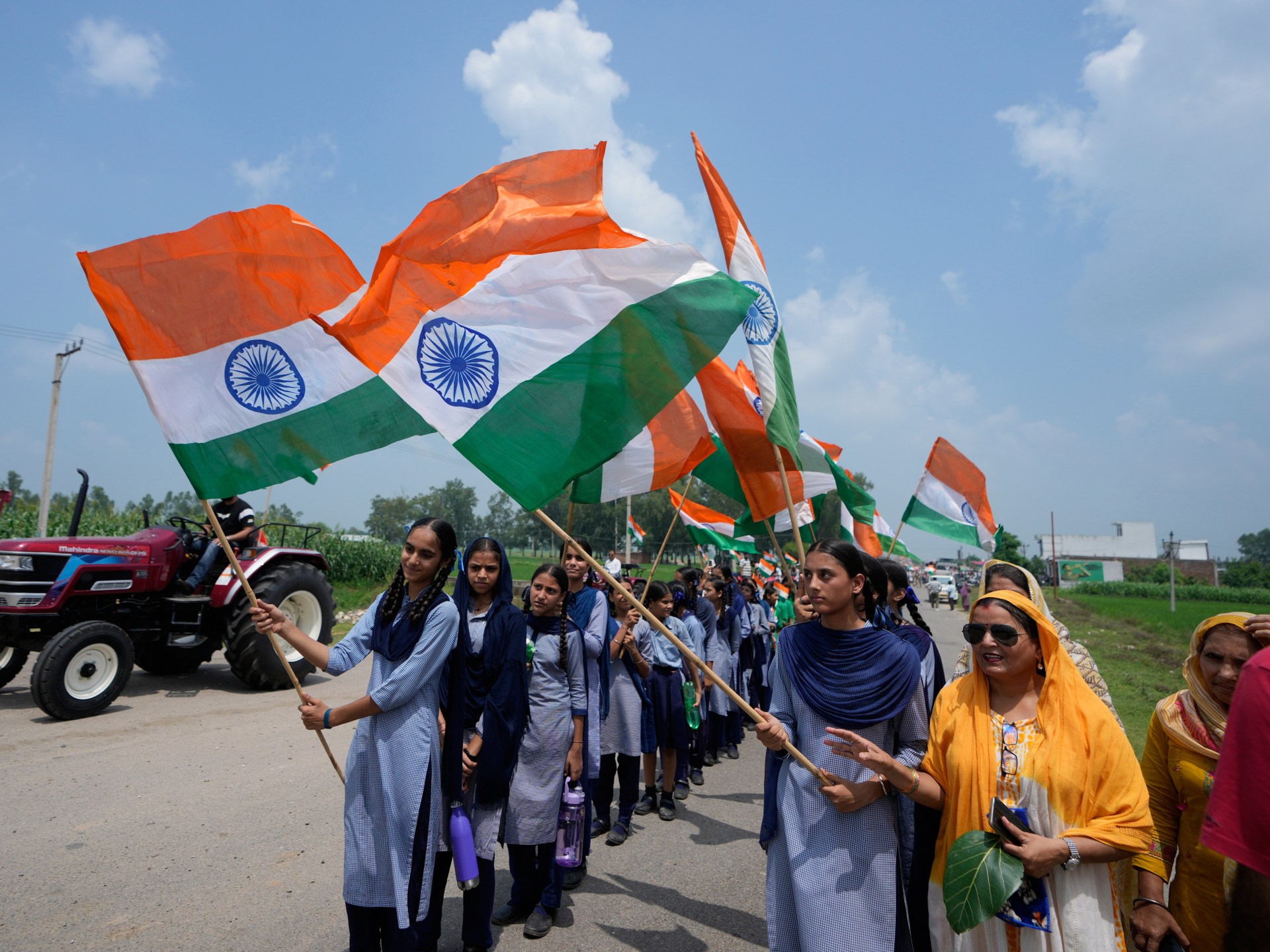
Dressed in their red-and-white checked uniforms, the students — some as young as six — refused to enter their classrooms until they received an assurance that the school would build the new building authorities had promised. Some, such as eight-year-old Priya*, held India’s national flag.
The current structure is old and dilapidated. A portion of the school lies in rubble — unrepaired — after a wall fell on a girl, severely injuring her in 2023.
Since then, the children have been asking for a new building for their safety. But no one listened to them until they launched their unlikely protest on August 22 , children no older than 10 challenging school and government authorities. As news spread that the youngsters were on strike, a senior education department official visited the school.
Block education officer Deepak Awasthi told the children that a new building would be constructed soon. That was when the pupils agreed to go back home as it was already close to evening.
“I am happy. We will get a new building. We (the children) dread the school building would one day fall. Its condition is poor,” Priya told Al Jazeera. “The fear does not let us concentrate on our studies. That is why we all protested.”
Priya and her friends aren’t alone. Children in at least 10 Indian states, including Maharashtra, Bihar, Rajasthan, Jharkhand and Madhya Pradesh, among others, have launched similar protests in schools since late July. Protests have been reported in rural areas where government-run schools are crumbling under neglect.
Advertisement
The protests represent a challenge, not only for India’s education system, but also point to a new political test for Prime Minister Narendra Modi’s government when it is already struggling to retain the support of young people.

From Gen Z to Gen Alpha
Starting in early June, thousands of Gen Z protesters flooded Jantar Mantar, the protest hub in the heart of India’s capital city, New Delhi. Their most pressing demand was accountability after a series of high-profile examination paper leaks, which in turn were seen as responsible for dozens of young Indians dying by suicide.
But as the Modi government tried to cast the protesters as extremists backed by foreign forces rather than engaging with their grievances, their questions of those in power grew: India’s vast unemployment and underemployment crisis became another flashpoint for the protests.
The popular youth movement was led by the Cockroach Janata Party, or CJP, a satirical society formed in May to express angst over large-scale unemployment and systematic flaws in the education system.
When security forces that report directly to Modi’s de facto deputy, Amit Shah, brutally cracked down on protesters peacefully marching towards the Indian parliament, the Gen Z youth movement drew widespread popular support from across the nation.
As the numbers of protesters swelled and their anger at being beaten up simply for demanding education reforms grew, the Modi government relented. Education Minister Dharmendra Pradhan, from Modi’s Bharatiya Janata Party, resigned.
The CJP has since turned its attention to the condition of India’s schools.
School students, such as in Samuhi Bhatpurwa, are now doing something that is rare in India’s cultural traditions: questioning teachers and those in authority.
Coming close on the heels of the Gen Z protests, this new generation of protesters is being widely described as heralding a Gen Alpha movement.

What ails Indian schools
India operates one of the world’s largest school systems, teaching 247 million students in 1.5 million schools. About 70 percent of the schools are run by federal, state or local governments, the rest either by charities or private institutions.
Advertisement
The government’s official audit of schools in 2025-2026 reported improvements in access to education and suggested that the teacher-pupil ratio was improving — one teacher for every 24 students. School dropout rates are falling too, the data shows.
But the reality for many students and their parents is very different. Some schools operate in buildings that are also used to rear cattle.
“The children are demanding their rights. They want teachers, benches, school buildings, drinking water, electricity and toilets,” Bengaluru-based education rights activist, Nagasimha Rao, told Al Jazeera. “Unfortunately, for a long time, the basic infrastructure and manpower to run schools have been missing. It is the story of most government-run schools across the country.”
“Is it because poor children study in these schools?” asked Rao, referring to government-run schools, where the student body is predominantly composed of children from economically and socially marginalised communities.
In one of the first protests in the current wave, students of Sarvodaya Inter College in Uttar Pradesh came to their school on July 28 in their blue-and-white school uniforms and started protesting. The school, which has classes up to grade 12, lacks drinking water, electricity and even benches.
“No one can imagine how difficult it is for us to study in the school. There is no electricity, so no fans during the hot and humid summers. We don’t have a drinking water facility. Many students sit on the floor because we don’t have enough benches. So we decided to protest,” said class 12 student Manoj*.
Manoj’s friend and classmate, Neelam*, added that the students had been asking for basic facilities for a long time. “This time we decided to hold a formal protest with placards and sloganeering.”
Similar protests followed. On July 31 , students of Vaidyanath Vidyalaya in Parli in the western state of Maharashtra organised a demonstration against the shortage of faculty members. The school was established in 1941.

Gen Z supports Gen Alpha
On August 15 , when India celebrated its Independence Day, the CJP launched its grassroots initiative, ‘School Thik Karo (Fix The Schools).’
Ratna Singh, the CJP’s legal affairs head, told Al Jazeera that their movement fully backed the protests in schools across the country, seeking to improve the education system.
“During our Jantar Mantar protest in Delhi, we met many young children and their parents who had travelled from rural areas,” Singh said. “They spoke about the poor condition of schools, the shortage of teachers and potholed, untarred roads leading to schools, among other issues. It is also a natural progression of our (the CJP’s) movement to fix schools for a better future of our children.”
Several instances of violence were reported as CJP members visited schools in different parts of the country to check their conditions and speak to children.
Advertisement
Gaurav Bharti, a member of the CJP from Uttar Pradesh, alleged that “the police and local goons are threatening members of the CJP”.
“After I visited the primary school in Uttar Pradesh’s Karanpur Majra (a rural belt) on August 16 and exposed its poor conditions, the police force is after me,” he said. “The headmistress of the school has filed a police complaint against me. But we are not scared. We are demanding what is already mentioned in laws like the RTE Act.”
The Right to Education (RTE) Act, which came into effect in 2009, made education a fundamental right for children aged six to 14. It clearly defines infrastructural standards, including “all-weather buildings, water, sanitation and safety for children.” It also states that the teacher-student ratio should be at least 1:30.
But while the national average meets that bar, the government’s own data shows that India has 100,843 schools that have only a single teacher — across all grades. About 2.9 million children are enrolled in those schools. Conversely, India also has 5,663 ‘ghost schools’ — institutions with no enrolment.
Substandard food provided in India’s massive school lunch programme — known as the midday meal scheme — has often been another cause of protests.
In Bihar’s Simuara village on July 28 , around 50 students walked 4km to meet a senior bureaucrat to protest against the quality of the midday meals they were being fed. The school does not have access to piped water, so raw ingredients are not cleaned before they are cooked. The students complained that the quality of rice, lentils and vegetables was substandard — vegetables, they said, were often almost rotten.
What India’s school system needs are systemic fixes that “involve providing equally good infrastructure everywhere; hiring and enabling teachers; incentivising families to send their children to school as well as holding them accountable for non-compliance,” said Chennai-based educationist and political scientist, Swarna Rajagopalan.
The school protests also portend a future political challenge for governments in power. More than 30 percent of India’s population is under the age of 18. Many of those joining school protests today will be of voting age in 2029, when India next holds its national elections.
“The children are our future. If they don’t get proper education in a conducive atmosphere, it would derail India’s growth. These children are tomorrow’s voters too,” Akash Sarkar, an education activist from the eastern state of West Bengal told Al Jazeera. “They will definitely vote keeping in mind the interest of the country’s education system.”
To Sujata Gowda, a student at Bangalore University in Bengaluru, the recent wave of protests — first among the Gen Z and now Gen Alpha — isn’t surprising: Students across the country, she said, felt abandoned by the system.
“This angst has been brewing for a long time. That is why even school children are protesting. Our schools, colleges and universities need to be revamped,” the 21-year old, who is pursuing postgraduate studies in mathematics, told Al Jazeera. “We need qualified teachers, examinations should be conducted fairly, infrastructure should be improved.
“For that the authorities must listen to students,” she added. “Otherwise, more protests are likely to take place across the country.”
*The names of school children have been changed.
Related News

‘Not welcome’: How Sweden’s far right took over Stockholm Central Station
Russian attacks kill eight people across Ukraine as US steps up diplomacy
What are the holes in the UK’s ban on imports from Israeli settlements?