New Zealand election results set up tricky talks for conservative incumbent
 27 November 2026
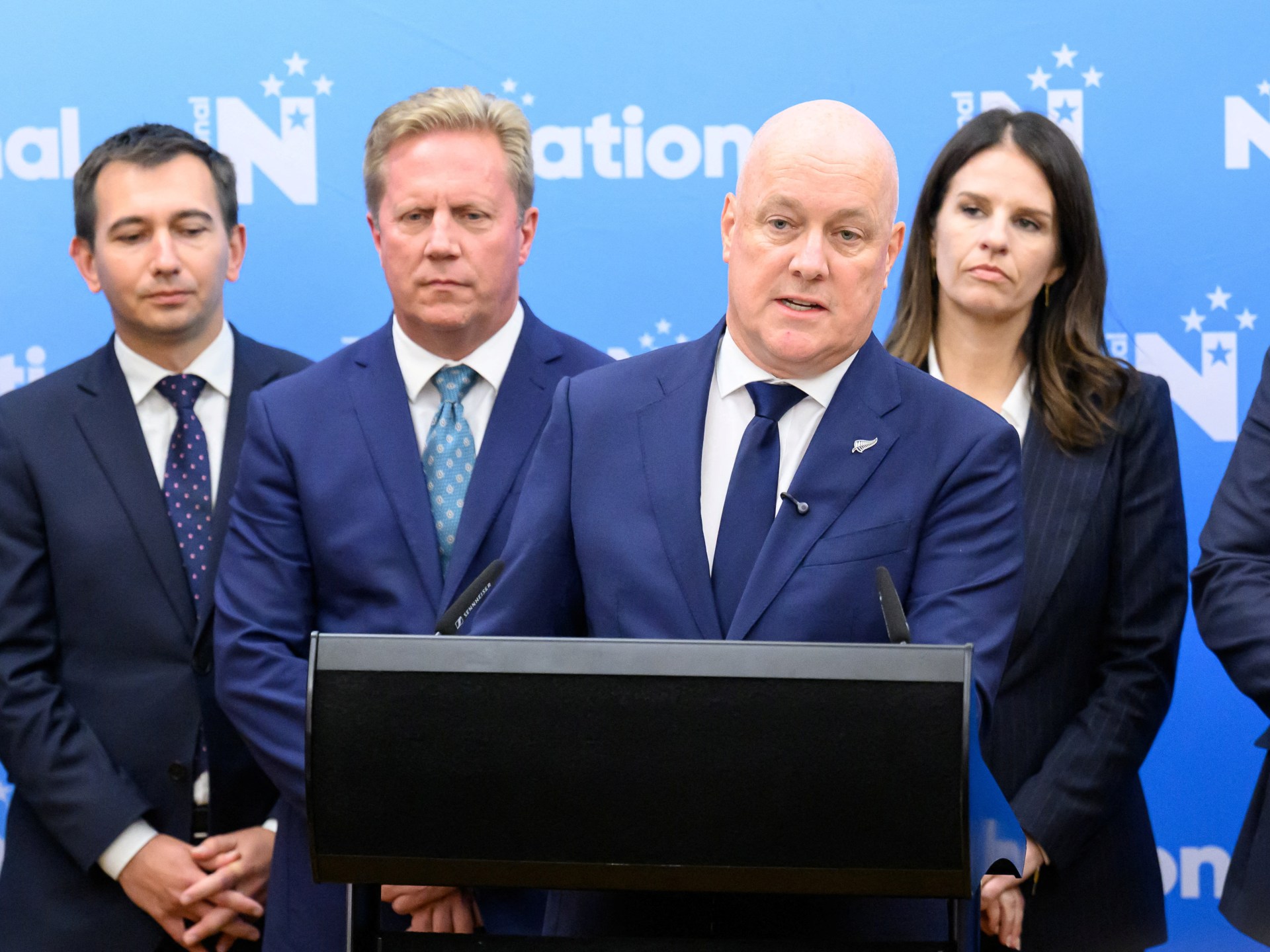

Conservative PM Luxon and populist coalition partners face negotiations with centrist kingmaker.
The final results of New Zealand’s November 7 election offer no clear path to forming a government, suggesting tricky political wrangling is likely in the weeks ahead.
The results, released on Friday, showed that the ruling centre-right coalition led by Prime Minister Christopher Luxon’s conservative National Party has fallen one seat short of a parliamentary majority.
- list 1 of 4What you should know about Spain’s election
- list 2 of 4Guinea-Bissau military leaders delay presidential election until 2028
- list 3 of 4Trump calls GDP data released before midterms ‘fake’, demands investigation
- list 4 of 4Who really wants Pedro Sanchez out of power?
end of list
Luxon has led New Zealand since 2023, but National and its junior partners – the populist New Zealand First and libertarian ACT – won just 65 seats between them. National secured 40 seats while ACT and New Zealand First won 13 seats and 12 seats, respectively.
The result reflects a loss of support for Luxon driven by a stagnant economy, and leaves the former businessman and his coalition partners to seek additional help to secure a majority.
“New Zealanders need a government that is stable, that works together and will last for the full term,” Luxon told a news conference on Friday.
Labour, the largest opposition party, won 36 seats, leaving it far below the 66-seat threshold in the 130-member parliament.
The results appear to position Qiulae Wong’s centrist Opportunity Party, which clinched 7 seats, as kingmaker. However, talks with the conservative and populist incumbents are likely to prove tricky.
The former consultant has promised a universal basic income of up to NZ$370 (US$208) a week, greater action on climate change, a ban on bottom-trawling fishing, and healthcare reforms.
She has also campaigned for a kinder approach to politics. Wong has pledged to do “everything we can” to ensure a stable government.
Advertisement
Her style contrasts with that of potential suitors such as Winston Peters of New Zealand First. The controversial foreign minister has called opponents “morons” and drew shock earlier this year when he told a Chinese-born lawmaker to “go back to your country”. His party promises to tighten immigration flows and withdraw from the Paris Climate Accord.
Deputy Prime Minister David Seymour of ACT campaigned against a greater governance role for the Indigenous Maori minority and has promised massive cuts to state spending.
Failure to meet an agreement could see Kiwis return to the polls next year.
Luke Oldfield, a political scientist at Victoria University of Wellington, told Reuters news agency a deal was likely, although it could be challenging.
“I don’t know exactly what kind of shape that will be yet, but it’ll be highly likely that there will be a right bloc formed and not a second election,” he said.
Related News

Activists accuse Israeli settlers of assault in occupied West Bank

US agencies unite to combat rogue drone threats nationwide

Haitians protest in support of El Salvador’s anti-gang troop deployment