
Deir el-Balah, Gaza Strip – As the rain intensified, 65-year-old Abu Sajed rushed to place buckets and pots strategically around his modest room in central Gaza.
The stone walls and tarpaulin roof offered little protection to his makeshift home, east of Salah al-Din Street, near the “Yellow Line” in Bureij refugee camp.
“We could no longer stay in bed because of the heavy rain. We moved to chairs in the only part of the room the water had not reached and waited for the rain to stop,” said Abu Sajed, who has diabetes.
He searched for his blood glucose monitor in the darkness. But it was soaked and no longer working.
His family’s solar power system, used for lighting and charging phones, was also damaged. Water also flooded his daughter’s neighbouring tent, soaking her clothes and belongings and destroying the inverter connected to her solar system.
“I did not know what to do. I could not protect myself or my family. Even going to the toilet had become difficult because of all the water,” he said.
His ordeal continued after the rain stopped. The following morning, as he tried to leave the room, his foot slipped on the muddy floor and he fell. Because of poor health, he could not get up alone. His wife and daughter struggled to lift him.
“I felt helpless and exhausted,” he said.

Recent rainfall has added to Gaza’s suffering, and due to Israel’s siege, most people lack adequate housing.
Advertisement
But the impact extends beyond flooded shelters and damaged belongings. It also threatens the energy sources residents depend on, particularly amid Gaza’s continuing electricity crisis.
In a room inside a damaged building in northern Gaza, Mohammed al-Hour uses sunlight to charge people’s phones through his solar power system. But rainwater also seeps through the cracked walls and damaged ceiling of his room.
“People come to me asking to charge their phones, even for a little while, so they can have lighting at night. But when the clouds persist and the sun disappears, it becomes difficult,” he said. “Whether you live in a tent or a house, rainwater will find its way in. The bombardment has destroyed almost everything.”
Companies trying to maintain electricity services are struggling with the damage.
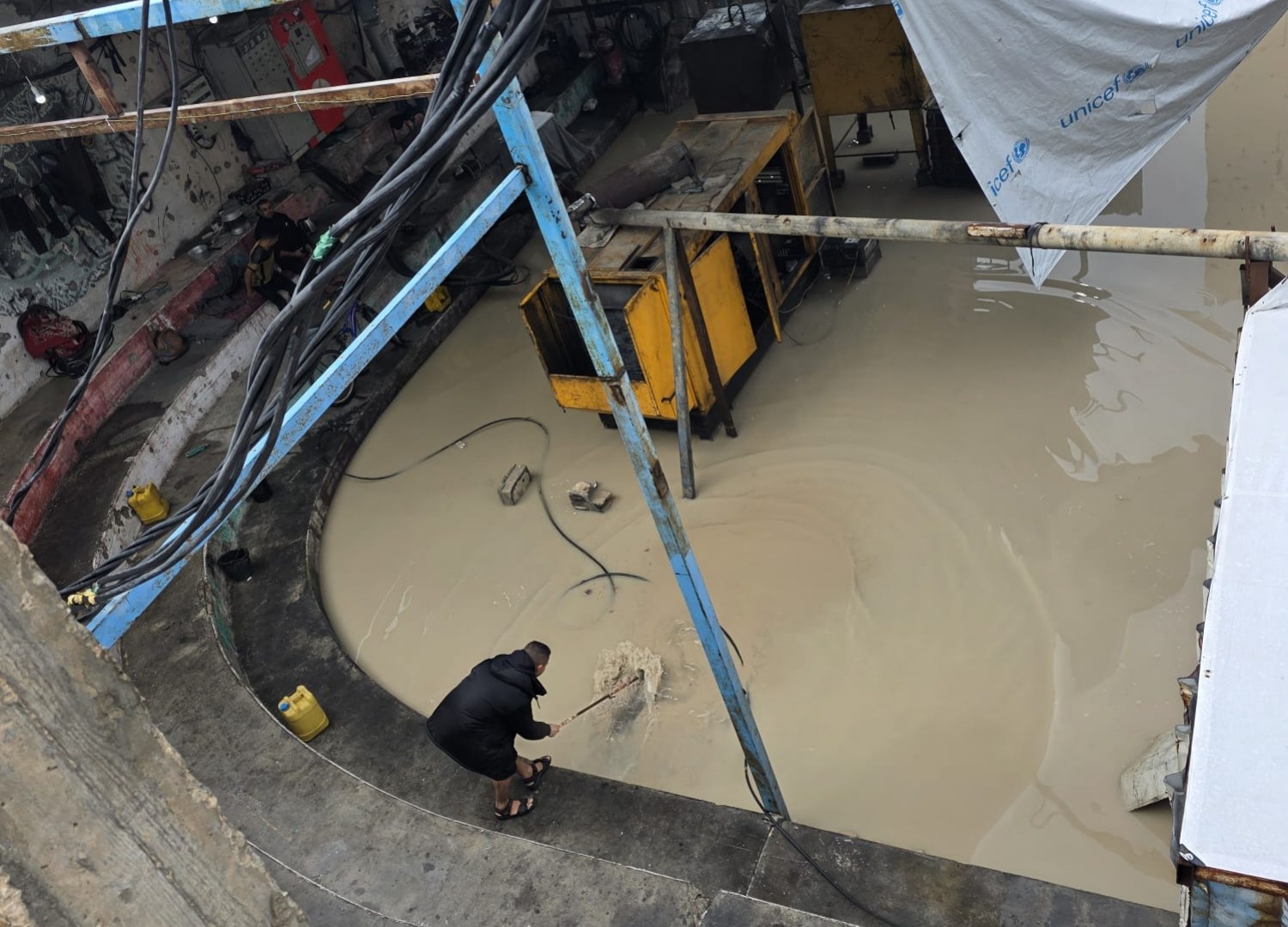
Despite preparations in advance of the winter, Abu Zayed Electricity Company could not prevent water from entering several facilities, damaging equipment and causing generators to malfunction. It temporarily suspended services at affected branches over fears of electrical contact and short circuits.
Aya Shaheen, the company’s general manager, said distribution panels and electricity metres were covered with plastic sheeting and tarpaulins, exposed wires were insulated, and municipalities were asked to pump out accumulated water. But the damage exceeded available resources.
“However much we try to prepare and protect our equipment, we continue to face major obstacles because of the extensive destruction of infrastructure,” she said. “Municipalities are also dealing with enormous pressure. Flooded tents need urgent intervention, so they cannot respond to every request for assistance.”
Water entered one of the company’s sites, even though its generators are housed in specially equipped prefabricated structures, Shaheen said. Restoring services and repairing equipment can take hours or days, depending on the damage.
According to UNICEF, the recent rainfall affected more than 106,000 people. About 950,000 displaced people live in flood-prone areas, including 400,000 in particularly high-risk locations.
A joint assessment by the World Bank, the United Nations and the European Union estimated that 80 percent of electricity generation and distribution assets had been destroyed or rendered inoperable during the war. This has severely limited access to reliable electricity, particularly as solar generation declines on cloudy days and equipment becomes vulnerable to water damage.

Mohammed Abu Khaled, an engineer specialising in energy systems and equipment used in the health sector, warns that rainwater entering solar systems can damage batteries and inverters, causing short circuits and corrosion of electronic circuits.
Advertisement
“The inverter is the weakest link and the component most likely to fail. It contains sensitive electronic circuit boards that are often not adequately protected against water,” he said.
He estimated that malfunctions in household solar systems and those used in displacement camps increased by more than 40 to 50 percent following recent rainfall. Repairing a damaged inverter can cost between $200 and $500, while families may have to replace an entire battery if it is damaged.
Solar panels’ electricity output can also drop by 60 to 80 percent on cloudy days, slowing battery charging and reducing the hours households can rely on stored electricity, he added.
The risks become more serious when rainwater reaches hospital equipment, particularly as many health facilities have been forced to operate from prefabricated structures and temporary buildings offering inadequate protection against the weather.
Abu Khaled said strong winds and heavy rainfall can cause water to seep into hospital departments, exposing operating-room equipment, portable oxygen generators, vital-signs monitors, laboratory devices and lighting systems to moisture and damage.

Some equipment has already been affected by damp conditions, adding pressure to healthcare facilities struggling with severely limited resources, he said.
As rainfall continues, Gaza’s residents face another winter with little infrastructure to protect them and few resources to replace damaged belongings and equipment.
With water seeping into shelters, electricity systems at risk of failure and medical equipment increasingly vulnerable, the weather is adding another burden to families struggling to maintain the most basic conditions for survival amid the destruction.
Related News
‘Nobody can stop them’: Who are Europe’s Black Bloc protesters?

Hungarian police reportedly detain brother of ex-PM Viktor Orban
Bolsonaro’s party accepts Brazil election after Trump calls vote ‘rigged’