
Primary races across the country have offered an early read on where voters want their parties to head before November’s consequential midterms in the United States.
With only a handful of US states remaining in the congressional primary calendar, voters in Alaska and Wyoming — two reliably Republican strongholds — head to the polls on Tuesday, with races that could send ripples well beyond their small electorates.
Although the state has long been safe Republican territory in federal elections, this year marks the third consecutive election cycle in which Alaska finds itself among a handful of states at the centre of the fight for control of Congress.
Wyoming offers a different kind of race: a rare wholesale turnover of Republican leadership. Wyomingites have a glut of new leaders to choose from at the statehouse, in the governor’s mansion and in the US Capitol. Contests that could further consolidate the state’s ultraconservative politics or begin to push them to the centre.
Here’s what’s on our radar.
Alaska
When do polls open and close?
Polls open at 7am (15:00 GMT) and close at 8pm local time (04:00 on Wednesday GMT), although Alaska’s two time zones stagger poll closings across the state.
What makes Alaska’s primary different?
Unlike most states, Alaska uses a single primary rather than separate Republican and Democratic contests. This comes after Alaska voters approved Ballot Measure 2 back in 2020, which effectively eliminated the state’s traditional party-primary system for most offices. Instead, all candidates appear on a single, nonpartisan primary ballot. The top four vote-getters advance.
Advertisement
What are the key races to watch in Alaska?
The US Senate race carries the clearest national stakes because it could tip control of the chamber. The governor’s race is worth watching because of its exceptionally crowded and competitive field.
Seventeen candidates are running to replace Alaska’s staunchly pro-Trump Republican Governor Mike Dunleavy, who is barred by term limits from seeking a third term. Among them is former Governor Bill Walker, who is running as an independent. Republican candidates include former state Senators Click Bishop, Shelley Hughes and Lesil McGuire, former Anchorage Mayor Dave Bronson, former state revenue Commissioner Adam Crum, Matanuska-Susitna Borough Mayor Edna DeVries, former state Attorney General Treg Taylor and business owner and conservative activist Bernadette Wilson.
Former state Senator Tom Begich and former state Representative Jonathan Kreiss-Tomkins are the two Democrats in the race.
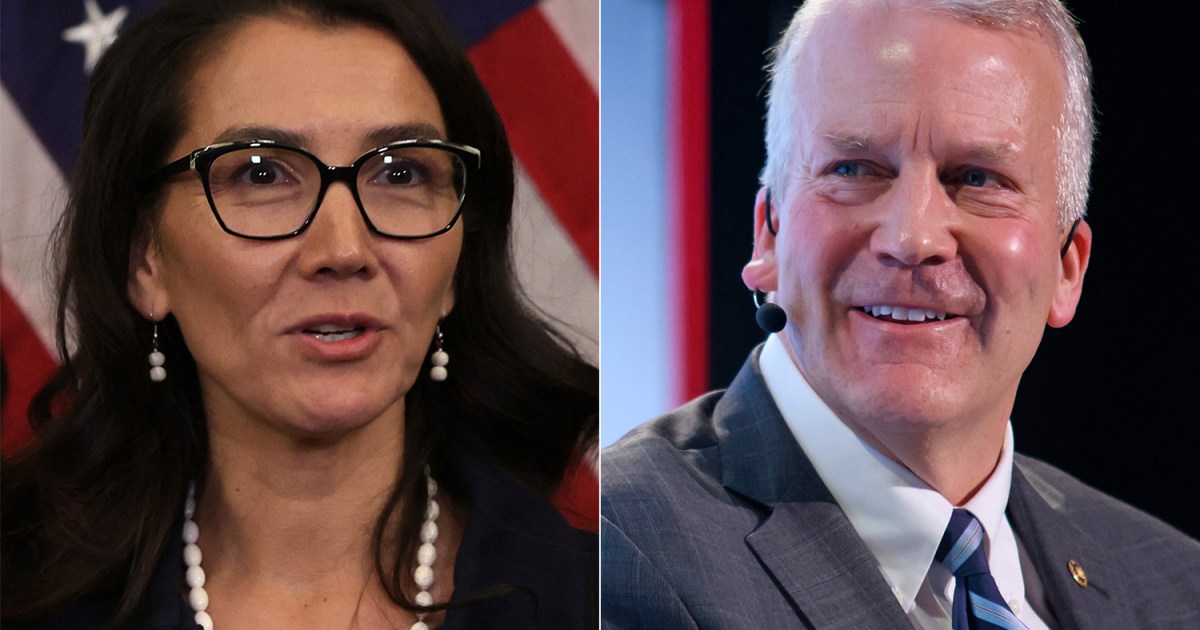
Meanwhile, sixteen candidates are running for Alaska’s US Senate seat, but the race has two chief frontrunners: incumbent Republican Senator Dan Sullivan and former Democratic Representative Mary Peltola. The Cook Political Report ranks the race among the country’s most competitive Senate contests.
Why the Senate race matters nationally
Though Alaska has not sent a Democrat to the Senate since 2008, former Representative Peltola, who represented Alaska in the US House from 2022 to 2025, demonstrated that a Democrat can win statewide there.
The race has drawn millions in campaign spending, including money being spent to elevate political unknowns who are unlikely to win the seat, but could materially alter the November field.
Super PACs have spent more than $2m trying to boost candidates who are not considered serious contenders for the seat, according to Alaska Public Media.
An Alaska Survey Research poll conducted in March found Peltola ahead of Sullivan among primary voters, 46.4 percent to 40.9 percent. In a simulated general-election matchup using Alaska’s ranked-choice system, Peltola also polled ahead of Sullivan.
A tale of two Dan Sullivans
There is an unusual Senate subplot: two Republicans named Dan Sullivan are on the ballot. One is the incumbent senator; the other, Dan J Sullivan Jr is a retired teacher from Petersburg. The state’s Division of Elections initially removed him from the ballot after determining that his candidacy appeared intended to confuse voters, but the Alaska Supreme Court later ordered officials to restore him to the primary ballot.
Advertisement
That creates a problem that is particularly acute in Alaska’s primary. Unlike the November election, the primary is not ranked-choice: voters select a single candidate, and the four highest vote-getters prevail in the general election. With two Dan Sullivans vying for the same electoral spot, even a relatively small number of mistaken votes could influence which candidate clears the hurdle.
Senator Sullivan will appear on the ballot as “Dan S. Sullivan” alongside the labels of “Registered Republican” and “Incumbent”. Challenger Sullivan will be listed as “Daniel J. Sullivan Jr.” without any party affiliation listed, although he filed for office as a Republican.
On Israel, Sullivan and Peltola find common ground
Much of the attention around incumbent Dan Sullivan’s fundraising reflects the issues that have defined his Senate career, including his strong support for Israel and his hawkish approach to Iran.
The 61-year-old has repeatedly backed military aid and closer US-Israel defence ties while vehemently opposing efforts by the International Criminal Court (ICC) to prosecute Israeli officials. His congressional record includes repeated efforts to maintain or strengthen sanctions on Iran.
Sullivan’s reelection run has attracted substantial backing from high-profile political organisations, including the Republican Senate Leadership Fund, which has committed at least $15m towards his campaign. The American Israel Public Affairs Committee (AIPAC ) has also helped funnel about $250,000 in individual contributions to Sullivan during the first quarter of 2026.
Peltola has also championed Israel-related legislation during her time in the House, and sometimes even broke with fellow Democrats on Israel-related votes. The Jewish Democratic Council of America, which describes itself as advocating for a strong US-Israel relationship, endorsed her Senate campaign back in March.
Wyoming
When do polls in Wyoming open and close?
Voting begins at 7am local time (13:00 GMT) and ends at 7pm local time (01:00 GMT the following day).
What’s one big race to watch?
The Senate Republican primary.
In deep-red Wyoming, the Senate primary is less a contest about whether the GOP will hold the seat than about which Republican candidate will win it.
The Cowboy State has voted Republican in every presidential election since 1964, with the exception of 1976, when Jimmy Carter carried Wyoming. The Senate race is also interesting because it is an open-seat succession fight.
What are the important races in the Wyoming primary election?
The US’s least populated state is in for a political makeover, with a shake-up at nearly every level. With incumbent Senator Cynthia Lummis declining to seek re-election and Representative Harriet Hageman relinquishing her House post to try to succeed her in the Senate, Wyoming is poised for an unusually broad reshuffling in elected officeholders.
Wyoming’s Republican Party is divided between a hard-right bloc that already controls the state House and more traditional conservatives who retain greater influence in the Senate.
Advertisement
Hageman, the Trump-backed hard-lined congresswoman who rose to national prominence after unseating Liz Cheney in the 2022 Republican primary, is the clear favourite to succeed retiring Senator Cynthia Lummis. Among the other Republicans running to replace Lummis in the US Senate are former Kirby Mayor Sam Mead and former environmental services business owner Jimmy Skovgard.
In an April interview with Jackson Hole Community Radio (KHOL), Mead said that the endorsements Hageman received from Trump, Lummis and Barrasso come with an expectation that she will support the administration “no matter what.” While Mead has promised that he would push back against Trump on public lands, tariffs and foreign wars when he believes the administration’s policies run counter to Wyoming’s interests.
Nine active candidates are competing for the Republican nomination to replace Hageman in the US House in what’s shaping up to be the most expensive contest on Tuesday’s ballot. The field includes former state Superintendent of Public Instruction Jillian Balow, state Senate President Bo Biteman, businessmen Steve Friess and Reid Rasner, and Wyoming Secretary of State Chuck Gray.
Related News
Will Germany bring back mandatory military conscription next year?

When is the next FIFA World Cup? 2030 hosts, dates and format
At least two dead as heavy rains, floods strike central Texas