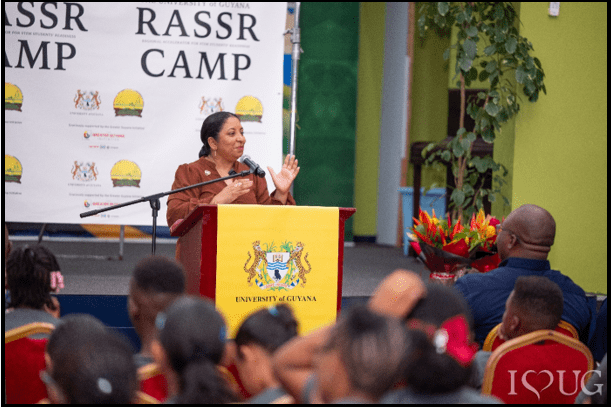


The Regional Accelerator for STEM Students Readiness (RASSR) Programme began with a simple thought that prompted a series of questions. For years, University of Guyana Vice-Chancellor Professor Paloma Mohamed Martin wondered what became of the exceptionally gifted students she encountered through her work with the Caribbean Examinations Council (CXC). She wondered who was nurturing their talents after they left secondary school and whether they were being given every opportunity to fulfil their potential. Those questions ultimately inspired the creation of RASSR, a programme designed to identify, support, and empower Guyana’s future scientists, engineers, researchers, and innovators.
Those questions, she said, led to a broader reflection on how Guyana identifies and supports exceptional students. “I honestly believe that we have geniuses among us. We spend a lot of time, as we should, dealing with vulnerable kids, but there’s the other side of the spectrum, the ones who are really, really talented and gifted, who I think we also need to find and nurture,” Professor Mohamed-Martin said.
Through RASSR, the University of Guyana has sought to create a pathway for those students, ensuring that talent is recognised regardless of their location or background.
The programme was established in 2022 through a partnership with the University of Guyana and Greater Guyana Initiative (GGI), which comprise of ExxonMobil Guyana, Hess Corporation, and CNOOC Petroleum Guyana Limited.
It identifies high-performing secondary school students from all ten administrative regions and exposes them to intensive learning experiences in science, technology, engineering and mathematics (STEM).
The programme focuses on areas including Mathematics, Chemistry, Biology, Physics, Integrated Science, Technology, Engineering, biodiversity and environmental stewardship, while also developing skills in critical thinking, leadership, teamwork and problem-solving.
According to Professor Mohamed Martin, one of the most important aspects of RASSR is ensuring that students outside traditional centres of opportunity are not overlooked. “I’m always very interested in making sure that not only children who are in an easy to reach area, like a geographic area, could benefit, but also students from everywhere. Once they had the talent and they showed the scores, then we could try to do it,” VC said.
The Vice-Chancellor explained that RASSR was also designed to help create a sustainable STEM pipeline by exposing students to the range of careers available in these fields. “We were trying to find a way with GGI to direct resources straight to communities and to build a pipeline of new scientists who would stay in STEM,” she said. “If they showed an interest in it at an early age, we wanted to see if we could help them to understand all of the careers that could be there, but also to help them to stay,” VC further stated.
Building such a programme, however, required commitment from a wide network of people within and outside the University. Professor Mohamed Martin recalled that the early stages of the initiative required dedication, particularly as the programme was being developed during the COVID-19 period. “The first year we did this, it was COVID, it was 2021… And I think we really worked on the good heart and passion and belief and courage of people within the University,” she said.
She credited the staff members, volunteers and supporters who helped transform the idea into a national initiative. “I cannot overstate the support of my own staff in my own office in [Department of Events Conferences and Communications] DECC, in the Vice-Chancellor’s Office, in PACE, of course, custodial staff,” she said.
Since its establishment, RASSR has continued to develop, with each cohort providing lessons that help strengthen the programme. “We’re now into our fifth year. Year after year, we learn, we iterate, we upgrade, we change,” Professor Mohamed Martin said.
Behind every student participating in the programme is a wider network of academics, mentors, volunteers and support personnel working to make the experience successful.
For the Vice-Chancellor, the greatest measure of RASSR’s success is not only the experience students receive during the programme, but the paths they continue to pursue afterwards. “It’s joy, not pride,” she said. “To see that we actually have students who were accelerated, who came into this University at 14 and 15, and who are still here… To also see that they could feel the sense of service and commitment to come back, those who have graduated and work with the younger ones,” She shared.
The programme has also recorded encouraging outcomes in retaining students within STEM fields. “I’m really glad that we were able to keep as many as 79 per cent of students in STEM, and 98 per cent of them in the programme in general,” Professor Mohamed Martin said.
Years after its first cohort entered the programme, RASSR is beginning to show the impact of investing early in talented students. For the University of Guyana, seeing these young people remain engaged in STEM and return to support others has become one of the clearest signs that the programme is achieving what it set out to do.
Subscribe to get the latest posts sent to your email.
Related News

3 days of national mourning declared following MV Barima tragedy

Children awaiting heart surgery to get treatment within two months – Pres. Ali

England defeat Mexico 3-2 to reach World Cup quarter-finals