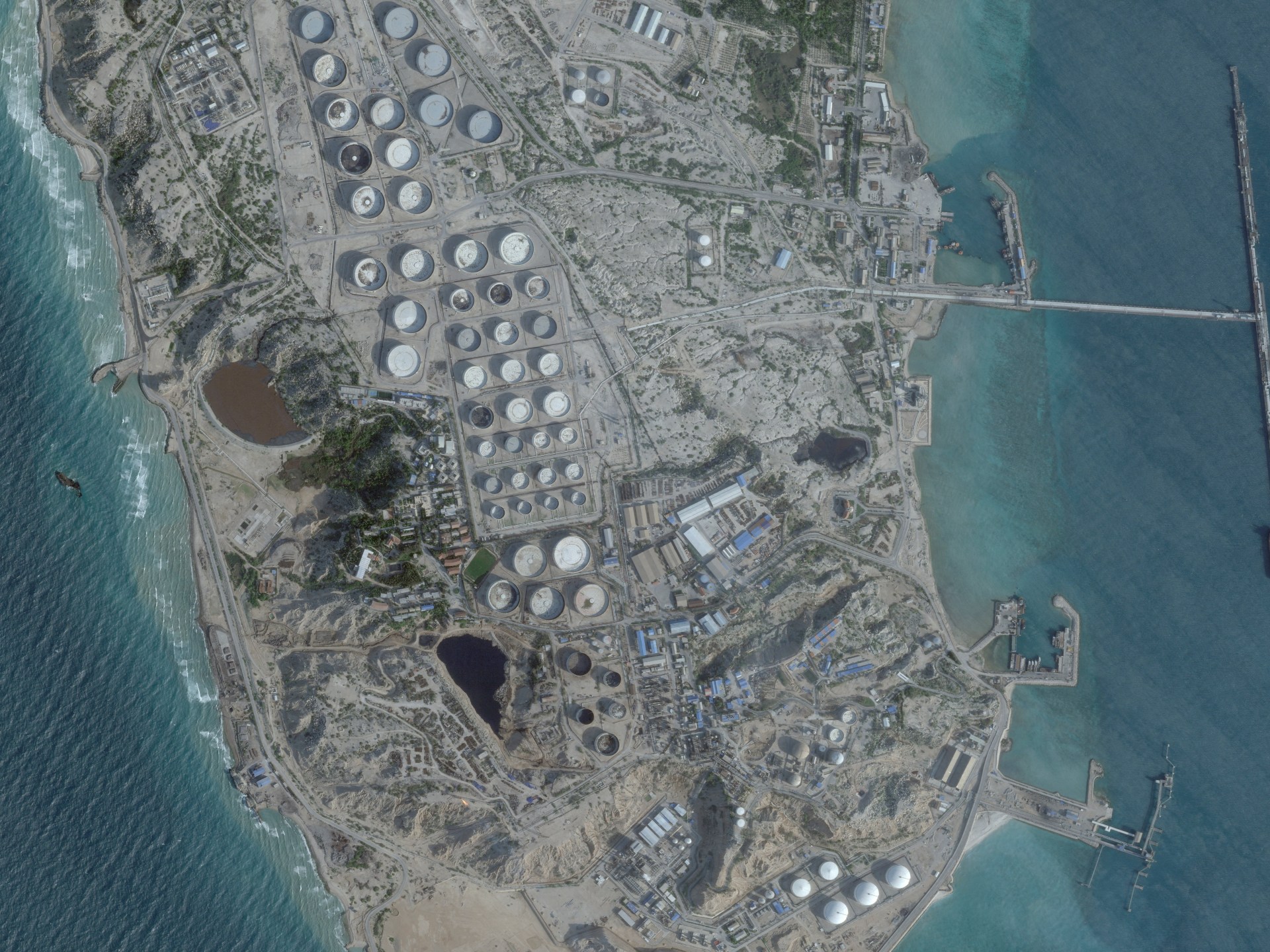

United States forces have struck Iran’s Qeshm, Kish and Abu Musa islands in recent days as part of an escalating campaign that has also pounded port cities along Iran’s southern coast, including Bandar Abbas.
The attacks have revived a question that has hung over the US-Israel war on Iran since its early weeks: Is Washington preparing to seize Iranian territory?
- list 1 of 4Sirens blare in Bahrain as Iran launches barrage of missiles, drones
- list 2 of 4How Iran’s southern coast is bearing the brunt of US attacks
- list 3 of 4US and Iran trade attacks as Trump threatens to hit civilian infrastructure
- list 4 of 4US resumes Iran ports blockade as Gulf attacks continue: What’s the latest?
end of list
In March, a month into the war, two unnamed US officials told The Washington Post that the US Department of Defence was gearing up for raids on Kharg Island, through which about 90 percent of Iran’s crude oil exports pass. The comments fuelled speculation of a ground operation.
Talk of a seizure died down after the two sides signed a memorandum of understanding on June 17. But the scenario is back on the table after US President Donald Trump refused to rule it out in a Fox News interview on Monday.
“I can’t say that to you because if I did, it would be foolish,” Trump said when asked about such an operation.
So is it bellicose rhetoric or a real possibility?

The US ability to occupy Iranian islands
In a “narrow tactical sense”, the US has the military capability to grab Iranian islands, Andreas Krieg, associate professor in security studies at King’s College London, told Al Jazeera.
With enough air, naval and amphibious power – and a willingness to absorb the escalation that would follow – the US could seize a small Iranian island, he said. The US has an estimated 50,000 soldiers stationed across the Middle East, including personnel at both large, permanent bases and smaller forward sites.
Advertisement
Beyond seizing the islands, the US also has the military and logistical capability to occupy them because it remains the “pre-eminent global military power”, Nader Hashemi, a professor of Middle East politics at Georgetown University, told Al Jazeera.
The question, Hashemi said, is what is the cost.
“Temporarily capturing an island is very different from holding it, supplying it and deriving strategic benefit from it,” Krieg said.
Qeshm would be especially hard, he noted, because it is a large island sitting directly off the Iranian mainland rather than an isolated outpost.
Smaller islands like Hengam could be overrun more easily but would stay within reach of Iranian artillery, drones, missiles and small-boat swarms – and taking several islands at once would amount to “a major amphibious campaign, not a limited raid”, Krieg said.
Seizing the islands would also not stop Iran from disrupting the Strait of Hormuz. It would instead leave exposed US garrisons under continuous attack while handing Tehran the narrative of the US as an occupying power, he said.
A costly campaign
Such a move would require significant manpower. Krieg estimated “a limited operation would probably require an initial force of at least 5,000 to 10,000 personnel once combat troops, air defence, engineers, logistics, medical support and command elements are included”.
The troop requirements could rise rapidly if several islands were involved or if the objective extended beyond the initial seizure, he said.
“Those troops would be operating under direct fire from the Iranian mainland. Supply vessels, landing craft and helicopters would have to cross waters exposed to missiles, drones, mines and artillery,” he said.
“Iran would not need to recapture the islands immediately. It could simply turn them into costly and politically embarrassing American positions through persistent attrition,” he added.
“The US could supply those forces, but doing so would require continuous naval protection, air superiority and suppression of Iranian fire systems. Sustainment would become the mission. What began as an operation to protect shipping could quickly turn into an open-ended territorial commitment,” he said.
Hashemi said he was “very sceptical” that the US would try to seize any of the southern islands, particularly Kharg.
The cost in American soldiers and the domestic blowback, especially among Trump’s own MAGA base, would be tremendous, he said, a political risk that would invite comparisons to the Iraq War.
Advertisement
In theory, the US could go much further and occupy mainland Iran too. It deployed half a million soldiers to Vietnam and has the capacity to do so again. But that would be politically impossible to even contemplate, quite apart from the destabilising effects on the wider Middle East and Washington’s relationships across the Arab world, analysts said.
“This is all at the level of theory,” Hashemi said, “not practical probabilities.”
Would Iran’s defences have to be destroyed first?
For the US to seize any Iranian island, it would first need to suppress Iran’s defences, but air power alone will not destroy them permanently, Krieg said.
Many of Iran’s radar systems, coastal missile batteries, drone sites and Islamic Revolutionary Guard Corps (IRGC) command centres are mobile, concealed or based inland, so US aircraft could suppress the threat for a landing, but keeping it suppressed would demand a continuous campaign.
That is the concept’s central weakness, Krieg argued. Iran does not need the islands to threaten shipping because missiles and drones can be launched from the mainland, he added.
Truly shutting down Iran’s ability to disrupt traffic through the Strait of Hormuz would mean striking, and potentially occupying, a broad stretch of Iran’s southern coast; “At that point, the operation would no longer be an island seizure. It would be the beginning of a much larger ground war,” he said.
This is a scenario that is not likely, Hashemi noted. It would require a far more intense and sustained bombing campaign than anything seen so far, which is why, he said, he remains sceptical that Washington is headed in that direction.
Implications for shipping, trade and energy security
Any US seizure of Iranian islands would be treated by Tehran as a major escalation, which would likely step up mining in the strait and attacks on vessels, US bases in the region and Gulf energy infrastructure, Krieg said.
Ships would likely avoid the strait regardless of who holds the islands with insurance premiums spiking and mine clearance taking time, he said, adding that a seizure would also strain ties with Gulf states, which want the Strait of Hormuz reopened but fear becoming staging grounds and targets.
His conclusion is that taking the islands might produce a dramatic military image, but it would turn a fight over freedom of navigation into a territorial war – and drag Washington towards the larger ground commitment it wants to avoid.
Related News

UK’s Starmer apologises for the state’s role in decades of forced adoptions
Polls open in New Caledonia’s first provincial elections since 2019

Donald Trump reports $1.4bn in cryptocurrency income in government filing