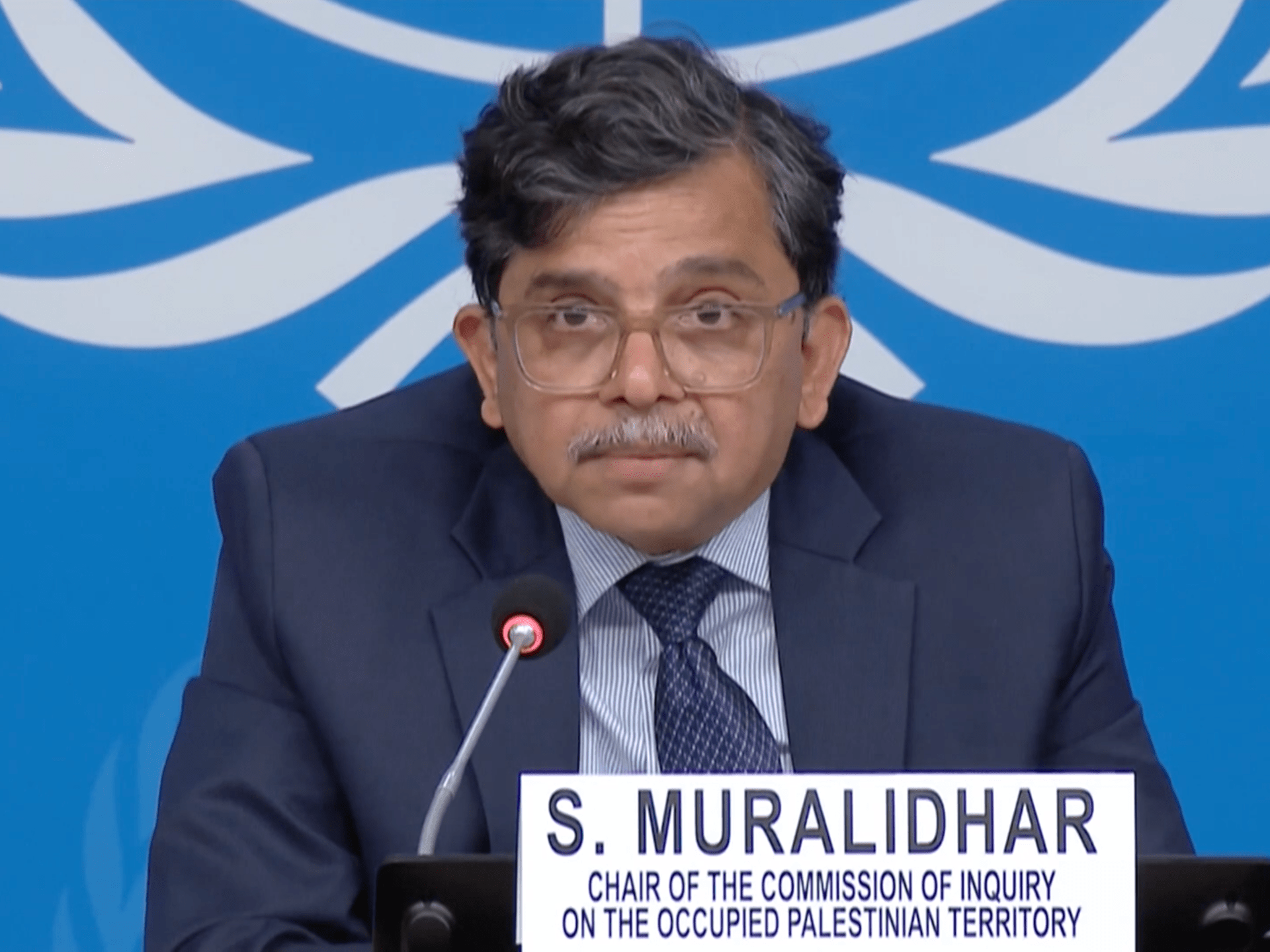

New Delhi, India – In 2020, the Indian government transferred Srinivasan Muralidhar, a judge in New Delhi, to another court in the middle of the night in an alleged move to stop him from acting against a politician from the governing party.
Six years later, the 64-year-old retired judge finds himself behind the most far-reaching United Nations investigation yet into Israel’s killing of Palestinian children in Gaza.
- list 1 of 4Israel’s deliberate targeting of Gaza children part of genocide: UN inquiry
- list 2 of 4Israel kills ‘a child a day’ on average in Gaza despite ceasefire, UN says
- list 3 of 4Kashmir, spying, demolitions: How Modi’s India embraced ‘Israel model’
- list 4 of 4How Modi ‘broke down walls’ between India, Israel – at Palestine’s expense
end of list
Published on June 23, the 94-page report by the UN Independent International Commission of Inquiry on the Occupied Palestinian Territory, including East Jerusalem, and Israel examined alleged Israeli violations against Palestinian children from the beginning of Israel’s genocidal war on Gaza in October 2023 to October 2025.
The commission, currently chaired by Muralidhar, was established by the UN Human Rights Council in May 2021. It is mandated to investigate alleged violations of international law and examine the “root causes” of the Israel-Palestine conflict.
Muralidhar joined the commission in November.
The commission found that Israel killed at least 20,179 Palestinian children in two years of the war, accounting for nearly 30 percent of all Palestinian deaths.
The report also documented more than 44,000 children injured and an estimated 58,000 children orphaned during the war.
It outlined a pattern of snipers and precision drone strikes targeting children, a blockade of humanitarian aid that fuelled starvation and disease as immunisation rates fell and a systematic targeting of maternity and neonatal facilities that endangered Gaza’s newborns.
Advertisement
The report also documented allegations of sexual violence, arbitrary detentions and torture of Palestinian children, particularly in the occupied West Bank.
‘Deliberately targeted and killed’
The commission recommended that UN member states halt arms transfers to Israel that “have involved or could involve the commission of genocide” and arrest Israeli officials wanted by the International Criminal Court (ICC), who include Prime Minister Benjamin Netanyahu.
“The evidence shows that Palestinian children have been deliberately targeted and killed by the Israeli security forces,” Muralidhar said.
Israel’s Ministry of Foreign Affairs rejected the report in its entirety, calling it a “libellous sham” and describing the UN commission as a mechanism designed to “vilify” the country. The report, it said, “completely erases Israeli children who were brutally murdered, kidnapped and targeted by Hamas while ignoring Hamas’s cynical use of Palestinian children as human shields and pawns of war”.
Meanwhile, inflammatory rhetoric targeting Palestinian children has come from top Israeli leaders since the October 7, 2023, Hamas-led attacks on southern Israel, including Knesset Deputy Speaker Nissim Vaturi, who said days after those attacks: “Don’t leave a single child there. Expel all the remaining ones, … so they have no chance of recovery.”
In a report released in September, the UN commission found reasonable grounds to conclude that Israeli authorities were committing genocidal acts against Palestinians in Gaza. A “ceasefire” agreed a month later has not stopped the killings.
“The air strikes are continuing, the killings are continuing and the situation is dire. It is really precarious,” Muralidhar told Al Jazeera on Monday.
He dismissed Israel’s claim that Hamas used Palestinian children as human shields, calling it a myth and instead noting that many of the children in the UN report were killed while going about everyday routines, not engaged in hostilities.
Muralidhar said the report’s real weight lies in the accountability it could set in motion.
He also pointed to thousands of foreign nationals serving in the Israeli military whose home countries, as Geneva Convention signatories, are obligated to prosecute them for violations upon their return.
Muralidhar said he personally has not been threatened since the report’s release. But a fellow commissioner, Chris Sidoti, has faced trolling and harassment since its publication.
Officials involved in international accountability work more broadly have faced growing pressure, including US sanctions on ICC judges and Palestinian rights groups linked to the court’s investigations into Israeli crimes.
Advertisement
“There are risks, but you learn to take these risks,” Muralidhar told Al Jazeera.
After four decades in law, he said, this was not an opportunity to pass up. “Everybody is looking at what’s happening in Palestine. They want to know why international law and systems aren’t working here.”
However, the UN report lands awkwardly for Muralidhar’s own country.
Since Prime Minister Narendra Modi came to power in 2014, India has become Israel’s most reliable arms buyer, purchasing 37 percent of its exports.
India’s Adani Group, led by Gautam Adani, a billionaire allied with Modi, sits at the centre of this relationship. In 2016, the group formed a joint venture with Israel’s Elbit Systems to manufacture Hermes 900 drones, one of Israel’s preferred tools of war, at a facility in the southern Indian city of Hyderabad. Other Indian firms, including Tonbo Imaging, Bharat Forge and Tech Mahindra, have followed suit. In January 2023, Adani also acquired Israel’s largest port in Haifa along with Israeli group Gadot.
When asked about such business partnerships between India and Israel, Muralidhar said the liability is not India’s alone.
“It can be any country or company, through arms or through logistics,” he said.
Conflict liability, in Muralidhar’s view, does not stop at borders: It falls on any state or company whose trade or technology ends up sustaining a war, wherever that war is being fought.
India and Israel weren’t always this close.
For decades after its independence in 1947, India backed the Palestinian cause, becoming the first non-Arab nation to identify a Palestine.
Things drastically changed in 2017 when Modi became the first Indian leader to visit Israel – a visit followed by an unprecedented political and security alliance between the two right-wing governments.
Days before Israel and the United States jointly attacked Iran in February, Modi again visited Israel, where he was the recipient of an award from the Israeli parliament created right before his trip.
‘Only judge with courage to act’
Muralidhar began his law practice in the southern city of Chennai in 1984. He moved in 1987 to practise in the Supreme Court of India and the Delhi High Court and counselled for India’s National Human Rights Commission and the Election Commission of India.
His pro bono work as a lawyer included representing victims of the Bhopal gas disaster, the world’s deadliest industrial accident, which killed more than 25,000 people in 1984. Muralidhar also worked for communities displaced by dams on the Narmada River, a project that led to years of protests by tribal groups and activists.
He also earned a doctorate in law from the University of Delhi in 2003.
Appointed as a judge at the Delhi High Court in 2006, Muralidhar built a reputation for defending civil liberties. In 2018, his bench convicted Sajjan Kumar, a former parliamentarian from the Indian National Congress party, for inciting mobs in the 1984 anti-Sikh riots that killed more than 3,000 people, and sentenced him to life imprisonment, overturning a lower court acquittal.
Advertisement
The same year, his bench heard the case of Najeeb Ahmad, a student at New Delhi’s Jawaharlal Nehru University who had been missing since 2016 after a scuffle with members of a campus student group affiliated with the Rashtriya Swayamsevak Sangh, the Hindu far-right organisation that mentors Modi’s Bharatiya Janata Party (BJP).
Rebuking India’s premier investigating agency, the Central Bureau of Investigation (CBI), for its “complete lack of interest” in Ahmad’s case, Muralidhar’s bench in its order said protests over his disappearance were a “democratic expression of the anxiety of the people”.
Ahmad remains missing. A New Delhi court last year accepted the CBI’s closure report in the case.
In 2018, Muralidhar was behind the conviction of 16 police personnel for the targeted killing of more than 40 Muslim men in 1987, three decades after a trial court acquitted them despite admissions that the custodial killings took place.
In February 2020, as deadly religious riots tore through New Delhi, prominent activist and writer Harsh Mander and filmmaker Rahul Roy were running a citizens’ control room to take phone calls the police had allegedly ignored, including from a clinic where men with bullet wounds would have died without hospital access.
Roy’s lawyer approached Muralidhar, who convened a midnight hearing at his residence to secure safe passage for the wounded. “I can say very clearly that he actually saved this city,” Roy said. “It could have been much worse.”
The riots, which erupted in the aftermath of protests over a citizenship law, killed 53 people, most of them Muslims.
The next day, Colin Gonsalves, a Supreme Court lawyer and rights activist representing Mander, petitioned the court for urgent police action against politicians accused of hate speech. Muralidhar’s bench ordered that videos of BJP leader Kapil Mishra’s speech inciting a crowd be played in court. He later directed the police to file a case against Mishra within 24 hours.
“Muralidhar was the only judge with the courage to act,” Gonsalves told Al Jazeera.
‘You have only one life’
But in what was widely seen as punishment for his strong stand over the New Delhi riots, the government issued a midnight transfer order for Muralidhar, packing him off to the Punjab and Haryana High Court 240km (150 miles) away.
Six years on, no police report has been filed against Mishra, who now serves as a minister in the BJP-led Delhi state government.
Muralidhar’s transfer sparked outrage. The Delhi High Court Bar Association held a strike to condemn it while the Congress party accused Modi’s government of shielding the BJP leader from prosecution.
But the transfer did not soften Muralidhar’s approach. During his stint at the Punjab and Haryana High Court, he rejected parole for Sanji Ram, convicted of masterminding the 2018 gang rape and murder of an eight-year-old girl from a Muslim nomadic tribe in Indian-administered Kashmir.
In January 2021, Muralidhar was elevated to the chief justice of the Orissa High Court, a post he held until his retirement in August 2023. He was given an unusual farewell in Odisha, where hundreds of lawyers lined up along the corridors and stairs at the court, throwing flowers at him as he walked out of the court for the last time.
Despite his credentials and qualifications, Muralidhar never reached the Supreme Court of India.
Years after the 2020 midnight transfer, Roy met him again. “I am really sorry that because of our petition, you were transferred,” he remembered telling him. Muralidhar smiled. “Happily so. I’m glad,” he replied to Roy.
Advertisement
Both Gonsalves and Mander think Muralidhar’s decision to hold the government accountable for the New Delhi riots cost him a Supreme Court seat.
“Judges who rule against the state in the high courts rarely make it to the Supreme Court, however competent,” Gonsalves said.
“In an ideal world,” Mander added, “what Muralidhar did should have been the rule, not the exception.”
It was the UN, Mander added, that “ultimately recognised his calibre, entrusting him with the Gaza inquiry that India’s own judiciary would not reward with a Supreme Court seat”.
In his public lectures as well, Muralidhar has spoken for the marginalised, once arguing that India’s laws are structured to favour the rich and pointing to the disproportionate share of Muslims, Dalits and members of other marginalised groups among those arrested and prosecuted.
“You have only one life. It’s a huge privilege being a lawyer,” Muralidhar said. “Every time one of us withdraws, there is one person less to fight injustice.”
Related News
El-Obeid under siege by RSF: Could this be Sudan’s next el-Fasher?
Over 5,500 children displaced by fighting in Sudan’s el-Obeid, charity says
Iran war day 118: IRGC rejects new Hormuz route; Rubio to meet GCC leaders