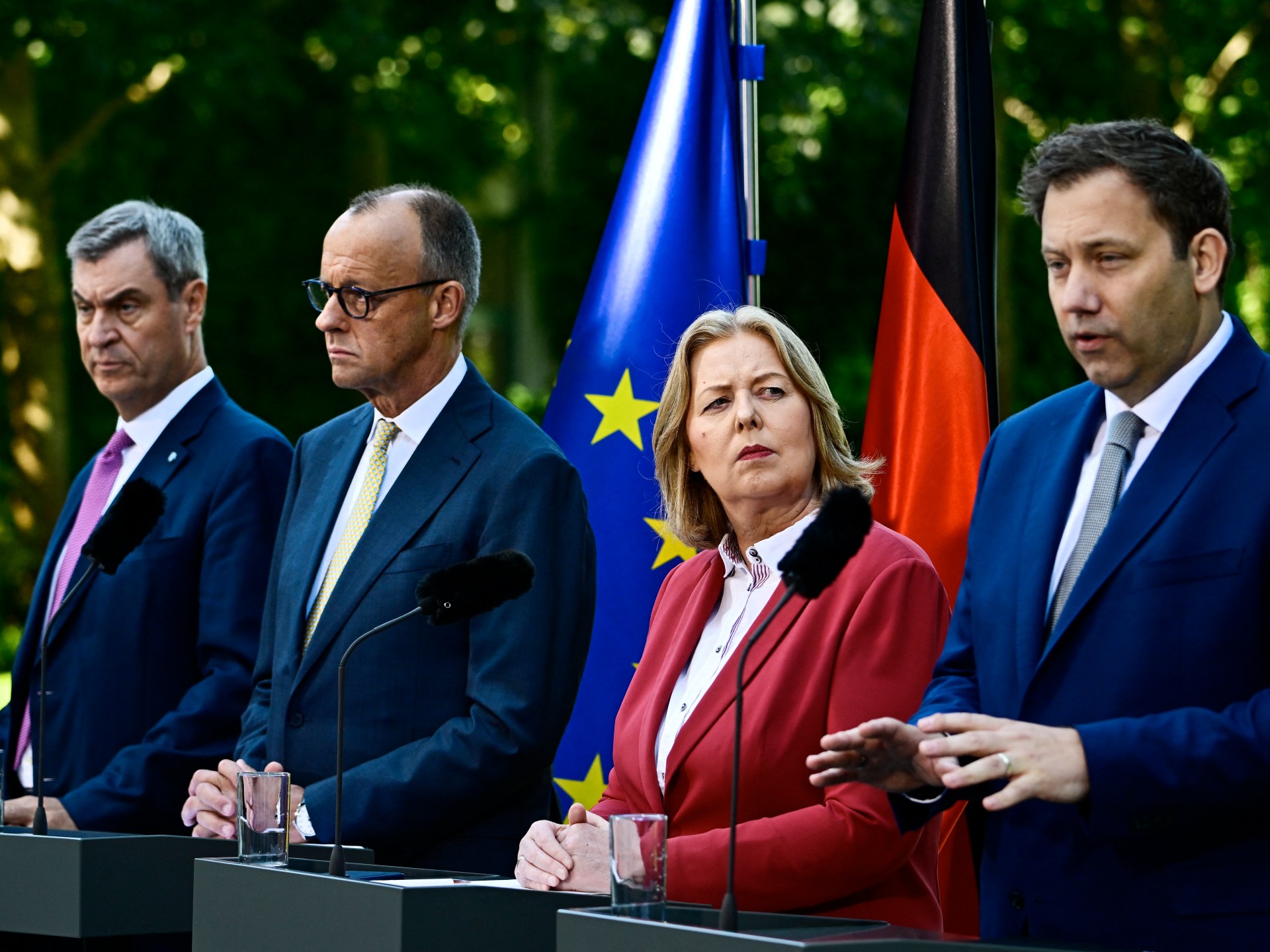

German Chancellor Friedrich Merz’s ruling coalition has unveiled a sweeping package of tax, labour and pension reforms aimed at reviving Europe’s largest economy and countering a surge by the far right.
The “Programme for Revival and Employment” announced on Thursday includes about 10 billion euros ($11.4bn) in annual income tax relief targeted at lower and middle-income earners, taking effect from January 1, 2027.
- list 1 of 3Top European leaders vow ‘strong’ support for Ukraine ahead of NATO summit
- list 2 of 3Germany’s Merz says EU to initiate integration of Western Balkans
- list 3 of 3US deepens European uncertainty with deployment of 5,000 troops to Poland
end of list
The 34 reform measures also include an overhaul of the creaking pension system, tougher rules for employees’ sick leave and a reduction of the country’s stifling bureaucracy.
The tax relief is to be financed primarily by restructuring the surcharge on top incomes.
“The highest earners in this country will therefore take on a larger share” of the tax burden, said Finance Minister and Vice Chancellor Lars Klingbeil of the centre-left SPD. “That is fair, so that our country can move forward.”
Trailing the far-right Alternative for Germany (AfD) in national polls ahead of critical eastern state elections this September, Merz’s centre-right CDU and their SPD coalition partners faced intense pressure to overcome months of internal deadlock.
“We are doing everything we can to overcome our country’s structural weakness when it comes to economic growth,” Merz told a Berlin news conference, admitting the government is “under pressure from many sides”.
He said the measures aim to cut red tape and protect the welfare state while easing the burden on companies hit hard by high energy costs, intense Chinese competition and US tariff pressures.
Advertisement
To address absenteeism, the package abolishes the pandemic-era policy allowing employees to obtain sick notes by telephone and requires a doctor’s certificate from the first day of illness, rather than the fourth as at present. It also loosens labour rules, doubling the maximum duration of fixed-term contracts without cause to 48 months, and scraps a range of corporate reporting obligations.
On pensions, the coalition committed to implementing all 33 recommendations of the government-appointed pension commission, with legislation to be completed by the end of the year. The proposals would link the retirement age to life expectancy after 2031, pushing it beyond the current legislated ceiling of 67 – with some estimates pushing it to 70 by the 2090s.
Marion Muehlberger, senior economist at Deutsche Bank, told the AFP news agency that Thursday’s announcement represented “one of Germany’s biggest reform packages in decades” and showed the government’s “ability to agree on important structural reforms”.
She said the package “should bode well for sentiment and dovetails with our forecast that growth will pick up in the second half of the year”.
The measures still require approval by the Bundestag, the lower house of parliament, and the income tax reform will also need the consent of the Bundesrat, the upper chamber, which has warned of a revenue shortfall.
Related News

Record 230 people reach UK on single boat after crossing English Channel

Mutual defence: The alliances that preceded Turkiye-Pakistan-Saudi pact

Israeli wounded in occupied West Bank stabbing