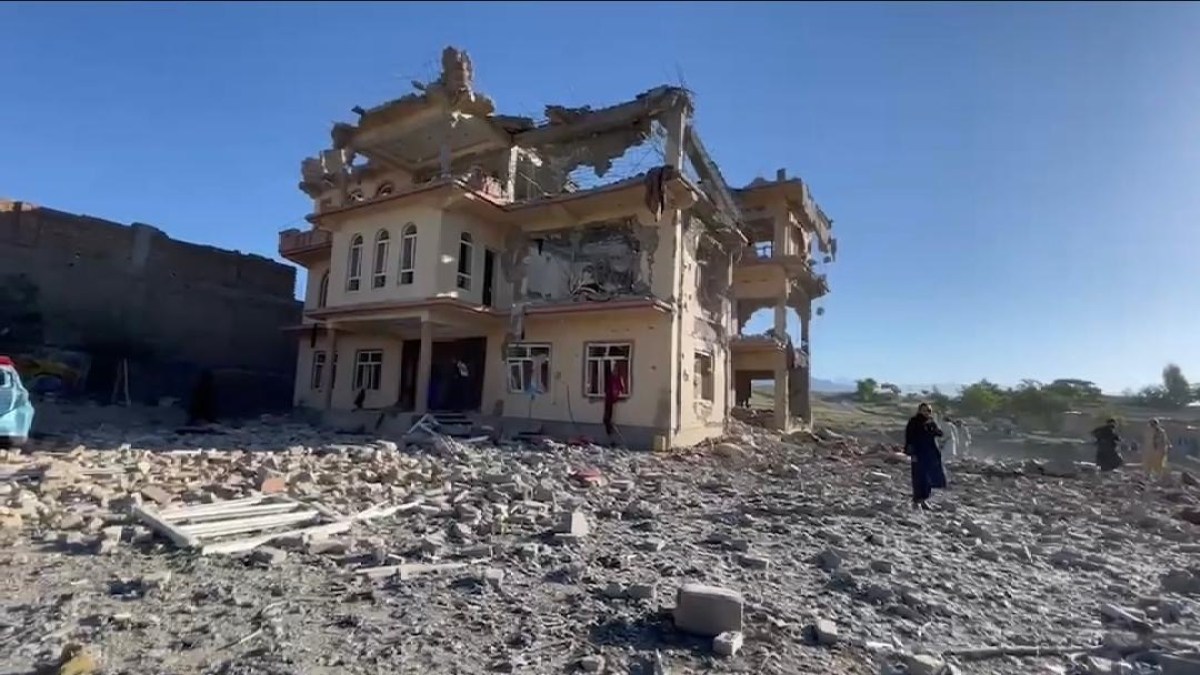

Bismillah Khan returned to his border village in Afghanistan’s Paktia province earlier this month with a dream: to spend the rest of his life in the home he had built with the hard-earned savings from 12 years of working in the Gulf.
The man in his 50s had invested everything he earned abroad in constructing a two-storey house for his children and grandchildren. But that dream was shattered within minutes when he awoke before dawn on Monday to the sound of powerful explosions ripping through the village of Mandikhil in Chamkani district.
Khan’s house was among dozens of civilian homes that Afghanistan says were struck by Pakistani air raids overnight in the provinces of Paktika, Paktia and Kunar along the two countries’ disputed border. The Afghan government said the attacks killed at least 36 civilians and wounded 163 others, most of them women and children.
Pakistan maintained its forces conducted “precise targeting” while striking at armed groups’ hideouts in the three Afghan provinces, saying its air and ground operations killed 29 fighters.
Standing amid piles of stone and mud that until recently formed his home, Khan struggles to comprehend what happened.
“There were only women and children inside the house,” he said, his voice breaking. Khan’s wife and daughter were killed in the attack, while some 10 other relatives were wounded.
“I do not know why our home became a target.”
But the pain did not end with the first attack.
Hours after the initial strikes, as people searched through the rubble for survivors and rushed the wounded to nearby medical facilities, another air raid struck again.
Advertisement
Residents said missiles landed near groups of civilians involved in rescue efforts, causing additional casualties.
“We were searching for children and women trapped beneath the rubble,” said resident Marzia Khan Wali of the second strike. “We were carrying the injured to vehicles to take them to hospital when we heard the aircraft again. Within seconds, those trying to save lives became victims themselves.”
In the village of Jilan in neighbouring Paktika province, Zarmina, a mother of five, sits beside the ruins of her destroyed home. She lost both her husband and young daughter in the attack.
“We were asleep when the bombs fell,” she said, clutching a blanket recovered from the debris. “There was no warning. When I opened my eyes, everything was gone.”
“We know nothing about politics or armed groups,” she added. “We are just farmers.”
In Kunar province, dozens of families have fled villages near the border, fearing further attacks. Local elders said many residents now prefer sleeping in open fields or moving farther away from the frontier.
“People here live between two fears,” said tribal elder Mera Khan. “The fear of war and the fear of losing their homes.”

The latest raids come amid escalating tensions between Afghanistan and Pakistan.
Since the Taliban returned to power in Afghanistan in August 2021, Pakistan has carried out a number of cross-border attacks, saying its forces have targeted fighters belonging to the Pakistan Taliban (TTP), whom Islamabad accuses of using Afghan territory as a safe haven to launch attacks inside Pakistan.
In recent years, Pakistan has witnessed a sharp increase in attacks claimed by the TTP, particularly in Khyber Pakhtunkhwa and Balochistan provinces, where security forces and military installations have repeatedly come under attack.
Pakistan’s Information Minister Attaullah Tarar, in a social media post, said his country’s counterterrorism campaign would “continue at full pace to wipe out the menace of foreign-sponsored and supported terrorism”.
The Afghan government strongly condemned the latest strikes, describing them as “a blatant violation of Afghanistan’s sovereignty” and “an attack on innocent civilians”.
The Taliban-run government maintains that it remains committed to the provisions of the Doha Agreement that was signed in February 2020 between the United States and the Afghan Taliban that committed it to preventing Afghan soil from being used in attacks against others.
Advertisement
Back in Paktia, Khan says the priority now is finding shelter for his surviving family.
“I left my homeland for years in search of a better future,” he said, quietly.
“I came back hoping to live in peace, but war arrived before I did.”
Related News
Inside the secret battle to document RSF abuses in Sudan
Trump says war can’t ‘go much longer’, Hormuz deal close
‘Barrel bomb mufti’ Ahmad Hassoun handed life sentence in Syria trial