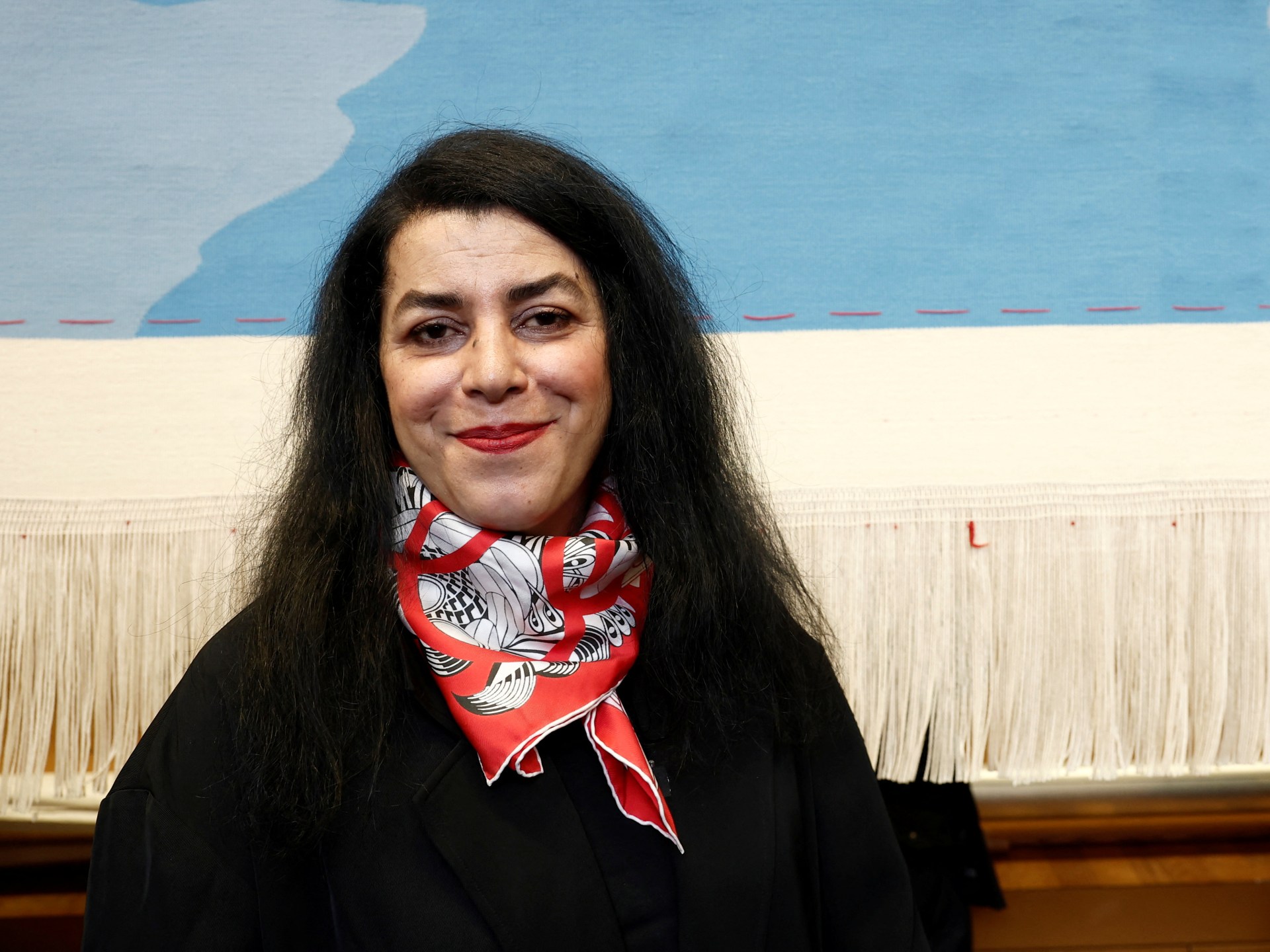

French-Iranian author and film director Marjane Satrapi has died at the age of 56.
Best known for her autobiographical graphic novel Persepolis, which she later directed as a film, Satrapi’s passing was announced on Thursday by French President Emmanuel Macron’s office.
- list 1 of 4Iranian authorities remain defiant, urge supporters to stay in streets
- list 2 of 4How Iran has changed, and how it hasn’t, in two months of war
- list 3 of 4Winning peace in Lebanon is harder than winning war
- list 4 of 4US says Iran’s new supreme leader alive and ‘increasingly engaging’
end of list
Her family said in a statement sent to the AFP news agency that Satrapi had died of “sadness” a little over a year after the death of her husband, Mattias Ripa.
Macron paid tribute to the author and said “her passing marks the loss of a leading figure in French culture and an artist devoted to freedom, whose work carried a universal message and earned her immense international renown”.
The dissident writer and illustrator was born in 1969 in Rasht, in northern Iran. In 1983, her parents sent her to Austria to finish her studies due to growing extremism following the Iranian revolution in 1979 that brought Ayatollah Ruhollah Khomeini to power.
But she returned home due to homesickness and attended the University of Tehran, obtaining a degree in visual communications which would lay the foundation for her artistic path.
Satrapi left for France in 1994, where she lived much of her life, but remained deeply connected to her Iranian roots through her work.
Her black-and-white autobiographical novel, which first came out in 2000, would be born from the experiences of her life, most notably Iran’s Islamic revolution and the fallout of its war with Iraq.
The coming-of-age story weaves together boys, booze and punk rock, while its monochromatic illustrations draw readers into the author’s world and the strong narrative breathing life into every page.

The film delves into her life about growing up a strong-willed young girl of intellectual parents.
Advertisement
“I come from a country where a woman is worth half a man,” she told US entertainment outlet Variety in 2007. “I never thought I had one leg less just because I was a woman.”
Persepolis was later adapted into a film which gained widespread praise, and was nominated for best animated feature at the 2008 Academy Awards. It won the Cannes Jury Prize in 2007 and the Cesar award for Best First Film.
“What we wanted to say is, if these people scare you, look closer: they have parents, they have lovers, they have hope, they have stories,” she told AFP in an interview in 2007 at Cannes.
She went on to work on more films which include Chicken with Plums, The Voices, which starred actor Ryan Reynolds, and Radioactive, starring Rosamund Pike as scientist Marie Curie.
In 2024, she was offered France’s highest award, the Legion of Honour, but refused to accept it as she felt France hadn’t done enough to support Iranian people fighting for democracy.
“Supporting the women’s revolution in Iran cannot be reduced to photos or speeches,” she wrote in a January 2025 letter to French authorities. “When people are fighting for democracy, we should support them.”
Related News

Senegal PM slams West’s ‘homosexual tyranny’, defends LGBTQ crackdown

Israel begins deporting Gaza aid flotilla activists amid global outcry

Guatemala denies agreeing to US strikes against drug traffickers