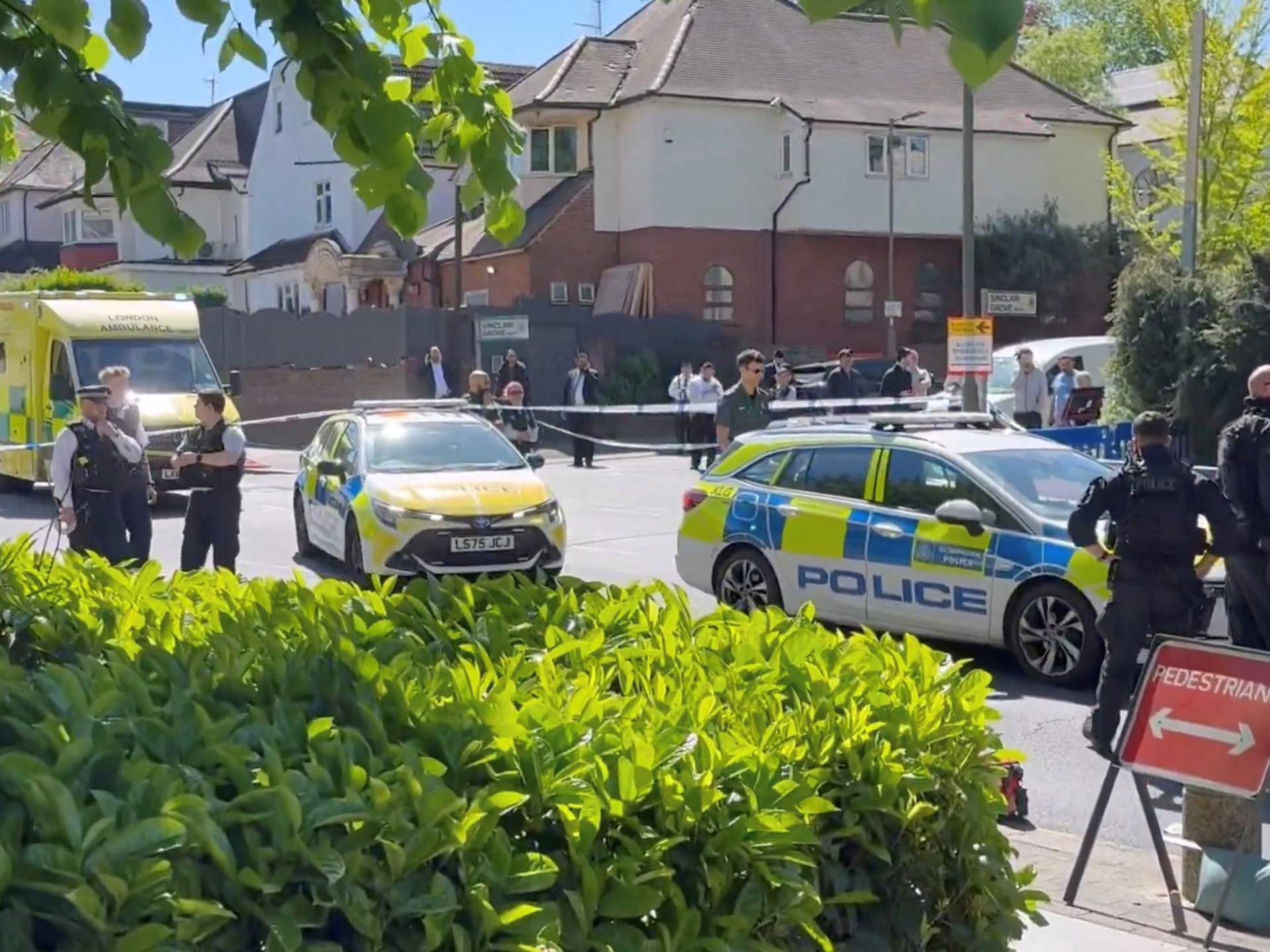

The United Kingdom’s Metropolitan Police have charged a man with attempted murder following an investigation into the stabbing of two Jewish men in Golders Green, north London.
Following the stabbings in a residential area of the UK capital on Wednesday, officials raised the national terrorism threat to its second-highest level, signalling that an attack within the next six months is “highly likely”.
- list 1 of 3$25bn or $1 trillion: How much has Iran war really cost the US?
- list 2 of 3US military equipment worth billions of dollars destroyed in Iran war
- list 3 of 3Iran, protests, human rights – all to know about the 76th FIFA Congress
end of list
This week, Prime Minister Keir Starmer pledged stronger action will be taken to protect Jewish people.
Police said Essa Suleiman, 45, had been charged with two counts of attempted murder and one count of possession of a bladed article in a public place in relation to the attack. He was also charged with attempted murder in relation to a separate incident earlier on the same day in south London.
Suleiman has been remanded in custody and is due to appear at Westminster Magistrates’ Court later on Friday.
Police said Suleiman resisted arrest and was detained with the use of a taser gun. Met Police Commissioner Mark Rowley said the police officers who arrested a man after Wednesday’s stabbings of two Jewish men in north London were “shaken” after the intervention.
The UK’s Green Party leader Zack Polanski retweeted an X post accusing the officers of “repeatedly and violently kicking a mentally ill man in the head” when he was already incapacitated from being tasered. Video showing the violent arrest was widely circulated.
Asked if the officers’ behaviour was “acceptable”, Rowley told LBC radio on Friday morning: “I sat down with the officers on Wednesday afternoon, a couple of hours after the attack, and you could still see they were shaken.
Advertisement
“They’d taken on a terrorist, and as that incident developed they were afraid, because he didn’t comply at all, even after being dropped to the floor by a taser, they were afraid that he might have an explosive device on him from the way he’s behaving, he didn’t in the end, and of course they used a lot of force,” he said.
Asked if it was “necessary” to kick the man in the head during the arrest, Rowley said: “They’re using the force that they seem (sic) necessary.
“Unless you’ve been in that moment where you’re scared stiff and you’re confronting somebody so dangerous, it’s hard to put yourself in that situation.
“They’re desperately concerned about stunning him and sort of neutralising him.
“I’m not interested in politics but if somebody eminent, rather than some of the oddballs on social media, if someone eminent says something or does something which I see has a risk to undermining the confidence of my officers to act – because they need that sense of public support – they now need to intervene on that, and that’s what I did with that letter.”
In a letter to Polanski, Rowley wrote that he was “disappointed”, adding that the post was “inaccurate and misinformed”.
The stabbing, which took place in an area that is home to a large Jewish community in London, was reported on social media by the Community Security Trust, a charity providing safety advice and security to Jewish groups and buildings such as synagogues.
One of the victims, a 34-year-old man, has since been released from hospital, while a 76-year-old victim remains in a stable condition, police said.
There are mounting security concerns linked to foreign states, which the government said had helped fuel violence, including against the Jewish community, in recent weeks.
Last week, the Finchley Reform Synagogue in north London was targeted. Other incidents have followed, including an attack on the Kenton United Synagogue in Harrow as well as the premises of a Jewish charity.
Several of the incidents have been claimed by HAYI, whose name means the Islamic Movement of the People of the Right Hand.
British police have arrested 26 people for various attacks launched since the start of the US-Israel war on Iran on February 28.
Related News
Spain, Slovenia, Ireland push EU to debate Israel pact suspension

Why is piracy rising off Somalia again — and is the Iran war responsible?
US gas reaches $4.30 per gallon; Trump says prices will drop after Iran war