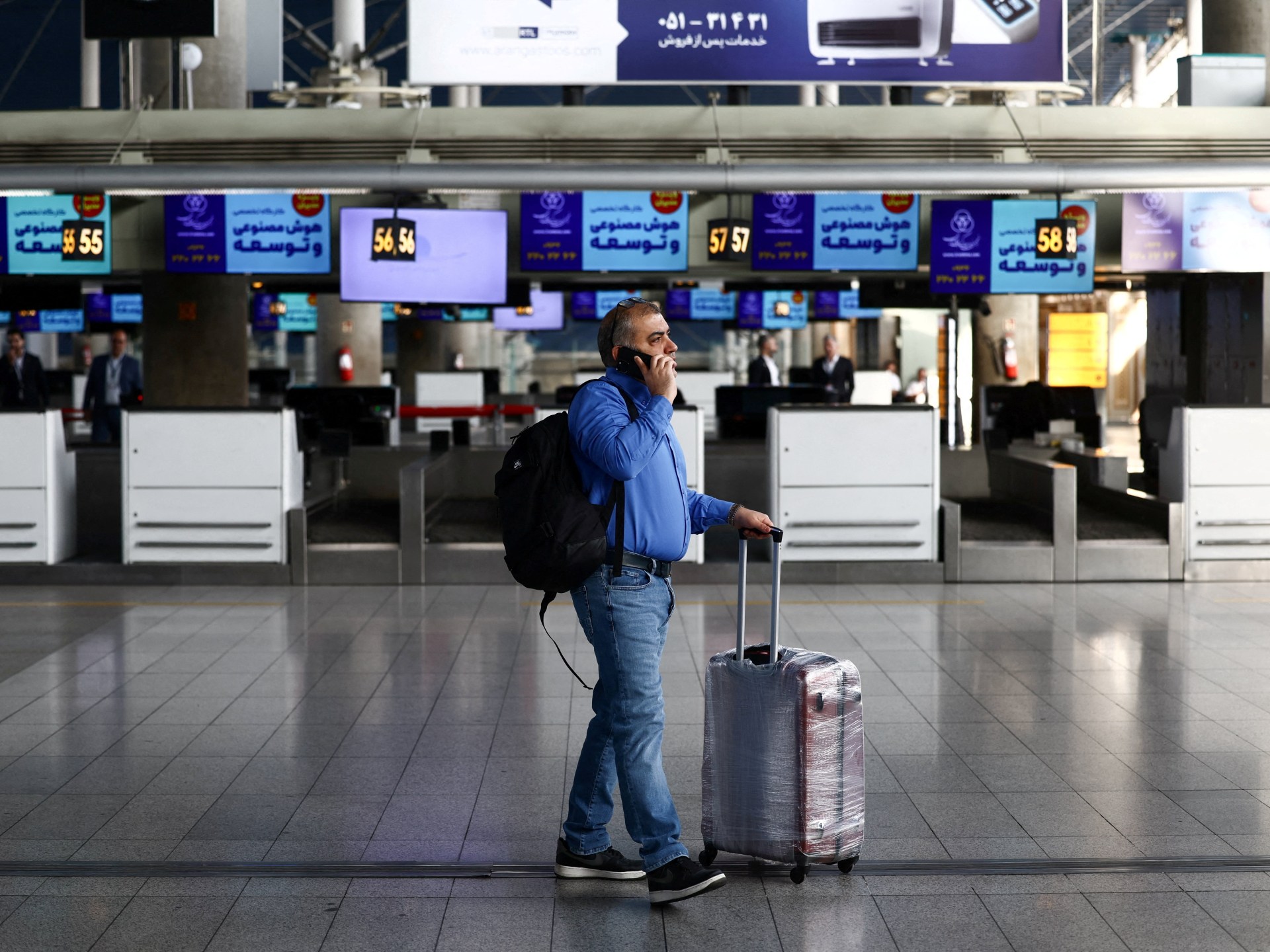

Iran has resumed commercial flights from the capital Tehran’s international airport for the first time since the United States and Israel attacked the country two months ago.
Iran’s state-run television reported that flights for Istanbul, Muscat and the Saudi Arabian city of Medina took off from Tehran’s Imam Khomeini International Airport on Saturday.
- list 1 of 4Jet fuel shortage: Why Iran war could ground flights in Europe
- list 2 of 4EU eyes options as Iran conflict threatens jet fuel shortages
- list 3 of 4Lufthansa cuts 20,000 flights as Iran war causes jet fuel shortage
- list 4 of 4How Iran war has triggered soaring cost of medicines
end of list
Iran’s state-owned carrier, Iran Air, operated its inaugural flight from Tehran to the second-largest city of Mashhad after a 56-day hiatus, state-run IRNA news service said in a series of Telegram posts, adding that more flights are scheduled for Baku, Najaf, Baghdad and Doha in the coming days.
Mohammad Amirani, CEO of the Iran Airports and Air Navigation Company, said the country’s eastern side – which borders Turkmenistan, Afghanistan and Pakistan – will be prioritised for domestic and transit flights.
Provincial airports, including Mashhad, Zahedan, Kerman, Yazd and Birjand, are slated to become nodes for directing air traffic, IRNA said. Authorities said they had started consultations with foreign airlines to clarify routes and to re-attract transit flights as a fragile ceasefire with the US continues, while efforts for more talks between Tehran and Washington continue in Pakistan.
The US-Israel war on Iran roiled international air travel for weeks, forcing much of the Middle East’s airspace to shut down and leaving tens of thousands of travellers scrambling to return home.
Even as dozens of countries organised chartered flights to repatriate their citizens, their efforts were stymied by the near-shutdown of commercial aviation in one of the world’s busiest regions for air travel.
Advertisement
Countries including Qatar and the United Arab Emirates partially reopened their airspaces days after attacks began on February 28, with schedules further expanding in the weeks that followed.
The ongoing blockade of the Strait of Hormuz, meanwhile, has triggered the prospect of a mounting jet fuel crisis. The European Union is considering jet fuel imports from the US, alongside new minimum reserve quotas, amid a pending supply crunch.
The head of the International Energy Agency Fatih Birol warned earlier this month that Europe has “maybe six weeks or so [of] jet fuel left” and that flight cancellations could commence “soon” without a shift in supplies.
German aviation company Lufthansa Group on Thursday said it would slash 20,000 short-haul flights until October amid rising oil prices and fears of jet fuel shortages.
Related News
UN experts urge member states to suspend Israel arms transfers

Rapper d4vd arrested on suspicion of murdering 14-year-old girl

US judge blocks Justice Department bid to seize voter data in Rhode Island