

The World Bank Group (WBG) is looking to play a greater role in Guyana’s unprecedented economic transformation by expanding its investment portfolio here through the local private sector.
This was cemented in an agreement that was inked between the WBG and the Guyana Government on the sidelines of the 2026 World Bank Group and International Monetary Fund (IMF) Spring Meetings that were held in Washington, DC, over the past week.
In a brief statement late Friday evening, the World Bank’s Caribbean division said it is strengthening the partnership with Guyana.
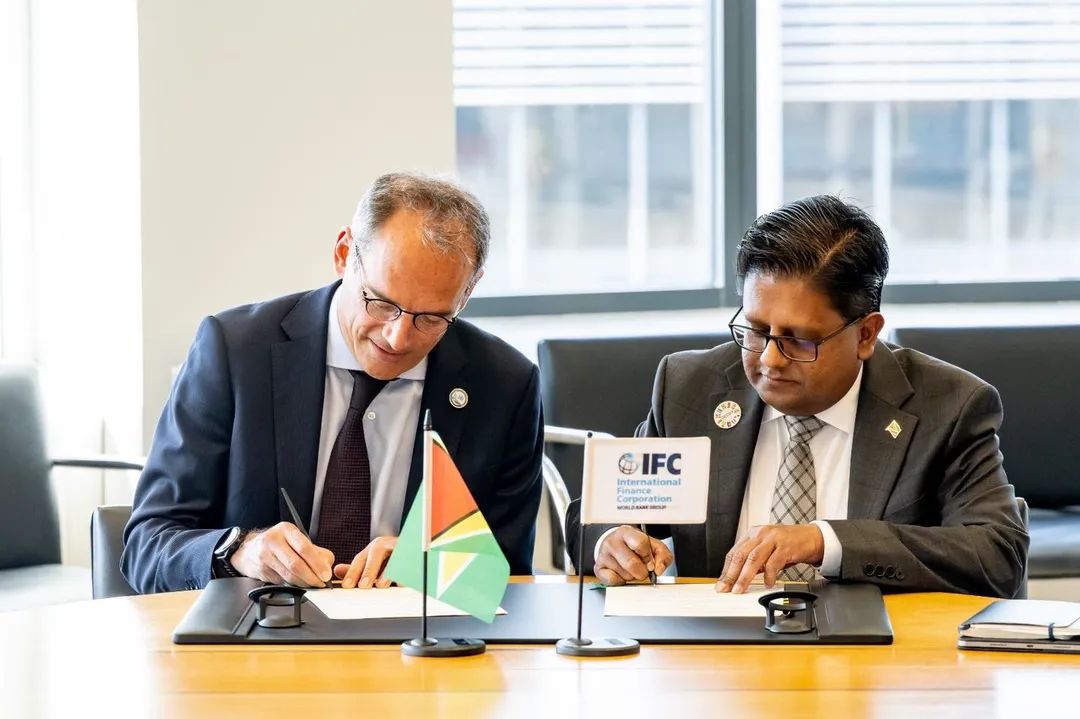
“In the context of the #WBGMeetings, the Government of Guyana and IFC (International Finance Corporation) signed the WBG Establishment Agreement-a key milestone to scale private sector development, support job creation and deepen impact in the country,” it noted.
Signed by Senior Minister with Responsibility for Finance in Guyana, Dr Ashni Singh, and IFC Vice President (VP) for Europe, Latin America, and the Caribbean (LAC), Alfonso García Mora, the agreement provides the institutional framework for the operations of all WBG institutions, enhancing its ability to deliver in the world’s fastest-growing economy.

The IFC is the private-sector arm of the WBG, focusing on economic development through private enterprise in emerging markets. As the largest global development institution for the private sector, it provides investments and advisory services to create jobs and reduce poverty.
This Agreement will pave the way for expanded engagement by the WBG in support of local private sector development, and strengthen the WBG’s ability to work closely with the private sector to play its part in promoting more resilient and inclusive economic growth and development.
During his remarks, Minister Singh expressed appreciation to the IFC for their support to the local private sector, but reiterated the need for more tangible results to be demonstrated by IFC’s efforts, especially if they are to play a meaningful role in this period of rapid expansion in the domestic economy.
n
Exploring new products
Only a few weeks ago, Minister Singh pointed out that Guyana’s relations with the World Bank are evolving into different dimensions, given the country’s changing economic circumstances. This includes exploring products being offered by entities within the Group, including the IFC.
Dr Singh’s remarks came in light of concerns as Guyana risks potentially losing its eligibility for access to concessional resources under the World Bank’s International Development Association (IDA) due to the country’s rising income per capita. Access to IDA resources is tied to the per capita income of countries, something which the finance Minister had said Guyana has long been arguing against, even before its oil boom and a challenge that the country is facing with many of its other development partners.
“We will always fight for the largest possible access to concessional resources, but as we navigate this period of change in the Guyanese economy, other members of the World Bank Group have tools, instruments and products that will take on new relevance, including, in particular, the World Bank’s private sector operations… The private sector arm of the World Bank is now doing a lot more in Guyana, and we’re pushing them to do a lot more given the speed at which we’re seeing the private sector grow,” the Minister explained during a podcast interview last month.
At the time, Dr Singh was joined by World Bank Country Director for the Caribbean, Lilia Burunciuc, as they reflected on the work of the financial institution in Guyana over the years and the role it will play in helping to build out the country’s future. In fact, Burunciuc assured that the World Bank is committed to continuing to work with Guyana even as a high-income nation, expressing hope that this collaboration would expand into new areas.
According to a former World Bank Country representative, these include “…focusing on attracting private investments, making sure that high-quality jobs are created, ensuring that not only the oil economy but also the non-oil economy is doing well, and for this, there is a need for investments… Going forward, it’s about more investing in systems, investing in ‘know-how,’ and investing in innovations to ensure that the economy continues to advance, while also trying to offer Guyana new innovative products like… various guarantees that will allow Guyana to access resources in the capital markets at lower costs .”
Subscribe to get the latest posts sent to your email.