Caricom leaders need to change approach to tackling climate change – VP Jagdeo
 27 March 2026
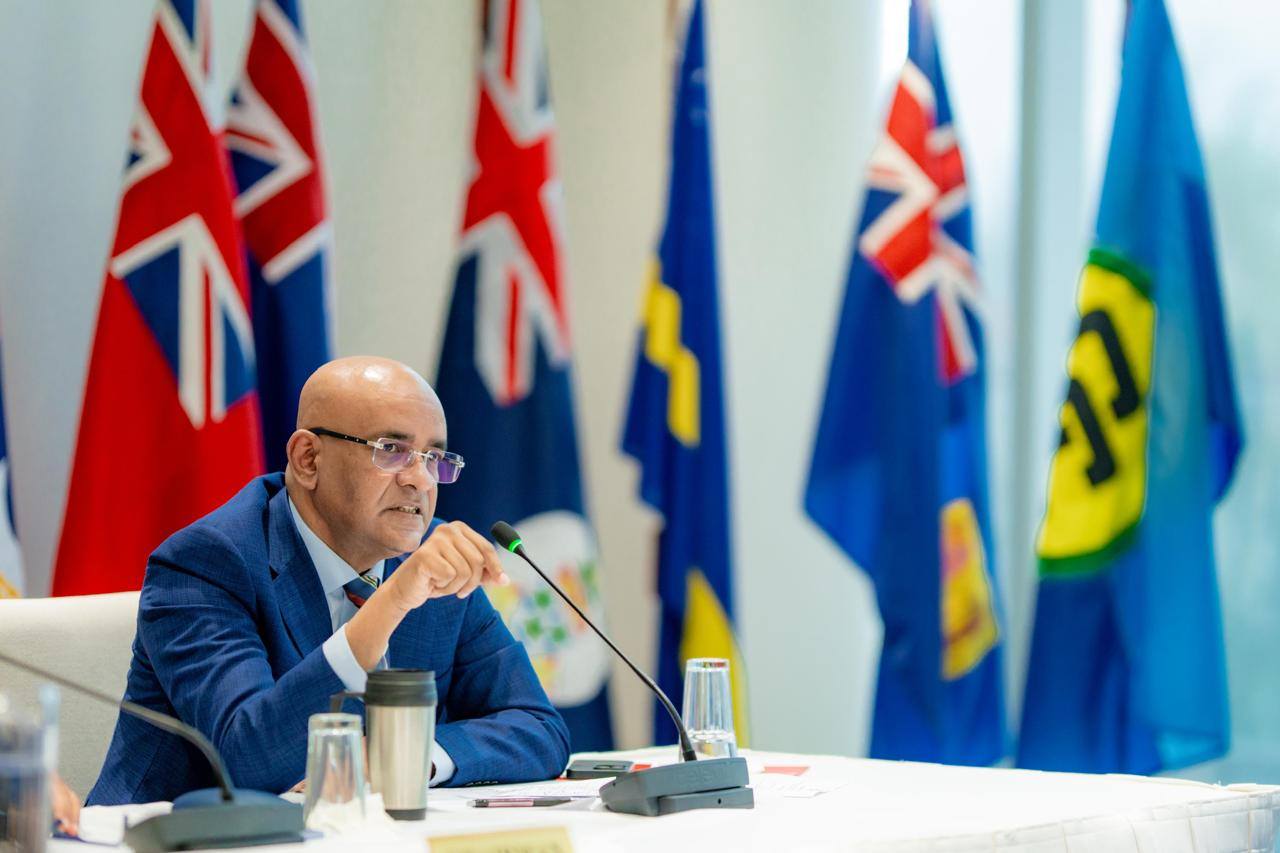


Recognising the risks that Guyana faces with its coastland being below sea-level, Vice President Dr Bharrat Jagdeo has said that the Government is using funds earned from the sale of the country’s high-quality forest carbon on a host of climate resilient initiatives to bolster its vulnerable coastline.
He made these remarks at the Caribbean Community’s (CARICOM) 124th Special Meeting of the Council for Trade and Economic Development (COTED) – Environment and Sustainable Development held on Thursday at the Pegasus Hotel in Georgetown, where he urged ministers and other stakeholders from across the region to change their approach to combatting climate change.
According to the Vice President, Guyana is currently earning nearly US$1 billion from selling just over 30 per cent of its accredited forest carbon and about 85 per cent of those revenues are injected into climate resilient projects including the installation of drainage pumps and the construction of canals as well as dams to prevent water from the highlands to flood the coast.
“We live here in a trough on the coast where most of our fertile lands are. So, we’re now installing 39 fixed pumps. We’re buying 40 mobile high-intensity pumps… We’re building 125 kilometres of dams to keep the water from the backlands from coming down. We’re going to do 841 kilometers of secondary and primary canals. That’s all under implementation, all funded by money that we have raised, climate funds, on our own.”
“When completed, that will climate-proof the coast. We’d be able to take water directly from the backlands and get it into the Atlantic [Ocean] without flooding the villages. But we will have another benefit…we’ll open up about 90,000 acres of land, make them arable, by draining and irrigating these lands – that’s just under the size of Barbados,” Jagdeo highlighted.
Change approach
But while he recognised that most CARICOM nations do not possess the resources as Guyana to do the same, the Vice President told regional officials at the COTED Meeting that they need to change their approach to climate change.
“You can be deliberate about your approach to climate change,” Jagdeo, a former Guyanese President who is recognised globally for his work on environmental sustainability and the mastermind behind Guyana’s Low Carbon Development Strategy (LCDS) that underpins the country’s sustainable development, declared.
VP Jagdeo pointed out that while like Guyana, the Caribbean region too is vulnerable to the effects of climate change, Member States have to stop overstating the problem and either look for or get involved in the search for solutions.
He quoted the International Monetary Fund (IMF), which reported that since 1950, some 511 disasters have hit small developing countries with populations of less than 1.5 million people. Of those, a whopping 324 disasters were recorded in the Caribbean region.
Foolproof against disasters
“We know the devastation it has caused the lives, but also how much it has taken away from development… [But] unless you are very deliberate, you are going to get caught up in the same never-changing, almost circular arguments… We have done this every single time we have gone to COP. We have overworked the impact of climate change on our region.”
“So, whether there was a climate crisis or not, we need to foolproof our region against disasters. And until now, whilst we talk a lot globally about getting funds for adaptation and getting funds for loss and damage, many countries in our region do not have a clear, detailed plan as to how we will climate-proof many parts of our economy. For example, would it cost if we are to take every school, every hospital, every police station, every public building, and climate-proof them so they can withstand a Category 5 hurricane? How much will it cost us? How much will it cost us if we were to take the power lines and bury them in the region, in our countries, so that any time we have a hurricane, we don’t lose that huge economic or social infrastructure? …So, climate crisis or not, we have to foolproof our economies and our societies from disasters,” Jagdeo stressed.
The two-day Special COTED Meeting, which concludes today, serves as an important forum to strengthen CARICOM’s preparedness and engagement ahead of major global environmental events including the 31st Conference of the Parties (COP31) to the United Nations Framework Convention on Climate Change and the 17th Conference of the Parties to the Convention on Biological Diversity (CBD COP17).
CARICOM Secretary-General, Dr Carla Barnett, said during opening remarks on Thursday that this multi-day programme being executed this week is focused on reinforcing regional coherence on a number of areas including the CARICOM Climate Finance Action Plan (2026–2030) which is intended to ensure Member States are better positioned in global discussions on climate funding and are able to secure transparent and accessible financing to support national and regional resilience efforts.
“The Secretariat has heard your call to integrate our approaches to addressing oceans, climate and biodiversity. This week, we have brought our partners together with the expectation that this will be a catalyst for cooperation towards our goal of a thriving Caribbean environment. We know this is not an easy task. Integrating issues means navigating and combining partnerships and processes. Mandates do overlap. Our collective dedication has brought us together today, ready to make meaningful progress for our Region and its future,” the Secretary-General noted.
Subscribe to get the latest posts sent to your email.
Related News

Suspect shot as police arrest 5 for armed robbery
Guyana's newest FPSO to be named ‘Essequibo 1899’ - Pres. Ali
De Kinderen hospital records significant emergency, outpatient intake over seven months