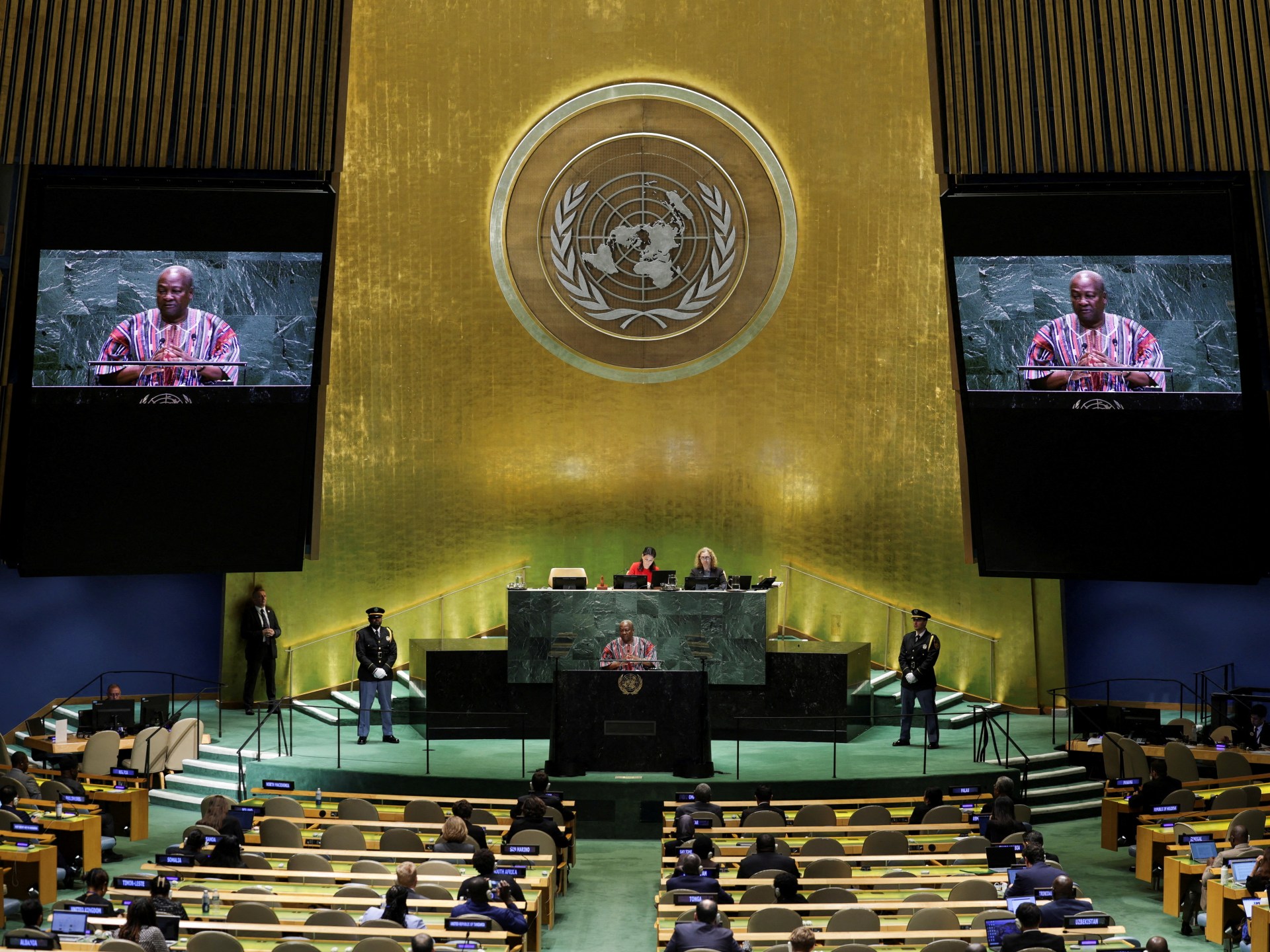

A United Nations resolution, proposed by Ghana, to recognise transatlantic slavery as the “gravest crime against humanity” and calling for reparations, has been adopted despite pushback from Europe and the United States.
At a UN General Assembly (UNGA) vote on Wednesday, 123 countries supported the resolution, which is not legally binding but carries political weight, while three opposed it, including the US and Israel, and 52 abstained, including the United Kingdom and European Union countries.
- list 1 of 4More than 600 British Empire-era artefacts stolen from Bristol Museum
- list 2 of 4Activist leads tour through ‘architectural crime scene’ of Cape Town’s past
- list 3 of 4Portuguese Empire: Ports and Profits
- list 4 of 4Behind the myths of the British Empire: Nigel Biggar and Mehdi Hasan
end of list
Ghana said the resolution was needed because the consequences of slavery, which saw at least 12.5 million Africans abducted and sold between the 15th and 19th centuries, persist today, including racial disparities.
Ghana’s President John Dramani Mahama, a key architect of the resolution, said the resolution’s passing was “a route to healing and reparative justice”.
“The adoption of this resolution serves as a safeguard against forgetting … Let it be recorded that when history beckoned, we did what was right for the memory of the millions who suffered the indignity of slavery.”
Ghana’s foreign minister, Samuel Ablakwa, said the resolution called for accountability and could pave the way for a “reparative framework”.
“History does not disappear when ignored, truth does not weaken when delayed, crime does not rot … and justice does not expire with time,” Ablakwa said.
UN Secretary-General Antonio Guterres told the UNGA that “far bolder action” was required from more states to confront historical injustices.
Advertisement
The Netherlands remains the only European country to have issued a formal apology for its role in slavery.
The resolution has come after the African Union last year set out to create a “unified vision” among its 55 member states about what reparations for slavery may look like.
It urges member states to engage in dialogue on reparations, including issuing formal apologies, returning stolen artefacts, providing financial compensation, and ensuring guarantees of non-repetition.
Despite the longstanding calls for reparations, there is also a growing backlash.
Several Western leaders have opposed even discussing the subject, with critics arguing that today’s states and institutions should not be held responsible for historical wrongs.
Both the EU and the US voiced concerns that the resolution could imply a hierarchy among crimes against humanity, treating some as more serious than others.
Related News

Israel says it killed Iran Intel minister in third assassination in 2 days
Madagascar names anticorruption chief as PM days after cabinet dissolved
Israeli attacks on Lebanon may amount to war crimes, UN rights office says