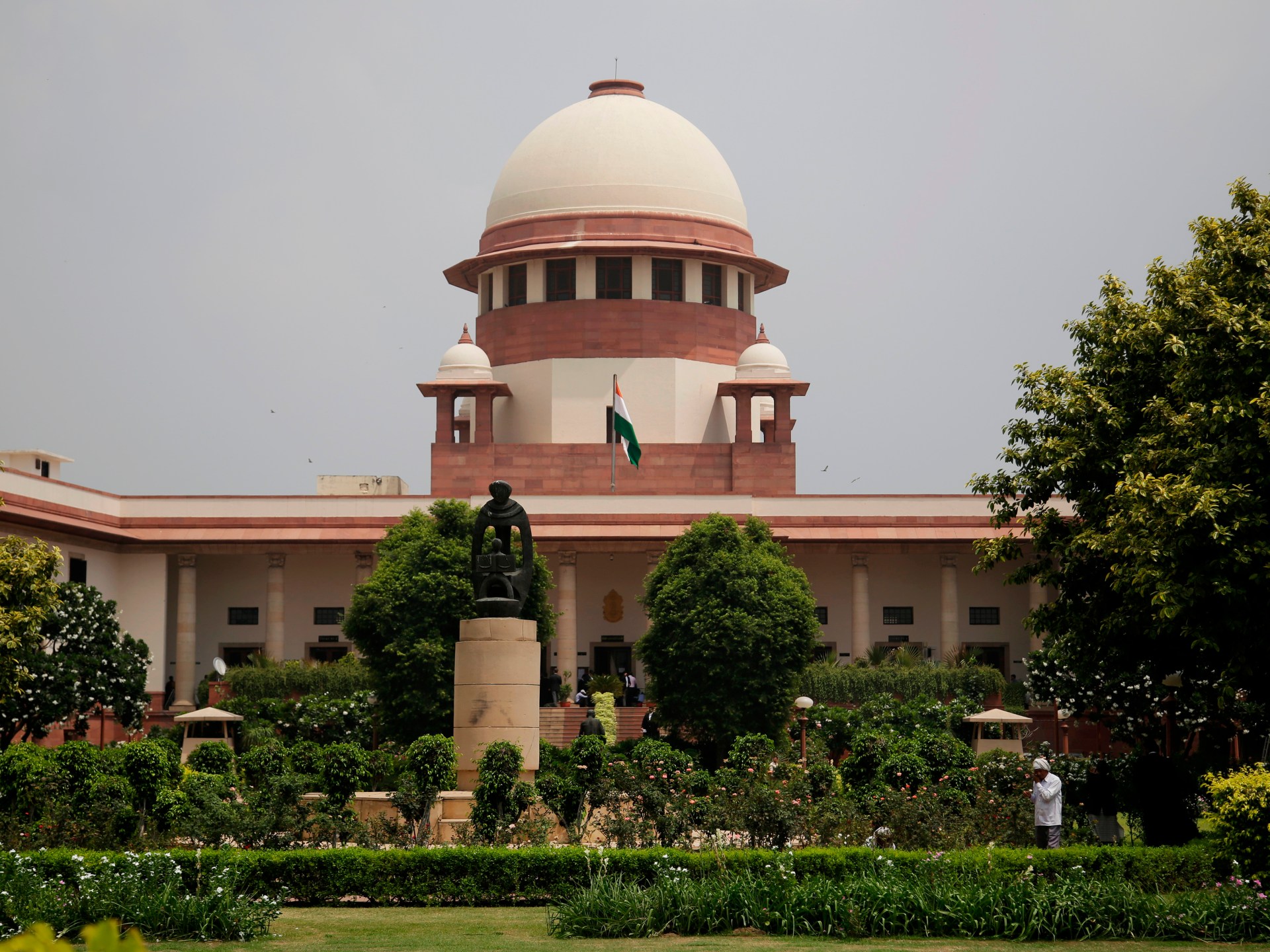

India’s Supreme Court has allowed the country’s first case of passive euthanasia – withdrawal of artificial life support – for a 32-year-old man who has been in a vegetative state for more than 12 years.
A bench of Justices J B Pardiwala and K V Viswanathan on Wednesday permitted the withdrawal of life support to Harish Rana, a resident of the northern state of Uttar Pradesh, who suffered severe head injuries after falling from a building in 2013.
- list 1 of 4India’s Supreme Court allows ‘passive euthanasia’
- list 2 of 4Slovenia referendum: Where is assisted dying legal?
- list 3 of 4Death doulas and end-of-life rights: The debate on assisted dying
- list 4 of 4‘I love life’: The man who has scheduled his death so he can enjoy living
end of list
“The patient’s next of kin and the medical boards have reached the opinion that CAN [clinically administered nutrition] administration should be discontinued,” the Press Trust of India news agency quoted the Supreme Court bench as saying.
The court was hearing a petition filed by Rana’s father, seeking permission to withdraw life-sustaining treatment for his son. The family said Rana was being kept artificially alive.
The court in its ruling said Rana exhibited “no meaningful interaction” and had been dependent on others for “all activities of self-care”.
“His condition has shown no improvement,” the court was quoted as saying by legal news website, Bar and Bench.
India recognised passive euthanasia in 2018, permitting the removal of life support under strict conditions to allow death to occur naturally. But this marks the first time that a court has approved its use for an individual.
Doctors had already concluded that Rana has virtually no chance of recovery.
But because he does not have a living will – a legally binding document outlining preferences for medical care in the event of a terminal condition – he has not been able to give his consent for passive euthanasia.
Advertisement
His parents, therefore, had petitioned the court to allow him to be taken off life support.
Active euthanasia, in which substances are directly administered to cause death, remains illegal in India.
But the debate in India over allowing someone to die dates to the 2011 case of Aruna Shanbaug, a nurse who spent 42 years in a vegetative state following a brutal sexual assault.
The Supreme Court rejected a plea by Shanbaug’s family to end her life, and she died from pneumonia in 2015 aged 66.
But the court did issue a landmark opinion, recognising passive euthanasia under strict safeguards and with judicial approval.
The move relied on earlier judgements that recognised the constitutional right to die with dignity, and served as a prelude to the expanded 2018 ruling on passive euthanasia.
Euthanasia remains a deeply divisive global issue, with supporters arguing that terminally ill patients should have the autonomy to choose a compassionate end to unbearable suffering, while opponents stress the sanctity of life.
Related News

Trump orders federal agencies to stop using Anthropic as dispute escalates

Who are Iran’s senior figures killed in US-Israeli attacks?
Syria faces twin battles as Assad loyalists and ISIL attack in west, east