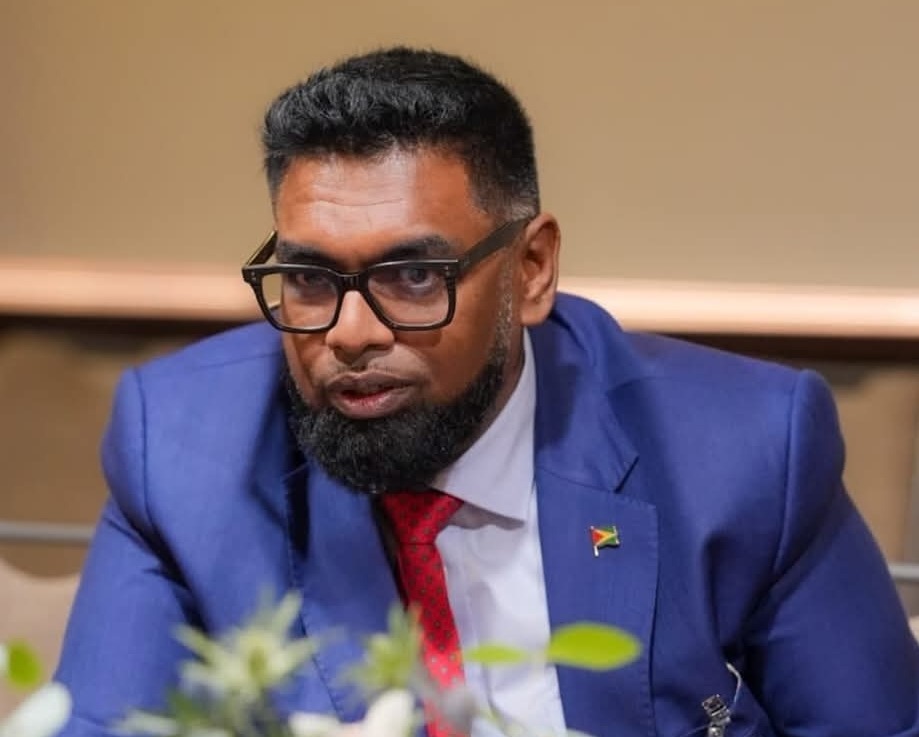


President Dr Irfaan Ali has reiterated calls for private sector companies around the world to recognise the investment potential in forest-rich countries such as Guyana and to support the marketing of sustainable forest products.
He made these remarks during a recent appearance on the podcast of the United Kingdom’s Climate Minister, Katie White, to discuss forests, climate change, and biodiversity.
The podcast was recorded last month during the Guyanese leader’s visit to the UK, where he held talks with Minister White on strengthening collaboration between the two countries on forests, climate change, and biodiversity.
The UK Minister commended Guyana for keeping its forests standing, which cover 85 per cent of the country, without hindering the nation’s development – something President Ali credited to its low carbon development model that was crafted and introduced under the Bharrat Jagdeo presidency.
That revised model, the Low-Carbon Development Strategy (LCDS 2030), has since been expanded to now capture biodiversity and marine life.
According to Ali, Guyana is future-proofing humanity by keeping its forests alive and standing. With support from nations like the UK, Guyana is now working with partners on scalable models to showcase how, at a jurisdictional scale, countries can deploy their natural assets, such as the forest, to be a positive contributor to both humanity and economic growth.
“Together, we are going to show the world, and we have started that process… [with our] standing forest, the standing ecosystem, and the standing biodiversity [to show how] in a world where 60 per cent of the biodiversity has already been lost in the last 50 to 60 years, we’ve kept ours intact. We want to demonstrate through this partnership how we would make this into an economic powerhouse, stimulating jobs, creating wealth, and developing a global product,” Ali stated.
In light of Guyana already trading its high-quality accredited forest carbon on the international market, the Head of State underscored the importance of having the global private sector play an active role in these sustainable efforts.
“The private sector must see the value of countries like ours and all those who are part of the FCLP (Forest & Climate Leaders’ Partnership) that [the UK is] co-chairing with us; the value of what comes out of that forest; and to create a special market, whether it’s the cocoa, whether it is the honey, whether it’s the mushroom – whatever comes out, the ecotourism product [or] the sustainable timber that comes out, not only to create a special marketplace…but also to find a way in which they can invest in that space and make it successful,” the Guyanese leader stressed.
Launched in 2022, the FCLP is a voluntary group that unites over 36 Governments to work together to accelerate global climate action through forest-based solutions with the aim of halting forest loss by 2030.
Guyana’s total forest spans over 18 million hectares, stores more than 19 gigatonnes of carbon and removes some 154 million tonnes of carbon dioxide from the atmosphere annually.
Already, the country has signed multi-billion-dollar deals with major international companies such as Hess Corporation and Apple Inc for its ART-TREES-issued jurisdictional forest carbon credits, earning more than US$200 million in revenues.
Only last week, the Guyana Government announced that ART has issued another nine million high-integrity TREES carbon credits for the year 2023. These credits have been labelled as CORSIA-eligible, making them among the most rigorously assessed credits available globally for international aviation and other compliance-orientated buyers seeking verified, jurisdictional-scale emissions reductions.
Minister White related, “I think it’s important for people to see examples of where countries [like Guyana] are pursuing the low-carbon, nature-positive agenda, and at the same time supporting livelihoods, growing the economy, and allowing that investment so that we can pursue both of those things at once.”
President Ali, on the other hand, posited that achieving this balance requires widespread collaboration and bringing together all stakeholders, including the private sector, to the table when tackling climate and environmental preservation issues.
“Let us come to the table; let us see how we can support research, see how we can support alternative energy development, and integrate into a system where everyone is working towards a balance and not working towards displacing businesses or whatever. If we can demonstrate to investors or shareholders in the highest and most dangerous forms of energy production – let’s take coal, for example, which still controls a good percentage of global energy and is the most damaging – and find ways in which they can still be viable businesses while investing in alternatives, giving them the opportunity and space to do that, along with market security.”
“You know, a lot of emphasis is being placed on the science of the alternative, but I think we have to look at the economics. If we are not able to find a balance between science, economics, and the planet, then all of us will be doing ourselves an injustice because, at the end of the day, we have to find the formula… It is this new generation of leaders in this global space that will have to work on helping us find that balance and finding partners that can showcase at a national and global scale how that balance can be achieved,” he emphasised.
Subscribe to get the latest posts sent to your email.
Related News
GtE, renewables central to ‘Putting People First’ budget – PM

Dataman conquers Olympic Kremlin in stunning win at Banks Classic

Raghoo’s Bar Rape: DJ to stand trial, music selector freed