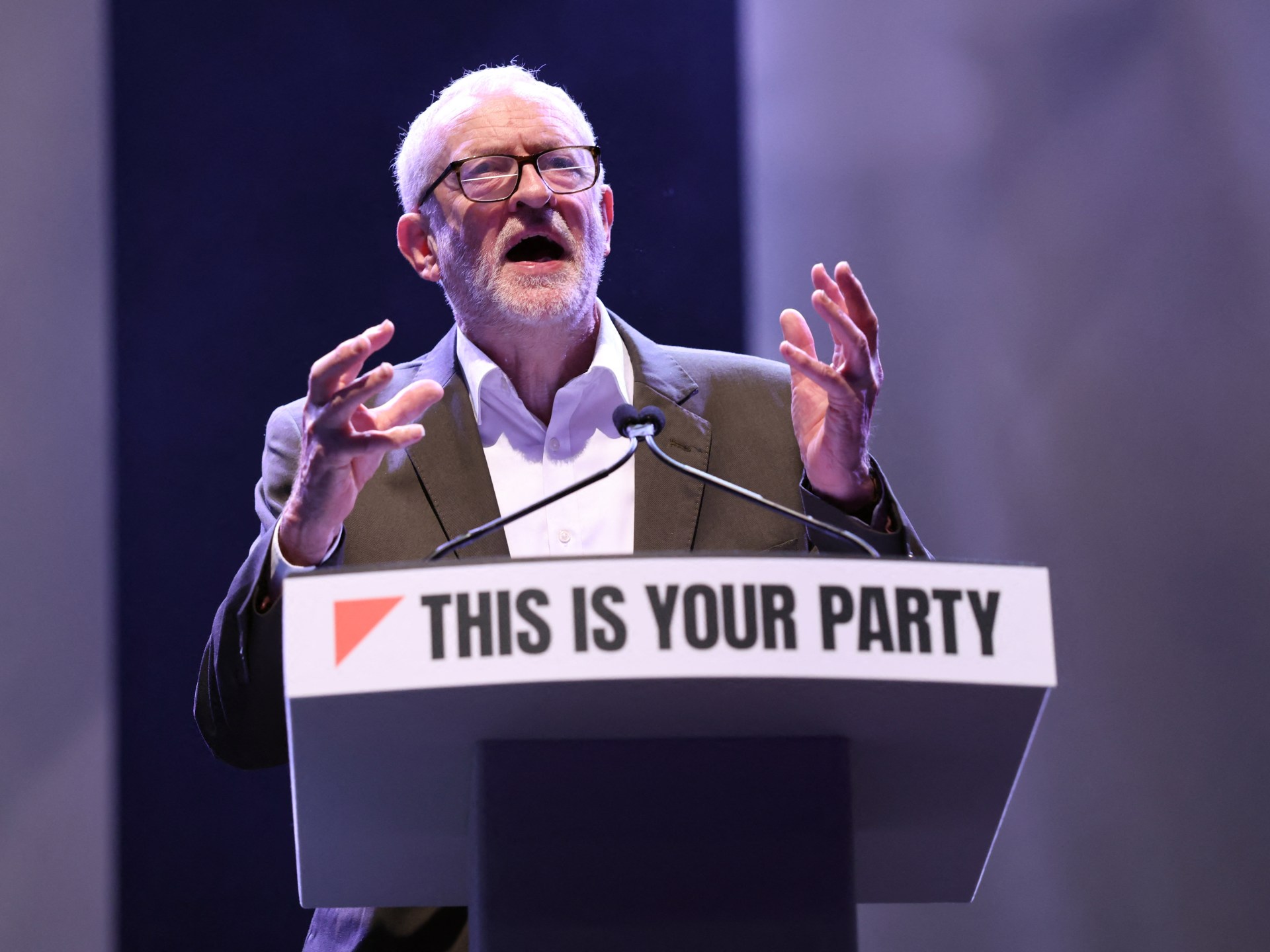
Syrians are marking the first anniversary of the overthrow of Bashar al-Assad, as the fractured nation struggles to overcome sectarianism and rebuild its economy following 14 years of civil war.
The 53-year-long rule of the al-Assad family ended on December 8, 2024, after a lightning 11-day offensive that took Syria and the world by surprise.
- list 1 of 3Hope, flags, fireworks as Syria starts to celebrate a year without al-Assad
- list 2 of 3The fragile fight for justice in a post-Assad Syria
- list 3 of 3Syria: One year after al-Assad
end of list
The toppling of al-Assad also ended a long civil war that left lasting scars on the country and saw some 6.8 million Syrians – about one-third of the population – flee abroad.
While Syria has, since then, seen the lifting of crippling economic sanctions and the formal restoration of diplomatic relations with other countries, it also faces great political uncertainty as it grapples with bouts of sectarian violence and protracted Israeli aggression.
More than one million Syrian refugees have already returned home, while millions more among the diaspora weigh the decision to do the same and rebuild their lives in their homeland.
Here is a look at what has happened over the past year:
December 8, 2024: Rebels led by Ahmed al-Sharaa’s Hayat Tahrir al-Sham (HTS) group capture Damascus during a rapid march to the capital following a lightning advance across the country. They announce that the “tyrant al-Assad has been toppled” and that all prisoners have been freed from the notorious Sednaya prison facility in Damascus.
Russian news agencies report that al-Assad and his family have arrived in Russia after being granted asylum by Russian authorities.
Advertisement
December 10, 2024: Syrians set fire to the grave of Hafez al-Assad, whose iron-fisted rule began in 1971 and ended in 2000, when his son, Bashar, succeeded him following his death.
December 13, 2024: Tens of thousands of Syrians converge on the landmark Umayyad Mosque in the capital, Damascus, to celebrate the removal of al-Assad. In a speech, al-Sharaa – previously known as Abu Mohammed al-Julani – pledges to resist sectarianism and, instead, form an inclusive government.
HTS, which was affiliated with al-Qaeda before breaking ties in 2016, is designated “a terrorist organisation” by many Western governments, which now face the challenge of determining their approach towards it as part of Syria’s new interim government.
December 16, 2024: In his first public remarks since being deposed, al-Assad defends his rule and denies planning his departure as armed opposition fighters – whom he describes as “terrorists” – closed in on Damascus.
December 17, 2024: Mass graves containing the remains of thousands of people believed to be victims of al-Assad’s rule begin to be uncovered outside Syria’s capital, Damascus. The new interim government promises to hold those responsible for atrocities under al-Assad to account.
December 25, 2024: Syrian armed factions agree to disband and come together to form a national army under the new Ministry of Defence.
December 26, 2024: Fourteen members of the Syrian police are killed in an “ambush” by forces loyal to al-Assad in Tartous governorate, and 10 are wounded. Interior Minister Mohammed Abdul Rahman says the government will crack down on “anyone who dares to undermine Syria’s security or endanger the lives of its citizens”.
January 3: The French and German foreign ministers meet Syria’s new de facto rulers in Damascus, marking the first trip by top European officials to the country since al-Assad’s fall.
January 15: Volker Turk meets al-Sharaa, becoming the first United Nations High Commissioner for Human Rights to visit Syria. He meets with officials and victims of the al-Assad regime, and visits the notorious Sednaya prison.
January 29: Syria’s de facto leader, al-Sharaa, is named president for a transitional period and authorised to form a temporary legislative council for the transitional phase.
January 30: Syria’s former governing party, the Baath, is dissolved in a highly symbolic move.
February 2: Al-Sharaa arrives in Saudi Arabia to meet Crown Prince Mohammed bin Salman (MBS) on his first foreign trip since being named president of the transitional government.
March 6-12: Fighters loyal to al-Assad attack security forces in several places in Latakia and Tartous governorates, which are home to the Alawite minority sect to which the al-Assad family belongs. The violence kills hundreds of people, including many civilians, presenting the most serious challenge yet to the new government’s authority.
March 10: The Syrian interim government says it has reached an agreement with the Kurdish-led Syrian Democratic Forces (SDF) to integrate the latter with state institutions. It stipulates that “all civil and military institutions in northeastern Syria” are to be merged “into the administration of the Syrian state”.
Advertisement
March 13: Al-Sharaa signs a temporary constitution, which will remain in force for a five-year transitional period.
March 17: Western powers and regional neighbours pledge more than $6bn in a post-al-Assad donor drive for Syria.
March 30: Al-Sharaa unveils the new transitional government, which comprises 23 ministers from diverse backgrounds, including Yarub Badr, an Alawite, who is named transport minister.
April 3: Syria’s president accuses Israel of attempting to destabilise the country following a double attack on airbases and a deadly ground incursion, which marks an intensification of Israeli military activity against Syria.
April 29: Clashes in a town largely populated by the Druze minority near the capital, Damascus, kill 13 people.
May 7: French President Emmanuel Macron welcomes al-Sharaa to Paris during his first trip to Europe since taking office.
May 13: United States President Donald Trump announces that he will lift all sanctions on Syria, declaring that it is time for the country to “move forward”.
May 14: Trump meets al-Sharaa in Saudi Arabia and describes him as Syria’s “attractive, tough” president. This encounter is the first to take place between the two nations’ leaders in 25 years.
May 20: The European Union lifts economic sanctions on Syria in a bid to aid the war-torn country’s recovery.
May 22: A blast in the al-Safa desert region of Suwayda province reportedly wounds seven Syrian soldiers.
May 30: ISIL (ISIS) claims the May 22 attack as the first of its assault on the new Syrian government.
June 23: A suicide attack on the Mar Elias Church in Damascus shakes Syria – particularly the country’s Christian community – and raises questions about the ability of the new Syrian government to manage security in the country and protect its citizens, including those from minority groups.
July 13-18: Sectarian violence between Druze and Bedouin tribe members sweeps through Syria’s southern Suwayda province. Tens of thousands are displaced from both communities during a week of bloodshed that kills more than 250 people and displaces more than 160,000, according to UN figures.
July 16: Israel launches an air attack on Suwayda as it pledges to protect the Druze from government forces. Syria condemns Israel’s intervention as a violation of international law. Israel also strikes the headquarters of the Syrian Defence Ministry and close to the presidential palace in Damascus.
August 4: The Kurdish-led SDF claims armed factions associated with the country’s security forces have attacked some of its positions in the northern province of Aleppo, amid efforts by Syria’s fledgling government to unify the nation.
August 27: Israeli forces conduct a series of strikes on a former army barracks in Kiswa, southwest of the Syrian capital of Damascus.
September 16: Syria, Jordan and the US announce plans to restore security in Suwayda, which includes proposals to launch an internal reconciliation process.
September 22: Al-Sharaa becomes the first Syrian head of state to attend a session of the UN General Assembly (UNGA) in almost six decades.
Advertisement
September 24: The UN reports that one million Syrian refugees have returned to their country since al-Assad’s fall.
October 6: Syria publishes the results of its first parliamentary election since al-Assad was toppled. Critics say the vote favoured well-connected figures and is likely to keep power concentrated in the hands of Syria’s new rulers.
October 7: The Syrian army and the SDF call a truce in two areas of Aleppo city after a member of the Syrian security forces is killed in an SDF attack on a checkpoint in the city.
October 15: Al-Sharaa meets with Russian President Vladimir Putin in Moscow during his first state visit to the country, which has been hosting al-Assad since his exile from Syria. He says his government will honour all past agreements with Moscow, a key ally of al-Assad, and “restore and redefine ties”.
November 6: The UN Security Council (UNSC) votes to remove sanctions on al-Sharaa and his interior minister, Anas Khattab, following a resolution championed by the US. The next day, Washington removes al-Sharaa from a “terrorist” sanctions list.
November 10: Trump holds talks with al-Sharaa at the White House, as the Department of the Treasury announces suspending sanctions against Damascus for a further six months.
November 18: Syria launches the trial of the first of hundreds of suspects charged over their roles in deadly clashes, which killed hundreds in the country’s coastal provinces in March. Seven of the defendants in the court are al-Assad loyalists, while the other seven are members of the new government’s security forces.
December 2: Israeli Prime Minister Benjamin Netanyahu says a non-aggression pact between Israel and Syria is achievable, but outlines expectations that Syrian authorities establish a demilitarised buffer zone stretching from Damascus to Jabal al-Sheikh, which Israel currently occupies.
December 4: A UNSC delegation arrives in Syria for its first-ever trip to the country, before the first celebration of al-Assad’s fall.
December 5: Thousands of people pour into the streets of Syria’s central city of Hama to mark one year since the longtime ruler’s fall.
December 7: Syrians gather to celebrate before the December 8 anniversary. Around Damascus’s Umayyad Square, children lean out the windows, waving Syria’s green, white and black flag as fireworks burst in the sky.
Related News
Saudi Arabia and Qatar sign high-speed rail deal to link capitals
More heavy rain slows Sri Lanka’s recovery after deadly cyclone
US calls on Sudan’s warring parties to accept ceasefire plan unaltered