‘Stop killing us’: Huge crowds rally in Brazil, decrying rise in femicide
 08 December 2025
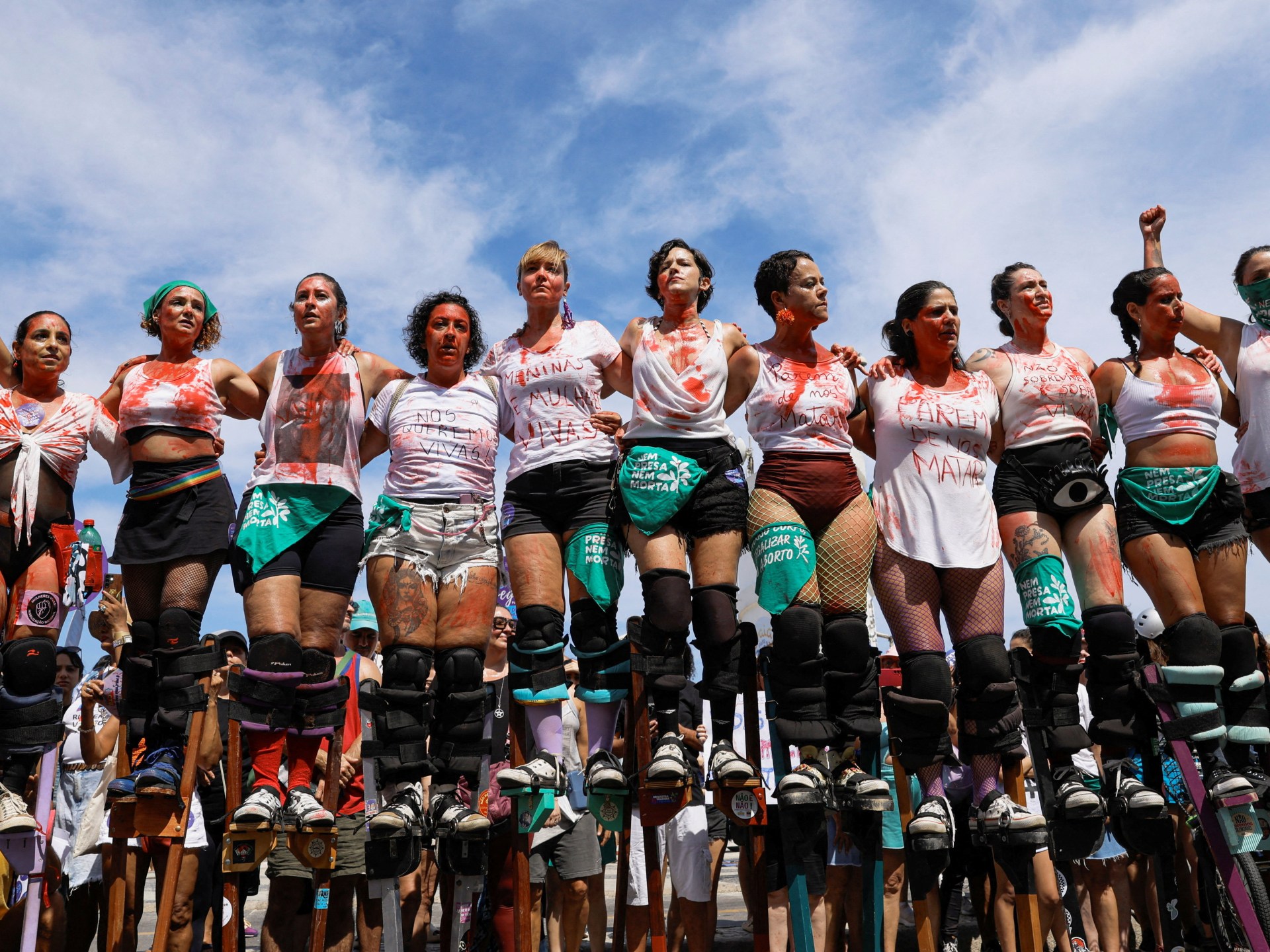

Tens of thousands of women have marched in cities across Brazil, denouncing femicide and gender-based violence, after a series of high-profile cases that shocked the country.
Women of all ages and some men took to the streets in Rio de Janeiro, Sao Paulo and other cities on Sunday, calling for an end to femicide, rape and misogyny.
- list 1 of 4Flavio Bolsonaro enters Brazil’s 2026 presidential race with father’s nod
- list 2 of 4Top 10 games, groups of death: All to know about the FIFA World Cup draw
- list 3 of 4US-Venezuela tensions: Your questions answered
- list 4 of 4Brazil’s Supreme Court orders Jair Bolsonaro to begin prison sentence
end of list
In Rio, the protesters put out dozens of black crosses, while others bore stickers with messages such as “machismo kills”. And in Sao Paulo, the demonstrators chanted, “Stop killing us”, and held placards that read, “Enough of femicide”.
The protesters in Rio’s Copacabana included Alline de Souza Pedrotti, whose sister was killed on November 28 by a male colleague. Pedrotti said the person who killed her sister, an administrative employee at a school, did not accept having female bosses.
“I’m devastated,” she told The Associated Press news agency. “But I’m fighting through the pain, and I won’t stop. I want changes in the legislation and new protocols to prevent this kind of crime from happening again.”
The protesters also denounced other shocking cases that took place last month in Sao Paulo and in the southern city of Florianopolis. In Sao Paulo on November 28, Taynara Souza Santos was run over by her ex-boyfriend and trapped by the car, which dragged her over concrete for one kilometre (0.6 mile).
The 31-year-old’s injuries were so severe, her legs were amputated.
Video footage of the incident went viral.
And in Florianopolis on November 21, English teacher Catarina Kasten was raped and strangled to death on a trail next to a beach on her way to a swimming lesson.
Advertisement
These recent cases were “the final straw”, said Isabela Pontes, who was on Sao Paulo’s Paulista Avenue. “I have suffered many forms of abuses, and today, I am here to show our voice.”
A decade ago, Brazil passed a law recognising the crime of femicide, defined as the death of a woman in the domestic sphere or as resulting from contempt for women.
Last year, 1,492 women were victims of femicide, the highest number since the law was introduced in 2015, according to the Brazilian Forum on Public Safety.
“We’re seeing an increase in numbers, but also in the intensity and cruelty of violence,” said Juliana Martins, an expert in gender-based violence and institutional relations manager at the Brazilian Forum on Public Safety.
More women are speaking out against violence targeting them, and have gained visibility in the public sphere, Martins said.
“Social transformations seeking equality of rights and representation generate violent responses aimed at reaffirming women’s subordination,” she said.
In Rio, Lizete de Paula, 79, said men who hate women had felt empowered during the term of former President Jair Bolsonaro, who dismantled public policies aimed at strengthening women’s rights.
“Women are increasingly entering new spaces and macho men can’t stand this,” the former architect said.
Joao Pedro Cordao, a 45-year-old father of three daughters, said men have a duty to stand with women by calling out misogyny, not only at protests but in day-to-day life.
“Only then will we be able to put an end to – or at least reduce – the current violence against women,” he said.
Related News

US adds Venezuelan ‘cartel’ to terror list as military threat rises

At least 13 dead as fire engulfs Hong Kong high-rise residential buildings

Japan accuses Chinese jets of directing fire-control radar at its aircraft