

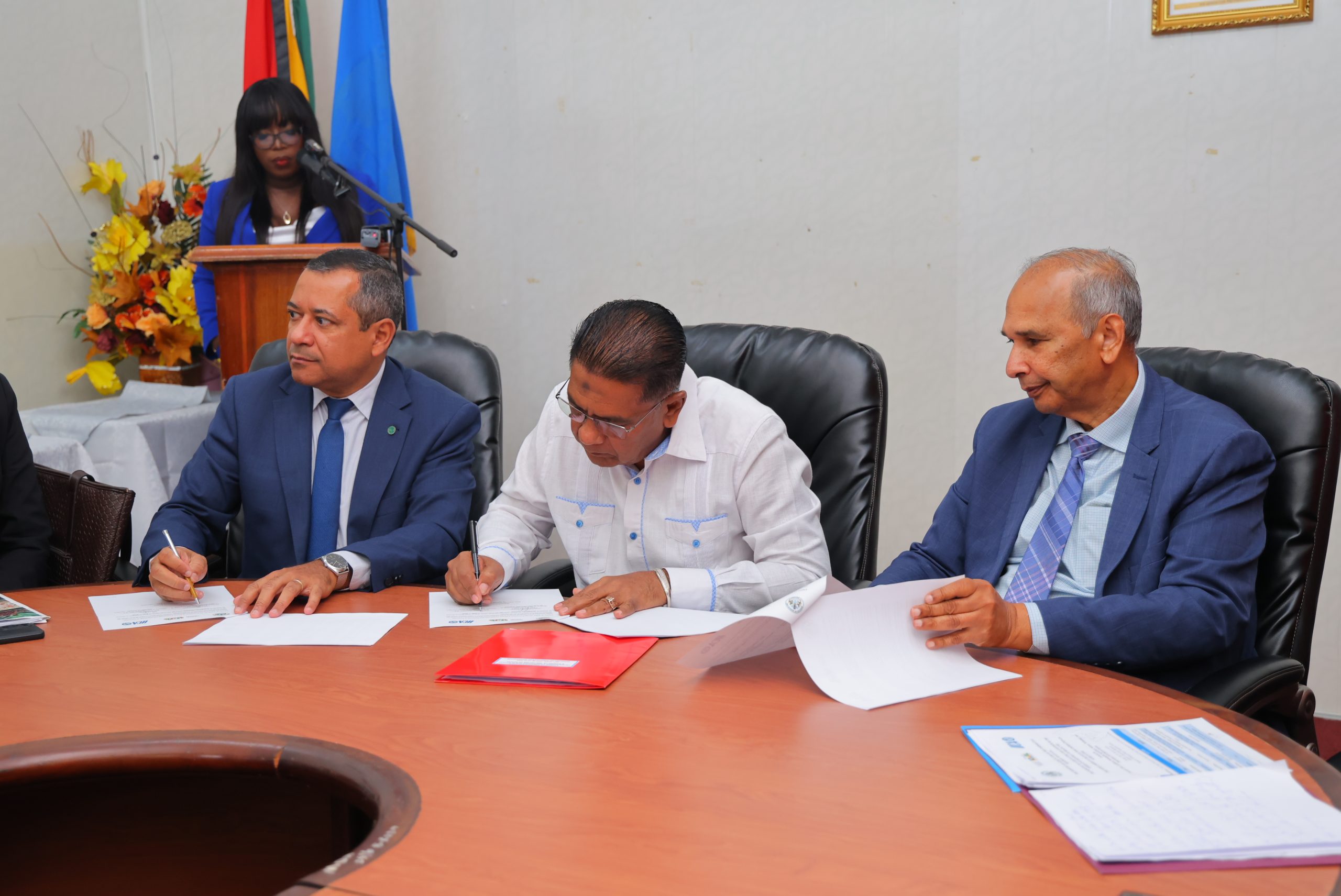


Guyana today took another significant step in advancing agricultural innovation and regional food security with the launch of the Caribbean Sustainable Agriculture Science, Technology and Innovation (STI) Hub, an initiative being developed through collaboration among the Ministry of Agriculture of Guyana, the Ministry of Agriculture and Livestock of the Federative Republic of Brazil, the Brazilian Agricultural Research Corporation (EMBRAPA), and the Inter-American Institute for Cooperation on Agriculture (IICA).
The launch ceremony was held in the Ministry of Agriculture’s boardroom and brought together government officials, representatives from Brazil, IICA, and key stakeholders in the agriculture sector.
The Caribbean Sustainable Agriculture Science, Technology and Innovation Hub emerges as a strategic response to the growing challenges confronting agrifood systems across the Caribbean, including productivity constraints, high food import dependency, climate vulnerability, limited research and innovation capacity, and the increasing need to strengthen resilience through solutions adapted to tropical agricultural systems.
The initiative aims to accelerate the deployment and scaling of agricultural technologies, strengthen scientific and technical capacities, and promote innovative solutions tailored to the unique needs of tropical agriculture throughout the Caribbean region.
Addressing the gathering, Minister of Agriculture Hon. Zulfikar Mustapha said the establishment of the hub reflects a shared commitment to harnessing science and innovation to transform agriculture and strengthen regional food security.
“This Science, Technology, and Innovation Hub is a shared vision between the Ministry of Agriculture of Guyana, the Ministry of Agriculture and Livestock of Brazil, and IICA to accelerate technology deployment and promote innovation tailored to our tropical agriculture. Guyana is pleased to have Brazil’s renowned research institution EMBRAPA, with more than 40 research centres and thousands of research scientists, bring its expertise to Guyana and the Caribbean,” Minister Mustapha said.
He noted that the establishment of the hub represents a major milestone for agriculture in the region and will help strengthen the Caribbean’s capacity to address emerging challenges through science-based solutions.
“This is a historic step in promoting innovation, applied research, and agricultural modernization in the region. Innovation is no longer optional; it is essential for our agrifood system and food security. The challenges facing our agrifood system, such as climate volatility, supply chain disruptions, and rising global food prices, demand solutions that are science- and data-driven and regionally coordinated. The time for incremental change has passed,” Minister Mustapha stated.
Highlighting the strategic importance of the initiative, Director General of IICA, Dr. Muhammad Ibrahim, said the hub will serve as a key mechanism for accelerating innovation, strengthening resilience, and supporting the transformation of agrifood systems across the Caribbean.

“The hub will have a lot of significance in what you’re planning under the 25 by 2025 +5 Initiative and in achieving those objectives. I’m in the process of launching a new medium-term plan in which the science, technology, and innovation hub will be very important for delivering objectives and advancing in a more modern agriculture, engaging youths, and engaging women,” he explained.
Dr. Ibrahim further stated that the new strategic direction recognizes the diverse realities across the 34 countries in which the organization operates and places a strong emphasis on innovation as a driver of agricultural development and resilience.
“This plan is focusing on four key programmes; one, looking at science, technology, and innovation because we need a new frontier of science and tools to accelerate the implementation of new technologies, enhance and boost the food systems, and examine resilience. We will also look at trade, agri-business, working on looking at the natural assets in biodiversity, transboundary pests and diseases, and biosecurity,” Dr. Ibrahim said.
The hub will operate as a regional platform for technical cooperation, applied research, capacity building, and technology transfer between Latin America and the Caribbean, with Guyana serving as its operational base. Through the initiative, technological solutions developed and validated by EMBRAPA and its partners will be adapted and scaled across Guyana and, progressively, throughout CARICOM Member States.
Minister Mustapha said that Guyana will serve as the operational base for this hub, which is a practical response to the challenges faced in the region.
“As we advance agricultural transformation, the establishment of the Hub in Guyana aligns perfectly with our national priorities and supports CARICOM’s Vision 25 by 2025+5, which calls for deeper integration, accelerated technology adoption, and a resilient regional agrifood system. The Hub strengthens our collective capacity to reduce the Region’s food import bill, expand intra-regional trade, and build true food sovereignty. It is a practical response to the challenges our region faces, such as persistent productivity gaps, high food import dependency, climate vulnerability, limited research and innovation capacity, and the urgent need to strengthen resilience across our agrifood systems,” he explained.
He underscored that Guyana’s role as the lead country for CARICOM’s Ministerial Task Force on Food Production and Food Security places it at the centre of the Region’s agricultural transformation, adding that hosting the Hub is a natural extension of that leadership.
The scientific component of the initiative will be led by EMBRAPA, a public corporation affiliated with Brazil’s Ministry of Agriculture and Livestock and internationally recognized as one of the world’s leading institutions in tropical agricultural research.
The hub’s initial priority areas will focus on tropical crop and livestock systems, climate-smart agriculture, and sustainable land-use and natural resource management. It will also facilitate joint research initiatives, strengthen regional scientific capacities, support technology deployment, and promote the scaling of agricultural innovations across the Caribbean.
The initiative is also expected to strengthen collaboration among EMBRAPA, Guyana’s National Agricultural Research and Extension Institute (NAREI), and the Caribbean Agricultural Research and Development Institute (CARDI), creating opportunities for knowledge exchange, technological adaptation, and the development of solutions tailored to Caribbean agroecological conditions.
As part of the next phase of implementation, a Technical Working Group comprising representatives from the Government of Guyana, EMBRAPA, Brazil’s Ministry of Agriculture and Livestock, IICA, and other key stakeholders will be established to guide the operationalization of the hub.
The partners have also agreed to undertake a preparatory phase during which institutional, operational, governance, technical, and financing arrangements will be finalized ahead of the commencement of operations in the coming months.
Once operational, the hub is expected to become the leading platform for South-South cooperation in tropical agriculture, accelerating technological modernization, strengthening regional food security, and enhancing the resilience and competitiveness of agrifood systems across the Caribbean.
Subscribe to get the latest posts sent to your email.
Related News
Hinterland residents to access loans, business support through new development bank

Corentyne Chambers lauds govt's intervention for rice farmers

Corentyne smash-up update: Speeding car hits oncoming vehicle while overtaking
